
Healthy Amount of New Issues in January
Also, our takeaways from the 2017 private placement conference.

The corporate bond market started 2017 with a healthy dose of new issue volume priced in the public debt markets. New issue supply in the corporate bond market totaled $178.5 billion in January. New issuance last week included several large new bond deals, such as Microsoft’s (rating: AA+, stable) $17 billion transaction. In December 2016, Morningstar Credit Ratings, LLC downgraded Microsoft by one notch, placing our AA+ corporate credit rating one notch lower than Moody’s and S&P. Our downgrade took into account the company’s trend toward higher use of debt, the result of a more aggressive shareholder-payout policy, and funding for the $26 billion acquisition of LinkedIn. Apple (rating: AA-, negative) also brought a large deal to market, pricing a $10 billion multitranche new issue. Again, our credit rating is lower than the other agencies, as we believe Apple’s credit profile has been affected by management’s trend toward more aggressive capital allocation and a dramatic increase in debt.
There was a short pause in new issue market last Wednesday as issuers held off tapping the market while investors awaited the statement from the Federal Open Market Committee meeting. As largely expected, the FOMC held rates steady and there was no substantive change from the prior statement. The markets took this as a sign that the FOMC is not considering raising the federal funds rate in the near term. According to the futures market, the market-implied probability that the Fed will raise the federal funds rate does not increase above 50% until June. Currently, there is almost a 68% probability that the Fed will raise the federal funds rate two or more times by the end of 2017.
The pause in the corporate bond market was short-lived, as new issuance resumed Thursday. With the abundance of new issues floating around the market looking for a permanent home, secondary market trading levels have been regularly hitting new highs. According to Bloomberg, secondary trading volume in the investment-grade market rose to $28.2 billion on Tuesday, the single-highest daily trading volume since 2005 when the data first was recorded. Of the top five highest-volume daily trading sessions, three occurred in January this year; the other two occurred at the end of November 2016 and beginning of December 2016.
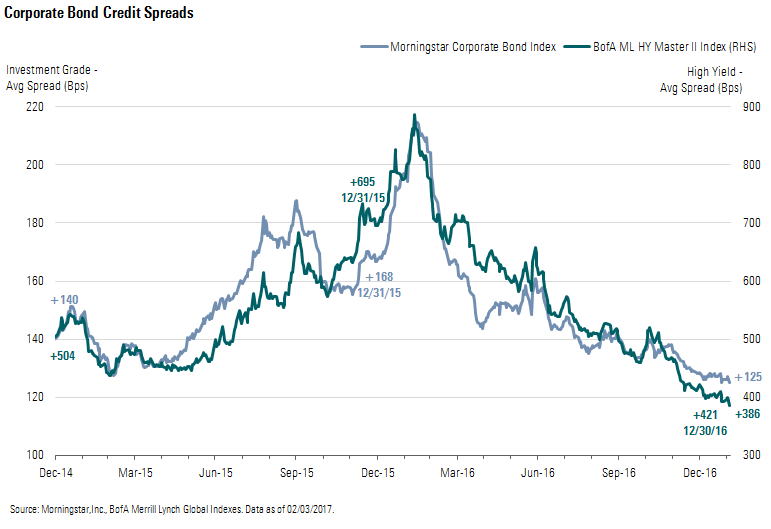
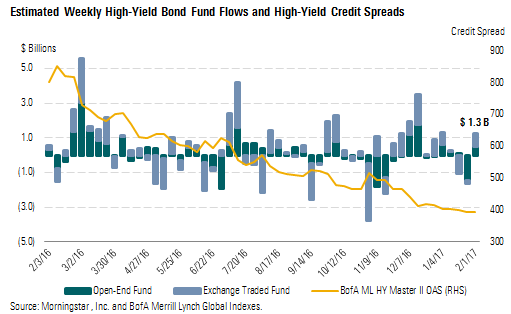
As all of this paper is sloshing around the market looking for a permanent home, the average spread of the Morningstar Corporate Bond Index, our proxy for the investment-grade bond market, only tightened 1 basis point to +125 last week. In the high-yield market, the credit spread of the Bank of America Merrill Lynch High Yield Master Index tightened 7 basis points to +386.
Review and Takeaways From the 2017 Private Placement Conference The private placement market held its annual Private Placements Industry Forum in Boca Raton, Florida, last week. Although growth in the private placement market has lagged that of the public corporate bond market over the past few years, 2016 was another solid year for new issue volume. According to Bank of America, in 2016 the amount of agented private placement debt issued was $51 billion; including direct placements, the total amount increased to approximately $65 billion.
After a slow start, issuance kicked into high gear in the latter half of the year, as approximately $20 billion was placed between Labor Day and Thanksgiving. The average transaction size was $264 million and the average maturity was 13 years. The average spread for issues rated NAIC 1 was +129 and the average spread of issues rated NAIC 2 was +180. The deal count in 2016 had declined from the prior year, but because of a greater amount of large transactions, the total dollar volume in 2016 increased compared with 2015. In fact, some market participants called 2016 the year of the megadeals as there were 22 transactions priced in which the deal size was over $500 million. The largest transaction was a $2.5 billion deal for Mars, Inc.
Energy and industrial issuers continued to lead the number of transactions, but other sectors such as real estate and infrastructure are growing. One panelist said the real estate market increased to approximately 14% of transactions and infrastructure accounted for approximately 8% of the agented private placement market.
Many panelists cited another trend that emerged in the market last year: Due to the prevailing levels of swap spreads between interest rates in the United States and in Europe, as well as cross currency/foreign exchange swaps, an increasing amount of transactions included a non-U.S. dollar-denominated tranche. An estimated 20% of transactions are believed to have included a tranche denominated in a foreign currency.
Industry participants expect many of these same trends to continue. The consensus estimate for new issuance in 2017 is $65 billion-$70 billion. This includes the expectation that the preponderance of $22 billion of private placement debt due to mature in 2017 will be refinanced. In addition, with Libor increasing, investment bankers are starting to see companies with floating-rate debt consider terming out short-term floating-rate loans with long-term fixed-rate debt. Bankers also expect that many issuers will look to refinance some of the $23 billion due to mature in 2018 before interest rates have time to rise much further.
Another topic covered at the conference was the impact from the growing number of nontraditional and foreign investors. These investors are not constrained by the National Association of Insurance Commissioners or other U.S. regulatory requirements and are having a greater influence in the market. Without the same capital constraints as traditional investors, these investors have an interest in investing in transactions that are rated 2- and 3+ by NAIC. As such, these investors may lead the private placement market to expand to include issuers whose underlying credit rating is a notch or two below investment grade (BB+ and BB). In addition to nontraditional and foreign investors becoming more involved, it was noted that foreign issuers are increasingly utilizing the U.S. private placement market.
The U.S. real estate sector and real estate investment trusts were often cited as one of the areas expected to grow in 2017. Other sectors/areas in which industry participants expect growth opportunities are financial institutions, contract monetization, structured transportation, and lower-quality middle-market issuers. However, the main takeaway from the conference was the constant buzz around infrastructure financing. Infrastructure spending and its related financing was the most talked-about subject among panels and individual meetings. With the new presidential administration looking to spur economic growth by increasing spending on infrastructure, this sector was generally regarded as the one with the most growth potential over the short term.
The other often-discussed topic is the advent of new rating agencies entering this market and the impact that increasing competition may have on the private placement market. Steve Monahan, the managing director and global head of U.S. debt private placements at Bank of America, specifically cited the entrance of Morningstar Credit Ratings in his keynote presentation. He also noted that industry participants recognize that not all agencies look the same and that industry participants are differentiating between the strengths and weaknesses of each rating agency.
With new rating agency entrants driving increased competition, investment bankers are working to identify which agency is best to use for different types of transactions and sectors in order to deliver the best deal to the market for the issuer. The question is no longer about the name brand of the agency, but rather which one is best suited to rate a specific transaction. While many issuers may still push back on using a rating agency and see not going through the process of being rated as a selling point of using the private placement market, investment bankers recognize the value of a rating for specific types of transactions and structures to enhance execution. As a consequence, investment bankers and investors are becoming more open-minded to using other rating agencies than the legacy NRSROs.
Morningstar Credit Ratings, LLC is a credit rating agency registered with the Securities and Exchange Commission as a nationally recognized statistical rating organization (“NRSRO”). Under its NRSRO registration, Morningstar Credit Ratings issues credit ratings on financial institutions (e.g., banks), corporate issuers, and asset-backed securities. While Morningstar Credit Ratings issues credit ratings on insurance companies, those ratings are not issued under its NRSRO registration. All Morningstar credit ratings and related analysis contained herein are solely statements of opinion and not statements of fact or recommendations to purchase, hold, or sell any securities or make any other investment decisions. Morningstar credit ratings and related analysis should not be considered without an understanding and review of our methodologies, disclaimers, disclosures, and other important information found at https://ratingagency.morningstar.com

 United States