
Following August Slowdown, Corporate Bond Issuance Springs Back to Life
Last week was the busiest of the year for new corporate bond issuance.

Following the typical seasonal slowdown in August, the new issue market sprang back to life following the Labor Day holiday. According to Bloomberg, this was the busiest week of the year for new corporate bond issuance, with over $53 billion worth of bonds priced. The largest transaction was brought by Cigna Corp (non-NRSRO rating: BBB/UR-) to help fund its pending acquisition of Express Scripts Holding Co (A-/UR-). Cigna issued $20 billion worth of notes across 10 tranches with maturities ranging from 3 to 30 years. This issuance came just a day after reports surfaced that the Cigna-Express Scripts merger and the pending merger between CVS Health Corp (BBB+/UR-) and Aetna Inc (not rated) will probably be allowed by antitrust regulators. Cigna has said it anticipates initially owing $41 billion in debt after the merger is completed. Therefore, pro forma leverage looks set to rise to the mid-3s if the merger closes as expected at the end of 2018, which is much higher than Express Scripts' stand-alone leverage around 2 times. However, Cigna management appears committed to deleveraging to maintain its investment-grade status, which is likely to inform our credit view of the combined entity.
Among other issuers we rate, Duke Realty Corporation (BBB+, stable) completed a $350 million, 10-year senior unsecured notes offering. The issuer is Duke Realty LP. Net proceeds are expected to be used for retiring in advance $224 million of secured debt maturing in March 2019, funding development, repaying borrowing under its revolver, and general corporate purposes. Duke Realty's BBB+ rating and stable outlook are supported by solid Business Risk and Cash Flow Cushion pillars, which are somewhat curbed by a weaker Solvency Score. Contributing to Business Risk is Duke's high-quality, largely unencumbered portfolio of bulk warehouse facilities, which is uniquely positioned to capture robust e-commerce demand. At an average age of 11 years, Duke's portfolio is the youngest among its peers; it is also among the largest in terms of average facility size, which results in lower capital expenditures and tends to draw higher-credit tenants with lower turnover. Larger average building size can also drive higher rent levels upon renewal. We believe the credit is further supported by some of the lowest leverage metrics among its industrial real estate investment trust peers, in particular debt/EBITDA and secured leverage.
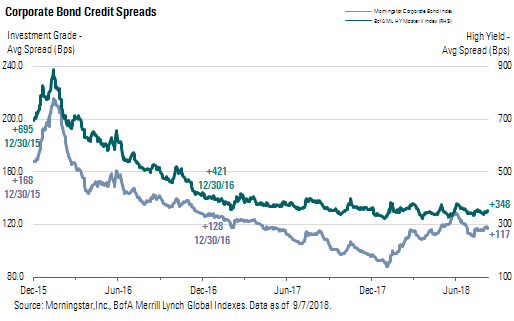
Considering that the equity market experienced a slight pullback and the corporate bond market had to digest a prodigious amount of new supply, the corporate bond market performed comparatively very well last week as credit spreads tightened slightly. The average spread of the Morningstar Corporate Bond Index (our proxy for the investment-grade market) tightened 1 basis point to end the week at +117. In the high-yield market, the BofA Merrill Lynch High Yield Master Index tightened 1 basis point to end the week at +348.
Among U.S. Treasuries, the middle and longer end of the curve were relatively unchanged. The yield on the 5-year widened 1 basis point to 2.82%. In the longer end of the curve, the yield on the 10-year decreased 1 basis point to 2.94% and the 30-year widened 1 basis point to 3.10%. However, in the short end of the curve, the yield on the 2-year bond rose 6 basis points to 2.70%, its highest level since mid-2008. At its current yield, the interest rate on the 2-year Treasury has risen 84 basis points thus far this year. Comparatively, yields on the 5-, 10-, and 30-year have risen 61, 53, and 36 basis points, respectively.
Based on the current market-implied probabilities for additional hikes to the federal-funds rate, it appears that the yield on the 2-year has further to rise. According to the CME FedWatch Tool, the market is pricing in a 25-basis-point increase to the federal-funds rate, to 2.00%-2.25% from its current 1.75%-2.00%, following the next Federal Open Market Committee meeting, which concludes Sept. 26. The market is pricing in an 80% probability of an additional hike following the December FOMC meeting to over 2.25%.
Even following that increase, with the economy running full steam ahead, inflation heating up, and wage growth finally showing life, the market is pricing in additional hikes in 2019. The Atlanta Fed's GDPNow forecast for third-quarter GDP growth is currently 4.4%, which would be an acceleration from the already strong 4.1% rate in the second quarter. Inflation pressures have been steadily building over the past few months, leading to an increase in the Federal Reserve's preferred measure of inflation, personal consumption expenditures, to 2.3% (higher than the Fed's 2% target), and the consumer price index for July rose at a 2.9% annual rate. Job growth remains robust as August nonfarm payrolls rose 201,000, and with the unemployment rate below 4%, annual wage growth surged to 2.9% in August, its highest in nine years. With these factors in mind, the market is pricing in a 76% probability that the federal-funds rate will be 2.50% or higher this time next year.
Weekly High-Yield Fund Flows Over the past six weeks, the volatility of high-yield fund flows has been relatively nonexistent as weekly flows have ranged within plus or minus $1 billion. Last week, net fund flows into the high-yield asset class were only $0.1 billion, consisting of $0.3 billion of inflows among open-end high-yield mutual funds, partially offset by $0.2 billion of net unit redemption across high-yield exchange-traded funds. Over the past six weeks, the average weekly fund flow was only $0.3 billion of inflows. Year to date, fund flows have registered a total outflow of $14.8 billion, consisting of $2.5 billion of net unit redemptions across ETFs and $12.3 billion of redemptions among open-end funds.
Morningstar Credit Ratings, LLC is a credit rating agency registered with the Securities and Exchange Commission as a nationally recognized statistical rating organization ("NRSRO"). Under its NRSRO registration, Morningstar Credit Ratings issues credit ratings on financial institutions (e.g., banks), corporate issuers, and asset-backed securities. While Morningstar Credit Ratings issues credit ratings on insurance companies, those ratings are not issued under its NRSRO registration. All Morningstar credit ratings and related analysis contained herein are solely statements of opinion and not statements of fact or recommendations to purchase, hold, or sell any securities or make any other investment decisions. Morningstar credit ratings and related analysis should not be considered without an understanding and review of our methodologies, disclaimers, disclosures, and other important information found at https://ratingagency.morningstar.com.

 United States