
Fed Lifts Federal Funds Rate, Projects More Hikes to Come in 2017
Investors remained attracted to corporate bonds and corporate credit spreads continued to compress.

In response to the increase in the federal funds rate, Treasury bonds continued their descent and pushed interest rates higher last week. The yields on the 2-year, 5-year, and 10-year bonds rose 11 basis points, 17 bps, and 11 bps, respectively, to 1.25%, 2.07%, and 2.60%. After the backup in short-term rates, the yield on the 2-year Treasury is at its highest since 2009 and the yield on the 5-year Treasury is at its highest since 2011.
As expected, the Federal Reserve raised the federal funds rate by 25 basis points to 0.50%-0.75% last week. The rate hike was a surprise to no one, as it had been fully priced in by the federal funds futures market. We wrote last week that the market-implied probability of additional near-term hikes was low and the market appeared to only expect another rate hike in 2017. Further, we cautioned that if the Fed were to indicate that subsequent rate hikes might come faster than expected, the Treasury bond market could experience some short-term disruption as investors would adjust to a different scenario. That cautionary tale came to fruition as the Fed’s summary of economic projections showed that the Federal Open Market Committee is forecasting three rate increases by the end of 2017. The Fed’s median forecast for the federal funds rate at the end of 2017 is 1.4%.
It appears that the market is taking these projections with a grain of salt as the Fed has had a poor forecasting record. For example, when the Fed first increased short-term rates in December 2015, the median forecast for the federal funds rate at the end of 2016 was also 1.4%. Even at the end of 2014, the Fed’s median 1-year forecast for the federal funds rate was 1.125%.
Although interest rates continued to rise last week, investors remained attracted to corporate bonds and corporate credit spreads continued to compress. It appears that investors’ expectations continue to price in an improvement in the economic environment in which risk assets will outperform. In the investment-grade corporate bond market, the average corporate credit spread of the Morningstar Corporate Bond Index tightened 1 basis point last week to +130. This is the tightest that the investment-grade bond market has traded since April 2015. Since the end of 1998, the average spread of our investment-grade index is +168.
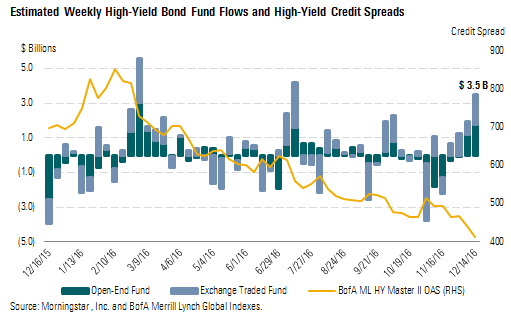
High-yield bonds also performed well as the average credit spread of the Bank of America Merrill Lynch High Yield Master Index tightened 7 basis points to +421. This level represents the tightest credit spread that the high-yield index has traded at since September 2014 and significantly tighter than the average spread over the past 20 years. Since the end of 1996, the spread of the high-yield index has averaged +580.
Primary market activity dwindled as the window to the new issue market began to shut as we near the holiday season. While there might be a few smaller transactions priced before the end of the year, the new issue market will be effectively closed until 2017. However, the demand for corporate bonds continues to rise. A deluge of fund flows flooded into high-yield open-end mutual funds and exchange-traded funds last week as $3.5 billion of inflows were recorded. This amount was the third-greatest weekly inflow over the past year and was nearly evenly split between open-end funds and ETFs, signaling that both retail and institutional investors were comfortable increasing allocations to the asset class. Without any new issue volume to satiate this level of demand, this underlying market technical should provide a strong bid through the end of the year.

 United States