
Fed Holds Rates Steady for Now, but Markets Expect a Hike in June
While equity markets hit all-time highs, the corporate bond market was mixed last week.

As the market widely expected, the Federal Open Market Committee decided last week to hold the federal funds interest rate unchanged at 0.75%-1%. In its meeting statement, the Federal Reserve acknowledged that economic growth had slowed and household spending had risen only modestly; however, it also said it expects the slowdown in economic growth will be transitory and believes the fundamentals underpinning consumption remain solid. Supporting this view was the April payroll report released Friday morning, which showed that nonfarm payrolls rose by 211,000 and the unemployment rate dropped to 4.4% (the lowest rate since mid-2007). Average hourly earnings grew 2.5% on a year-over-year basis.
Supporting the FOMC's contention that economic activity will accelerate, the Federal Reserve Bank of Atlanta's GDPNow model forecasts GDP to rise 4.2% in the second quarter. Morningstar's director of economic analysis, Robert Johnson, also subscribes to this view. Following the release of the first-quarter GDP report, Johnson reiterated his full-year forecast for GDP growth of 1.75%-2%, which incorporates an improvement in the second quarter from the 0.7% rate reported for the first quarter.
With employment running at its lowest level in a decade and expectations for economic growth to accelerate, the market is pricing in a very high probability that the FOMC will hike rates at its next meeting in June. According to the CME, the probability of a rate hike in June has risen to 83%. This is a sharp reversal from two weeks ago, when the market-derived probability of a rate hike fell below 50%. Even after this expected rate hike, the market doesn't think the Fed will be done. The probability of an additional rate hike by the end of the year rose to 58%. If there are two rate hikes over the course of the year from the current level, that would result in a federal funds rate of over 1.25%.
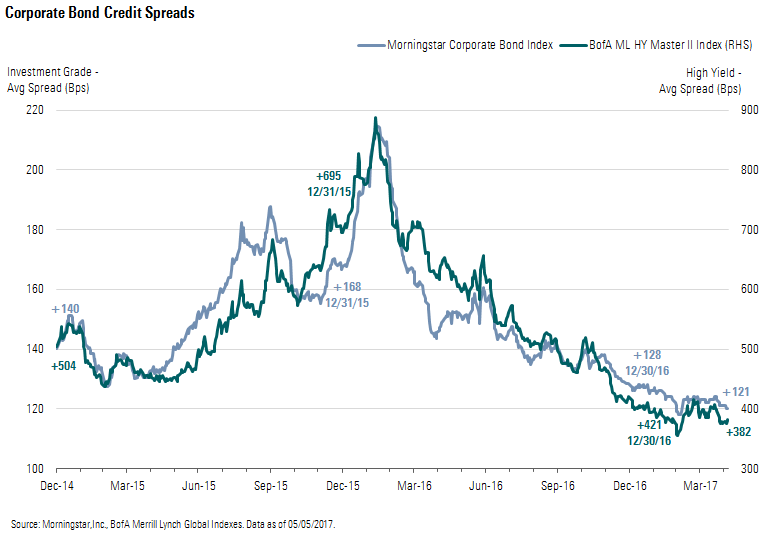
Although the equity markets continued to hit all-time highs, performance in the corporate bond market was mixed last week. The average corporate credit spread of the Morningstar Corporate Bond Index (our proxy for the investment-grade bond market) tightened 1 basis point last week to +120. At the current level, the average spread of our index is only 2 basis points higher than where it bottomed out in early March, which is the lowest since October 2014. The average spread of the Morningstar Corporate Bond Index has been lower only about one fourth of the time since the end of 1999.
In the high-yield market, the Bank of America Merrill Lynch High Yield Master Index widened slightly as declining oil and other commodity prices pressured the energy and metals and mining sectors. For example, oil fell 5.4% to $46.50 per barrel and copper fell 2.7% to $2.54 per pound. Over the course of the week, the average spread of the energy sector widened 32 basis points to +460 and the metals and mining sector widened 17 basis points to +386. Overall, the high-yield index widened 7 basis points to +382. However, even after this recent backup in credit spreads, the average spread of the high-yield index has been tighter only 18% of the time since the end of 1999.
In other market news, Apple (rating: AA-, negative), already the 10th-largest bond issuer in the Morningstar Corporate Bond Index, returned to the capital markets for the second time this year, issuing $7 billion worth of bonds with maturities ranging from 3 to 10 years. While the stated use of proceeds is for general corporate purposes, we believe a portion of the new notes is likely to be allocated toward refinancing current debt maturities and commercial paper. Our AA- rating reflects Apple's moderate Business Risk and strong Solvency Score and Cash Flow Cushion rankings, supported by high returns on invested capital and over $250 billion of overseas cash and investments. However, Apple's credit picture remains clouded by slowing revenue growth and management's willingness to increase debt to support large share repurchases to offset cash overseas. Our rating assumes revenue growth of 6%-7% over the next two years, buoyed by iPhone 8 sales. Longer term, we expect growth to moderate toward 3% or 4%, with operating margins settling at 20%-25% by 2021 compared with 28% in 2016. Our negative outlook takes into consideration a recent slowdown in revenue growth and the growing concentration of revenue.
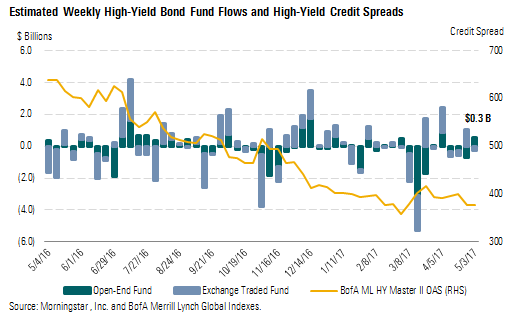
Inflows into the high-yield sector continued to eke out small gains last week. According to our data, among high-yield mutual funds and exchange-traded funds, fund inflows were $0.3 billion. Reversing the prior week's flows, inflows into open-end mutual funds outweighed outflows from high-yield ETFs.
Morningstar Credit Ratings, LLC is a credit rating agency registered with the Securities and Exchange Commission as a nationally recognized statistical rating organization ("NRSRO"). Under its NRSRO registration, Morningstar Credit Ratings issues credit ratings on financial institutions (e.g., banks), corporate issuers, and asset-backed securities. While Morningstar Credit Ratings issues credit ratings on insurance companies, those ratings are not issued under its NRSRO registration. All Morningstar credit ratings and related analysis contained herein are solely statements of opinion and not statements of fact or recommendations to purchase, hold, or sell any securities or make any other investment decisions. Morningstar credit ratings and related analysis should not be considered without an understanding and review of our methodologies, disclaimers, disclosures, and other important information found at https://ratingagency.morningstar.com.

 United States