
Fed Holds Policy Steady for Now
But Bank of Japan modifies focus.

The tone across the fixed-income markets was subdued at the beginning of last week as investors waited for the U.S. Federal Reserve and Bank of Japan to release their monetary policy statements. Following those statements, the tone turned much more positive as investors were relieved that the central banks remained resolved to maintaining their easy money policies.
The Bank of Japan announced it was revising the emphasis of its monetary policy to focus on managing the shape of the yield curve and lessen the reliance on the size of its asset-purchase program. The BOJ held the size of its asset-purchase program steady at JPY 80 trillion (approximately $781 billion) for now, but will modify its purchases to target the yield on its 10-year bond at 0% as opposed to the negative yield the bond has been trading at over much of this year. The intent of this program is to steepen the yield curve in order to minimize the impact that the flat and negative yield curve has had on financial institutions and pension funds. In addition, the BOJ is looking to influence inflation expectations as it revised its goal to overshoot its 2% inflation target.
The Fed held its policy steady and did not make any changes to either the federal funds rate or its reinvestment program, but it seemed to telegraph that it is closer to raising interest rates in the near term. While it’s highly unlikely the Fed would raise rates at the November meeting as the timing is right before the U.S. presidential election and the meeting does not include an update to the Federal Reserve’s economic projections, it did make several revisions to its meeting statement that suggest it is much closer to contemplating a rate hike. In addition, three members of the Federal Open Market Committee voted against the policy action as they preferred to raise the federal funds target rate at this meeting. In the press release, the FOMC revised the statement to reflect that “the labor market continued to strengthen and growth of economic activity has picked up from the modest pace seen in the first half of this year.” The statement also included a new statement, “The committee judges that the case for an increase in the federal funds rate has strengthened but decided, for the time being, to wait for further evidence of continued progress towards its objectives.”
While the Fed appears to be telegraphing a higher probability of a rate hike, the market-implied probability that the Fed will hike the federal funds rate in December had not changed meaningfully after the FOMC meeting. Currently, the futures market is pricing in a 54% probability that the Fed will hike its federal funds rate after the December meeting; prior to last week’s FOMC meeting, the market-implied probability of a December rate hike was 55%. The U.S. market is currently pricing in a high probability that the current ultraloose monetary policy will remain in place over the next year. According the futures market, there is only approximately a 7% probability the Fed will hike rates to over 1% in September 2017. This is a significant departure from the Fed’s most current Summary of Economic Projections, in which FOMC participants’ average projection for the federal funds rate at the end of 2017 is 1.30%.
Following the central bank announcements, prices on fixed income traded higher, sending yields down toward the same levels seen earlier this month. Investors were especially attracted to the levels in the longer end of the curve. As long-dated bonds outperformed short-dated bonds, the yield curve flattened. The yield on the 2-year and 5-year bonds declined 1 basis point and 4 basis points respectively, whereas long-dated bonds such as the 10-year and 30-year bonds dropped 7 basis points and 30 basis points.
In the global bond markets, after a brief foray into positive territory the prior week, the price on Germany’s 10-year bond rose enough to push its yield back down to negative territory, ending the week at negative 0.08% after trading as high as 0.07%. Following the announcement of the Bank of Japan’s change in policy, the yield on Japanese 10-year bonds rose, yet ended the week at negative 0.05%, below the central bank’s new stated goal of 0%.
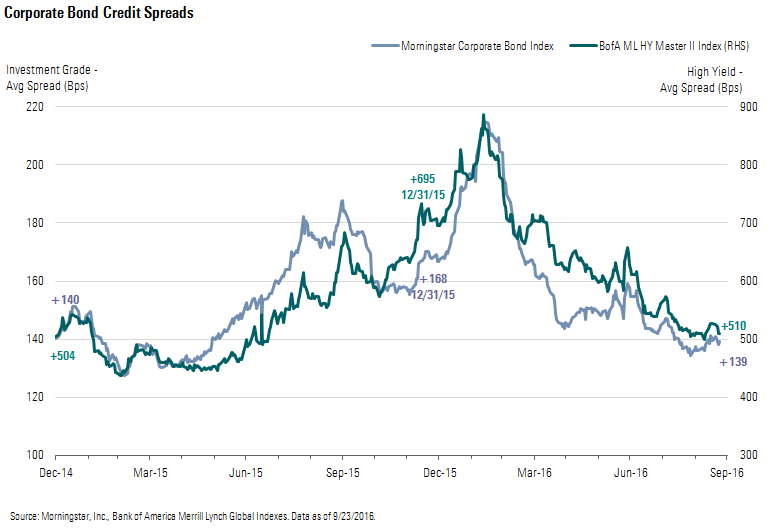
In the corporate bond market, traders reported that there was a strong bid for long-dated bonds in order to extend duration. For example, intermediate-term investors looked to swap out of 5- and 7-year bonds for 10-year bonds, and long-term investors looked to sell 10-year bonds in order to reinvest those proceeds in 30-year bonds. Investment-grade corporate credit spreads were generally unchanged as the average credit spread of the Morningstar Corporate Bond Index held steady at +139 bps. In the high-yield market, credit spreads continued to tighten as the Bank of America Merrill Lynch High Yield Master Index tightened 17 basis points to +510 bps.
Morningstar Credit Ratings, LLC is a credit rating agency registered with the Securities and Exchange Commission as a nationally recognized statistical rating organization (“NRSRO”). Under its NRSRO registration, Morningstar Credit Ratings issues credit ratings on financial institutions (e.g., banks), corporate issuers, and asset-backed securities. While Morningstar Credit Ratings issues credit ratings on insurance companies, those ratings are not issued under its NRSRO registration. All Morningstar credit ratings and related analysis contained herein are solely statements of opinion and not statements of fact or recommendations to purchase, hold, or sell any securities or make any other investment decisions. Morningstar credit ratings and related analysis should not be considered without an understanding and review of our methodologies, disclaimers, disclosures, and other important information found at https://ratingagency.morningstar.com.

 United States