
In Face of Global Central Bank Easing, Fed Holds Policy Steady
Investors continue to pour funds into high-yield sector.

Central banks across the world have been out in force over the past month, easing their monetary policies in an attempt to stimulate their economies. This has had a stimulative effect on asset markets across the world as well. First was the Bank of China. It lowered the reserve requirement ratio in its banking system to free up capital, which banks can then use to increase lending. Next was the Bank of Japan, which lowered its excess reserve rate to negative 0.10% (joining the NIRP club) and cut its rate on required reserves to 0%. Two weeks ago, the European Central Bank cut its interest rates, with the deposit facility going even more negative (0.40%), and announced it was increasing the size of its monthly asset purchase by EUR 20 billion to EUR 80 billion (which at an annualized rate is approximately a EUR 1 trillion program). Further, the ECB announced that it will begin to buy nonbank investment-grade corporate bonds as part of its purchases. And in the United States, even though core CPI increased 2.3% on a year-over-year basis last month and unemployment is running at 4.9%, the Federal Reserve held off on raising the fed funds rate from its current 0.25%-0.50% range.
Liquidity has to flow somewhere, and in the short term it flooded back into the capital markets. The U.S. corporate bond market continued its multiweek rally as credit spreads tightened and underlying interest rates dropped. The average spread of the Morningstar Corporate Bond Index tightened 8 basis points to +170, and in the high-yield market, the Bank of America Merrill Lynch High Yield Master II Index tightened 11 basis points to +671. Between the rally in credit spreads and the sharp decline in interest rates, the Morningstar Corporate Bond Index rose 1.37% last week and has risen 2.91% thus far this year. The Bank of America Merrill Lynch High Yield Master II Index rose 1.1% last week and has generated a 3.6% return year to date.
The S&P 500 rose 1.35%, which was enough to bring the index back into positive territory for the year; it has risen 0.28% year to date. Even though no country has actually cut production or even agreed to a production freeze, oil also continued to march higher, rising $1.75 a barrel to $40.20, its highest level since December.
Treasuries performed well last week. While the all-in yield on Treasuries remains paltry, the interest rates are attractive compared with the sovereign debt of other developed markets. The yield on 5-year Treasury declined 14 basis points to 1.34%, the 10-year Treasury fell 11 basis points to 1.87%, and the 30-year dropped 8 basis points to 2.67%. The yield on the 10-year German bond is 0.22%, the Italian 10-year debt yield is 1.27%, and investors in Japanese bonds are willing to lock in long-term losses as the yield on the 10-year is negative 0.09%. Among our other fixed-income indices, the longest-duration indices have outperformed this year. For example, the Morningstar Long Term US Treasury Index has risen 5.67% this year. After suffering losses last year, the Morningstar TIPS Index is regaining ground, having risen 3.50%, as investors price in rising consumer price inflation and a longer-duration easy monetary policy from the Fed.
Second-Quarter Corporate Bond Outlook In the first quarter, the average spread of our investment-grade index ranged between 168 and 216; in high yield, credit spreads ranged between 671 and 887. For the second quarter, we think investors should be braced for another bout of corporate credit spread volatility. In such a volatile environment, investors should look to use sell-offs to increase exposure in sectors whose underlying credit risk dynamics are unaffected by the downturn in commodity prices, but in which credit spreads widen in sympathy with overall market movement.
We expect the volatility will be bounded by swings in expectations for a relatively stable economic environment in the U.S. as opposed to global economic recessionary fears in conjunction with downward pressures in the commodity sector. Robert Johnson, Morningstar's director of economic analysis, expects real GDP growth in the U.S. to be 2.0%-2.5% in 2016, inflation as measured by the consumer price index will average 2.5%, and the unemployment rate will drop to 4.6%-4.8%. On the basis of these assumptions, he expects the yield on the 10-year Treasury will increase to 3.00%. While the U.S. economy should hold its course, we expect economic growth in China may continue to wane. Even though a very small percentage of U.S. exports are directly tied to China, it is the second-largest economy in the world, so a slowdown in Chinese economic activity will have ripple effects globally. In addition, credit spread volatility will continue to emanate from the commodity sector and, more specifically, oil prices. Andy O'Conor, Morningstar's credit analyst covering the oil sector, believes ongoing overproduction in the oil sector could lead oil prices to tumble once more.
With the recent recovery in commodity prices probably having run most of its course over the past few weeks, prices are poised to either stabilize or reverse. Even at current price levels, default rates in energy and basic materials sector will continue to climb over the course of the year. This will increase the overall default rate; however, continued moderate economic expansion in the U.S. will keep default rates in check in other sectors.
In addition to the economic outlook and volatility in commodity prices, a new exogenous variable will affect the U.S. corporate credit markets. Not only has the ECB continued to expand its easy monetary policy by cutting financing rates further and increasing the negative yield on its deposit facility, but it also has increased the size of its monthly asset purchase program to EUR 80 billion from EUR 60 billion. As part of its quantitative easing program, the ECB has announced that it will begin purchasing nonbank investment-grade corporate bonds by the end of second quarter. In our view, the ECB will not be a price-sensitive buyer of corporate credit risk, as its main goal is to further expand its easy monetary policy in an attempt to bolster economic growth and stoke inflation, as opposed to traditional investors, which look to maximize their return for a given level of risk. Toward the end of the second quarter, once the ECB begins this aspect of its purchase program, we expect credit spreads will tighten (or at least restrict the amount credit spreads would widen if global economic fundamentals are deteriorating) as supply is removed from the corporate bond market and those investors that sold their bonds will need to reinvest the proceeds. As such, the ECB's purchases are likely to distort the normal market discounting function and artificially suppress credit spreads. Not only are fixed-income investors' returns affected by the abnormally low interest rates due to the negative interest rate policy, but now their compensation for accepting corporate credit risk will be reduced as well.
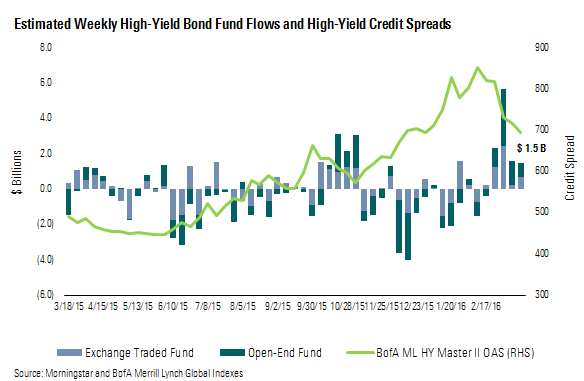
Investors Continue to Pour Funds Into High-Yield Sector Inflows into high-yield open-end mutual funds and exchange-traded funds totaled $1.5 billion last week. While this is a far cry from the record-breaking $5.7 billion that surged into high yield two weeks ago, it is a respectable amount. For the four consecutive weeks ended March 16, a record $11.4 billion of inflows entered the high-yield asset class. Excluding this period, the second-greatest four-week consecutive inflow was $10.2 billion in November 2011. At that time, corporate credit spreads were just beginning to recover from the European debt and banking crisis, the Fed had just recently launched Operation Twist, and the equity markets were on their way higher.

 United States