
As Energy Prices Slide Lower, High-Yield Investors Head for the Exits
As commodity prices fell to multiyear lows, corporate credit spreads widened and stock prices waned.

In what was probably the most telegraphed central bank move ever, the Federal Reserve finally raised the federal funds rate by a quarter percentage point to a targeted range of 0.25%-0.50%. From an economic point of view, Robert Johnson, Morningstar's director of economic analysis, viewed this single quarter-point hike as a non-event. However, in his Dec. 19 report, "Why Inflation May Overrun the Fed," Johnson makes the case that once the decline in energy and commodity prices levels off, headline inflation is set to accelerate higher. While the consumer price index was nearly unchanged on a month-to-month basis in November, it rose 0.5% on a year-over-year basis. Johnson forecasts that the year-over-year increase could rise to 1% in January and 2% by June, and depending on commodity prices could range from 2% to 3% next December. In such a scenario, the Fed may be forced to raise short-term rates faster than Wall Street consensus currently projects, which could have a significant effect on the economy and markets.
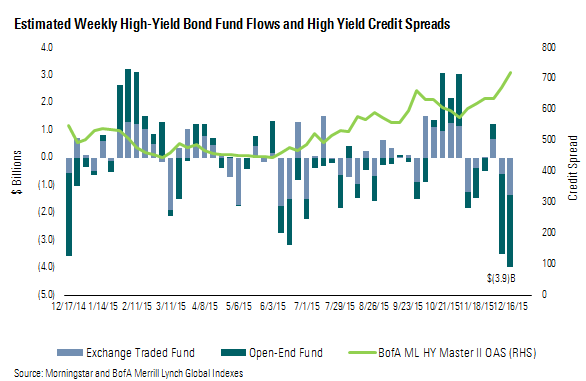
Commodity prices have yet to find a bottom and slid lower last week. As commodity prices fell to new multiyear lows, corporate credit spreads widened and stock prices waned. The average spread of the Morningstar Corporate Bond Index widened out 4 basis points last week to +170 bps over Treasuries. The weakness was mainly felt in the energy and metals and mining sectors, which widened 20 and 23 bps, respectively, whereas the credit spreads in sectors that are not correlated to commodities held in relatively well. The average spread of the Bank of America Merrill Lynch High Yield Master Index widened 10 bps last week to +720 bps, rivaling the widest spread level that the high-yield index has registered since June 2012, when the market was recovering from the European financial crisis. Treasuries also weakened last week as the yield on the 5-year Treasury rose 11 bps to 1.68%, the 10-year Treasury increased 6 bps to 2.12%, and the 30-year Treasury rose 3 bps to 2.91%.
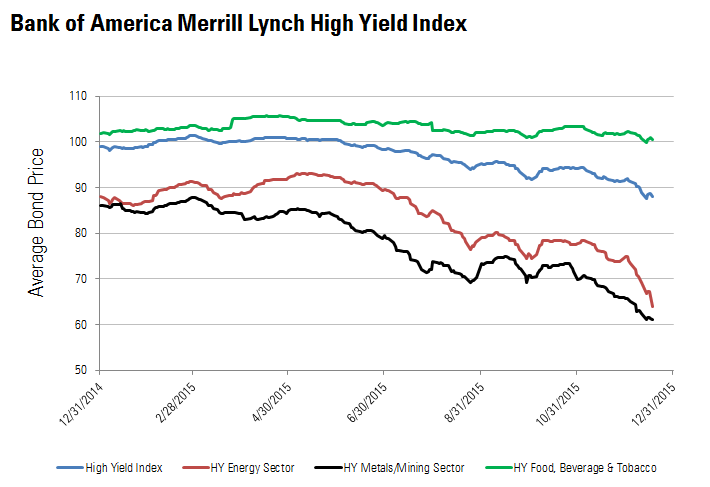
The main culprit that led to weakness among corporate credit spreads was the ongoing deterioration in the commodity markets. As commodity prices have fallen, bankruptcy risk in those sectors reliant on raw material prices has increased substantially and the credit ratings on those firms have been slashed. In addition, analysts have been sharply ratcheting down their estimates of recovery values. Between heightened near-term bankruptcy risk and lower recovery values, bond prices in the energy and metals and mining sectors have dropped precipitously. However, as we highlighted last week, not every sector in the bond markets have been suffering to the same degree, and many sectors not correlated to commodity prices have been holding their own. For example, the average bond price in the food, beverage, and tobacco sector of the BofA Merrill Lynch High Yield Index has only fallen a little over 1 point this year, while the average bond price in the energy and metals and mining indexes has fallen over 24 points.
Investors continued to flee the high-yield market last week. High-yield mutual funds and exchange-traded funds registered a $3.9 billion outflow, the greatest weekly outflow over the past 52 weeks and the third-largest weekly outflow since we began gathering the data in June 2009. The cumulative amount of outflows over the prior two weeks, including last week's $3.3 billion outflow, is the second-greatest outflow over two consecutive weeks in the high-yield category since June 2009.

 United States