
Credit Spreads Tighten as Investors Fight Over Limited Supply
This week, U.S. investors will be focused on the Fed's Jackson Hole symposium.

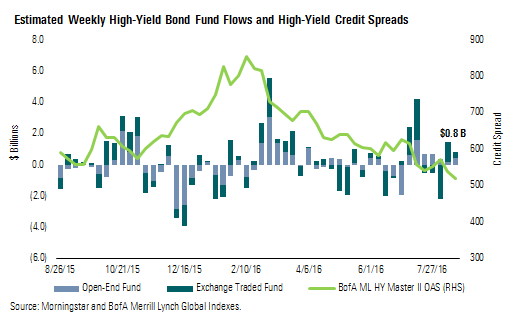
Dwindling new issue supply and rising oil prices provided the impetus for corporate credit spreads to tighten last week. The new issue market ground to a halt as senior bond traders and investment bankers took vacation time during the seasonal August slowdown. However, cash continued to pour into corporate bond mutual funds and exchange-traded funds, and portfolio managers sought out assets to put this money to work. As the thinly staffed trading desks fought over the few trades that took place, traders bid prices up in order to source bonds. In addition, credit spreads in the energy sector performed especially well as oil prices rose almost $4 per barrel to $48.50. The average spread of the Morningstar Corporate Bond Index tightened 4 basis points to +137 and the average spread of the Bank of America Merrill Lynch High Yield Master Index tightened 19 basis points to +515. These are the indexes’ tightest levels over the past year.
Barring any unforeseen events, this week will be similarly quiet as the new issue market will remain effectively closed and secondary trading volume will be kept to a minimum. In the United States, investors will be focused on the Federal Reserve’s annual confab at Jackson Hole on Aug. 25-27 in order to gain a better understanding of what data the Fed is focused on and try to game when the Fed may raise interest rates next. Fed watchers will be especially focused on Fed Chair Janet Yellen, who is scheduled to speak Aug. 26. In our quarterly outlooks, we make our case as to why we don’t expect the federal funds rate to rise anytime in the near future. Currently, the market-implied probability of a hike in interest rates at the September meeting is only 12%, and for the December meeting, the probability remains under 50%. The probability of an increase in short-term rates does not increase to over 50% until March 2017.
While the Federal Reserve made its first foray into normalizing monetary policy by raising the federal funds rate a quarter point in December 2015, the ultra-easy monetary policies that exist among global central banks are unabated. In fact, based on recent reports, the European Central Bank and Bank of Japan are considering loosening their already historically easy monetary policy by increasing their asset-purchase programs and/or lowering interest rates even further into negative territory. This easy monetary policy will continue to support the corporate bond market over the near term. With interest rates negative in the European Union and Japan and rates on U.K. bonds hitting all-time lows, the U.S. dollar will probably continue to appreciate over time against other developed-market currencies. As global interest rates remain near their lowest historical levels, corporate bonds have become increasingly more attractive on a relative value basis. With underlying interest rates as low as they are, the extra return provided by the credit spread on corporate bonds above the underlying benchmark bond has become an increasingly larger portion of total return.

 United States