
Credit Markets Sell Off on Global Economic Weakness Even Though U.S. Economy Remains Resilient
Boosting 2015 GDP expectations.

The corporate bond market opened to the downside last week and slid further from there. It tried its best to recover on Friday, but gave up its gains in the afternoon. Over the course of the week, the average spread of the Morningstar Corporate Bond Index widened 5 basis points to +179 bps over Treasuries, and the Bank of America Merrill Lynch High Yield Master Index widened 35 bps to end the week at +615. These levels represent their weakest points since recovering from the Greek sovereign debt crisis in mid-2012. In the investment-grade index, the worst-performing sectors were once again the basic industries and energy sectors. The average spread of basic industries widened 19 bps to +274 and energy wasn't far behind, widening 17 bps to +270. In the high-yield index, the energy sector widened 68 bps to +1,049 and the metals and mining sector widened 70 bps to +1,259.
At the beginning of the week, the main concern was that since the Federal Reserve did not begin to raise rates the prior week, it may be concerned that either the U.S. economy is weakening or the global economy is even weaker than current economic metrics indicate. This concern was reinforced in the middle of the week when Markit's Purchasing Managers' Index reports were released. China's manufacturing PMI report fell to 47.0 from 47.3, its lowest level in 78 months. A reading below 50 suggests economic contraction whereas a reading above 50 indicates economic expansion. This is the third consecutive decline in China's manufacturing PMI, and over the course of the past 12 months, this reading has been at or above 50 only three times. While still registering above the demarcation line for expansion, the European manufacturing PMI also slid three tenths to 52.0; this is also the third consecutive decline. According to Markit, the European PMI readings "indicate that the eurozone economy expanded 0.4% in the third quarter, in line with the second quarter" and "puts the economy on course to grow by just 1.6% this year." The manufacturing PMI in the United States remained stable at 53.0, but that is the lowest the index has registered over the past year.
The markets tried to rebound Friday morning after Fed Chair Janet Yellen gave a speech Thursday night; however, the rally quickly fizzled out, and by the afternoon the markets ended the day relatively unchanged. Her speech mainly centered on the Fed's views toward current inflation and its expectations that inflation will rebound toward the Fed's 2% target as the impact of lower energy prices subsides. She also ventured into the Fed's view that economic growth is still on trend and the labor market is improving. As such, given the Fed's expectations for inflation to return to target, continued economic growth, and further labor gains, she said, "Most of my colleagues and I anticipate that it will likely be appropriate to raise the target range for the federal funds rate sometime later this year and to continue boosting short-term rates at a gradual pace thereafter."
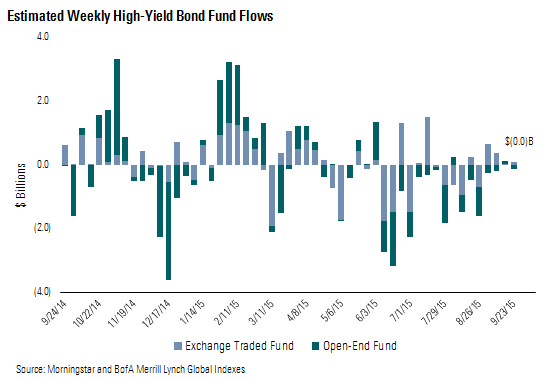
In addition to heightened default risk in the metals and mining and energy sectors because of low commodity and oil prices, the high-yield market has also had to contend with a significant amount of outflows over the past few months, which has weighed on credit spreads. Since the beginning of June, there has been a total of $12 billion of funds withdrawn from high-yield open-end mutual funds and exchange-traded funds. Withdrawals have subsided over the past few weeks and net fund flows were unchanged last week as inflows in ETFs were offset by the outflows from open-end funds. Wider credit spreads have yet to attract new buyers to the asset class, but we suspect that these wider credit spreads will attract buyers as soon as we see stability in the commodity markets.
Boosting 2015 GDP Expectations The Bureau of Economic Analysis just released its third estimate of second-quarter GDP, revising it to 3.9% from 3.7%. Robert Johnson, Morningstar's director of economic analysis, noted that the revision is what economists call a "high-quality revision," meaning that the underlying factors indicate positive economic momentum will continue into the following quarter. For example, the contribution from inventory expansion was reduced to 0.2% from 0.4%, meaning that there was less inventory build than previously thought. The upward revision to GDP was due to large revisions in consumer spending and construction-related categories. Consumer spending rose 3.6%, which represents about two thirds of total GDP growth and is the highest quarterly increase during this current economic recovery. Between higher consumer spending and lower inventory accumulation, it portends well for retailers as they will not be stuck having to discount merchandise this fall to make way for holiday goods. Net exports were a contributor, albeit only 0.1%, but this may indicate that the strong dollar and weak global economies may not weigh overly heavily on continued economic growth in the U.S. Overall, Johnson thought this was one of the most balanced GDP reports the country has experienced in a long time.
Following this release, Johnson increased his forecast for full-year GDP to 2.2%-2.6% from his prior expectation of 2.0%-2.5%. While this may not be much of an increase, Robert thinks the most likely outcome for GDP growth will be at the top end of his forecast range. Based on the existing growth year to date, GDP growth over the next two quarters will need to average 2.9%. Given the economic metrics released thus far this quarter, Johnson thinks the third quarter will beat that average. He also reiterated his five-year estimate for GDP growth of 2.0%-2.5%.

 United States