
Corporate Credit Spreads Widen as Looming Global Trade Tariffs and M&A Risk Intensify

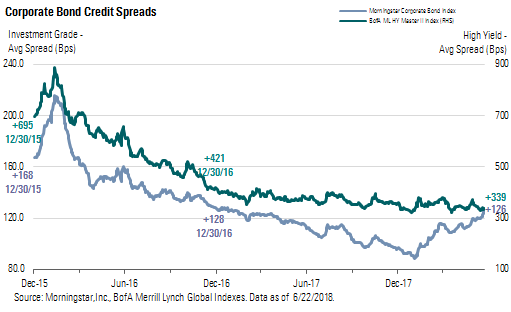
Corporate credit spreads continued to widen last week as the increasing hazard from global trade wars, with their corresponding import tariffs and retaliatory tariffs, took its toll on investor psyche across all risk assets. In addition, renewed expectations that large-scale mergers and acquisitions may be on the horizon further pressured the investment-grade market. The average spread of the Morningstar Corporate Bond Index, our proxy for the investment-grade bond market, widened 6 basis points last week to +126. In the high-yield market, the BofA Merrill Lynch High Yield Master Index similarly widened 6 basis points to +339.
Typically, high-yield credit spreads are more volatile than investment-grade because of their greater credit risk and elevated probability of default; however, the high-yield market has significantly outperformed the investment-grade market so far this year, as the underlying companies in the high-yield universe are more correlated to economic activity, which has been robust this quarter. Year to date, credit spreads in the investment-grade market have widened 30 basis points, whereas in the high-yield market, spreads have tightened 24 basis points. At its current level, the average credit spread in the investment-grade market is at its widest level this year and is as high as it was since February 2017. In contrast, the average credit spread of the high-yield index remains near its tightest levels since before the 2008-09 credit crisis. Since the beginning of 2000, the high-yield index has only ever traded below the current level less than 10% of the time.
-
Following a recent court ruling in which the U.S. Department of Justice lost in its attempt to block the proposed merger between
As the bidding war between Disney and Comcast continues, credit spreads for those companies' bonds have widened as investors price in a higher probability that debt leverage will increase significantly for whichever firm emerges as the winner. Disney’s 2027 notes are 18 basis points wider month to date and 33 basis points wider than at the end of 2017. The credit spread on Comcast’s 2028 notes is unchanged in June but 48 basis points wider since the end of last year.
While the investment-grade market has been under pressure from the emerging economic trade skirmishes, the high-yield market has benefited from an acceleration in economic activity. Economic activity has been on a tear this quarter and is much stronger than was expected at the beginning of the quarter. In its most recent GDPNow estimate, the Federal Reserve Bank of Atlanta is projecting that second-quarter GDP growth will be 4.7%. This rate of growth would represent the second-strongest quarterly growth rate over the past four years, surpassed only in the third quarter of 2014.
Morningstar Credit Ratings, LLC is a credit rating agency registered with the Securities and Exchange Commission as a nationally recognized statistical rating organization ("NRSRO"). Under its NRSRO registration, Morningstar Credit Ratings issues credit ratings on financial institutions (e.g., banks), corporate issuers, and asset-backed securities. While Morningstar Credit Ratings issues credit ratings on insurance companies, those ratings are not issued under its NRSRO registration. All Morningstar credit ratings and related analysis contained herein are solely statements of opinion and not statements of fact or recommendations to purchase, hold, or sell any securities or make any other investment decisions. Morningstar credit ratings and related analysis should not be considered without an understanding and review of our methodologies, disclaimers, disclosures, and other important information found at https://ratingagency.morningstar.com.

 United States