
Corporate Credit Spreads Tighten Following Trump's Address to Congress
Probability of March interest rate hike soars.

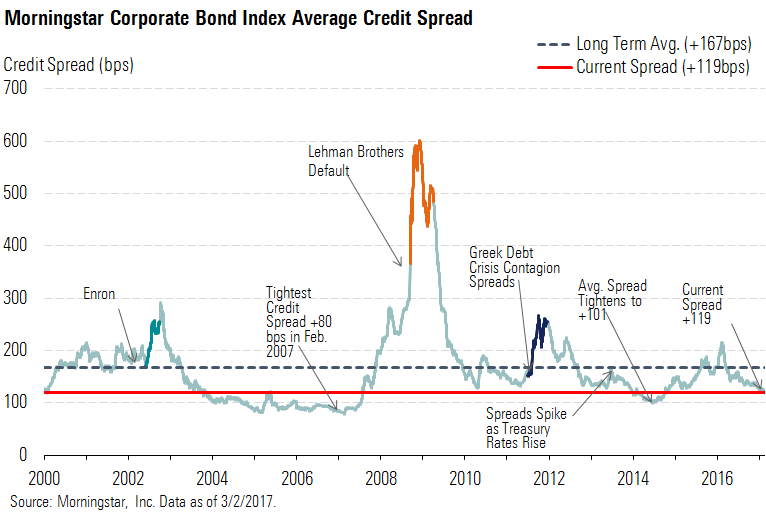
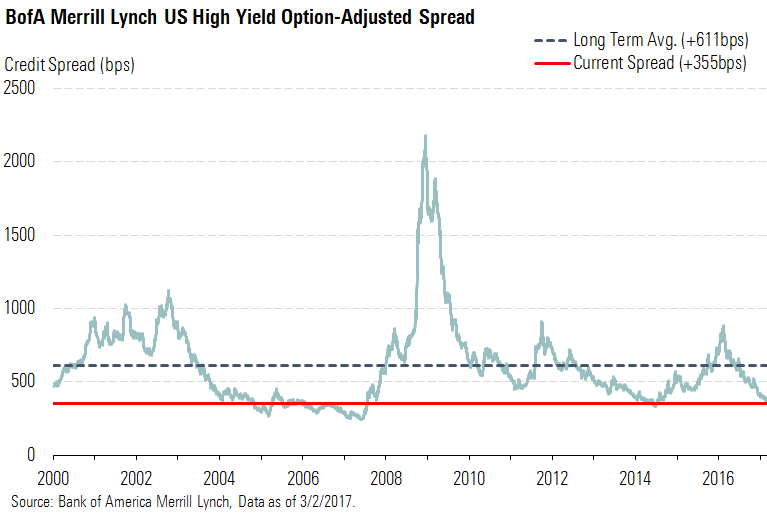
While the markets pulled back slightly in the latter half of last week, risk assets remained near their highs after a significant boost Wednesday following President Donald Trump’s address to Congress. The average spread of the Morningstar Corporate Bond Index, our proxy for the investment-grade bond market, tightened 5 basis points to +118 last week. In the high-yield market, the credit spread of the Bank of America Merrill Lynch High Yield Master Index tightened 24 basis points to +360.
While current levels are wider than their historical lows of 2007, the corporate bond market levels are the tightest that credit spreads have registered since the fall of 2014 and significantly tighter than their long-term averages. The average spread of the Morningstar Corporate Bond Index is 50 basis points tighter than its long-term average of +168 since the end of 1998. The average spread of the Bank of America Merrill Lynch High Yield Master Index is currently 220 basis points tighter than its long-term average of +580 basis points since the end of 1996.
As an indication of how tight corporate credit spreads have become compared with their historical averages, since the beginning of 2000, the average spread of the Morningstar Corporate Bond Index has registered below the current level only 26% of the time. In the high-yield market, the average spread of the Bank of America Merrill Lynch High Yield Master Index has registered below its current level less than 13% of the time over the past 17 years. The preponderance of the time that the index resided at a level tighter than the current credit spread occurred during the buildup to the 2008-09 credit crisis. During 2004-07, corporate credit spreads were pushed to historically tight levels as new structured investment vehicles were engineered to arbitrage the differentials in expected default risk; however, once the credit crisis emerged, investors found that many of these vehicles did not perform as advertised.
Probability of March Interest Rate Hike Soars While risk assets performed well last week, U.S. Treasury bond prices fell precipitously as the market re-evaluated the probability that the Federal Reserve will increase the federal funds rate following the Federal Open Market Committee meeting March 14-15. Between language in the minutes released from the prior Fed meeting and intimations contained in the speeches by several Fed governors, the market-implied probability of a March rate hike rose to over 80%, according to CME, from only 22% the prior week. As bond prices fell, interest rates rose across the yield curve. The yield on the 2-year Treasury bond rose 17 basis points to 1.31%, the highest yield the 2-year bond has reached since 2009. The 5-year bond rose 21 basis points to 2.01%, the 10-year increased 17 basis points to 2.48%, and the 30-year rose 12 basis points to 3.07%. Even if the Fed increases the federal funds rate by 25 basis points to 75-100 basis points, this range still represents a highly simulative monetary policy. Before the 2008-09 credit crisis, the lowest the federal funds rate had been targeted was 1.00% in 2003, when the Fed was trying to prop up the economy after the tech bubble burst.
Sovereign interest rates in other developed markets also rose last week. The interest rate on Germany’s 2-year bond, which had hit new historical negative yields the prior week, rose 16 basis points to negative 0.80%. The yield on Germany’s 10-year bond rose 17 basis points to 0.36%. The spread between German and French sovereign bonds also began to normalize last week after having widened in reaction to National Front leader Marine Le Pen’s rise in recent French presidential election polls. The National Front has long advocated against the European Union, and Le Pen’s platform advocates for a referendum on France’s membership in the EU as well as restoring a national currency.
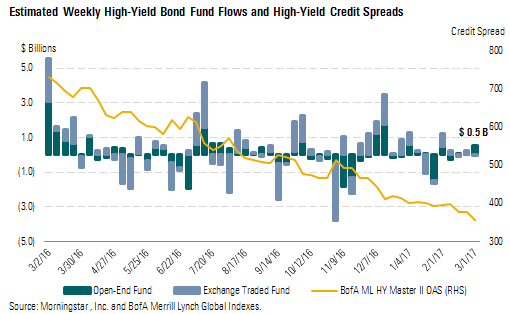
High-Yield Fund Flows Muted in Contrast to Rapidly Tightening Credit Spreads Although credit spreads tightened, the amount of inflows into the high-yield asset class remained subdued last week. Among the high-yield open-end mutual funds and exchange-traded funds, only $0.5 billion of funds flowed into the asset class. The inflows were concentrated in the open-end mutual fund category (generally considered a retail investor product) as fund flows into ETFs (generally considered an institutional investor category) were essentially unchanged for the week.
Morningstar Credit Ratings, LLC is a credit rating agency registered with the Securities and Exchange Commission as a nationally recognized statistical rating organization (“NRSRO”). Under its NRSRO registration, Morningstar Credit Ratings issues credit ratings on financial institutions (e.g., banks), corporate issuers, and asset-backed securities. While Morningstar Credit Ratings issues credit ratings on insurance companies, those ratings are not issued under its NRSRO registration. All Morningstar credit ratings and related analysis contained herein are solely statements of opinion and not statements of fact or recommendations to purchase, hold, or sell any securities or make any other investment decisions. Morningstar credit ratings and related analysis should not be considered without an understanding and review of our methodologies, disclaimers, disclosures, and other important information found at https://ratingagency.morningstar.com.

 United States