
Corporate Credit Spreads Hold Steady in Face of Weakening Economic Expectations
Calm waters attract high-yield investors.

Expectations for economic growth in the first quarter had been steadily falling over the past four weeks, but the decline picked up speed last week. For example, by the end of last week the Federal Reserve Bank of Atlanta's GDPNow forecast for the first quarter had fallen to a 0.1% annualized rate. This economic indicator was forecasting a 2.3% annualized rate as recently as mid-March. Weak economic metrics pressured the equity markets, and Treasury bonds rallied. As investors bid up Treasury bond prices, the yield on the 10-year Treasury bond fell to 1.72%, toward its lowest levels over the past few years and not much higher than the all-time lows it hit in mid-2012.
While the S&P 500 fell 1.30% and the yield on the 10-year Treasury declined 7 basis points, spreads on corporate bonds were largely unchanged last week. The average credit spread of the Morningstar Corporate Bond Index held steady at +162 and the spread of the Bank of America Merrill Lynch High Yield Index only tightened 2 basis points to +703.
Investor demand for corporate bonds remains robust, but in contrast to the strong rally over the past month, investors have become increasingly selective. Investors have become much more discerning in their purchases compared with a month ago, when the nascent rally in corporate bonds had begun and investors were less discriminate in their purchases. Traders have reported that the highest demand remains for corporate bonds rated single A or better and for bonds in the shorter end of the yield curve. Typically, this indicates that portfolio managers have cash inflows that need to be put to work, but these same portfolio managers are wary that the corporate bond market could be set up for a pullback. As such, they are unwilling to reach too far down the spectrum of credit risk, lest they take on too much risk and are saddled with lower-quality bonds if the market weakens.
For the second quarter, many of the same dynamics that affected the first quarter are still in place, and we think investors should brace for another bout of corporate credit spread volatility. In such a volatile environment, investors should look to use sell-offs to increase exposure in those sectors whose underlying credit risk dynamics are unaffected by the downturn in commodity prices, but in which credit spreads widen in sympathy with overall market movement. If economic activity is slowing as indicated by the current weakness in economic metrics, defensive sectors such as consumer products or regulated sectors such as U.S. banking will probably hold their value better than the cyclical sectors.
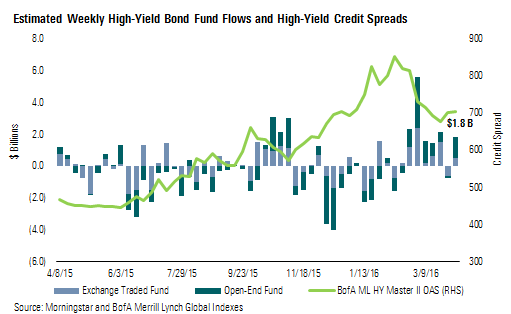
Calm Waters Attract High-Yield Investors Investors allocated an additional $1.8 billion into high-yield open-end mutual funds and exchange-traded funds last week. As volatility has subsided in the corporate bond market and oil prices continue to move higher, investors remain comfortable reaching for yield as the average credit spread of the high-yield index remains 121 basis points above its long-term average.
While the wider-than-average credit spreads are attractive from a historical perspective, we encourage investors to not become too complacent. We expect high-yield bonds and oil prices will remain correlated in the near term. Major oil producers have agreed to meet April 17 in Doha to discuss implementing a production freeze. Considering how much oil prices have risen from their lows since the idea of a production freeze was floated, the market will probably need to see a strong agreement emanating from the meeting; otherwise, oil prices could quickly slide once again and take the high-yield market back down with them.

 United States