
Corporate Bonds Steady as Turkish Markets Stabilize
The lira regained some of its lost value against the dollar last week.

Performance across the asset markets diverged last week as the equity market continued its march higher, corporate bonds and Treasuries were largely unchanged, and commodity markets weakened. In the equity market, investor enthusiasm was supported by better-than-expected second-quarter results from Walmart (AA-, negative), whose stock price soared 9.3% after the earnings release and helped propel the S&P 500 up 0.6%. Year to date, the S&P 500 has gained a healthy 6.60%. The solid equity market performance has been driven by rising earnings and especially by strong top-line growth. Reported revenue for the second quarter has been generally strong across the board, and many companies have increased their guidance for 2018 to incorporate the resulting earnings growth.
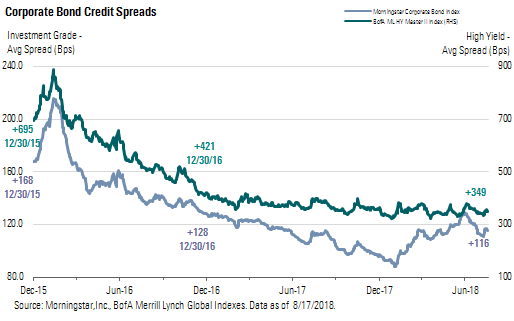
In the corporate bond market, the average spread of the Morningstar Corporate Bond Index (our proxy for the investment-grade market) was unchanged, ending the week at +116. In the high-yield market, the BofA Merrill Lynch High Yield Master Index tightened 1 basis point to end the week at +349. Among U.S. Treasuries, the 2-year widened 1 basis point to 2.61%, the 5-year was flat at 2.74%, and the 10-year and 30-year tightened by 1 basis point to 2.86% and 3.02%, respectively.
Across the commodity markets, the most economically sensitive commodities were hit the hardest. For example, the copper market is close to entering bear-market territory as the price per pound has fallen almost 20% to $2.66, down from its early June high of $3.30. Oil prices also continued to slide last week, falling almost $2 per barrel to end the week at $65.91. This is a 12% decline from their recent high of $75 per barrel in early July.
In our prior Credit Research Highlights, we wrote about how the turmoil in Turkey's lira and sovereign bonds had pressured the global markets. Last Monday, the country's currency and 10-year bonds started off weak. Over the course of the week, the lira was able to regain some of its lost value against the U.S. dollar, but Turkey's sovereign debt was only able to recoup enough to end the week unchanged. The lira gained almost 7% against the dollar, but even after that rebound, it is down 18% month to date and 37% year to date. Turkey's 6.125% notes due 2028 ended the week at $0.84 on the dollar, which equates to an 8.50% yield to maturity or a spread of 564 basis points over comparable U.S. Treasuries. These notes were issued in mid-April and initially traded over par at a 6.05% yield before beginning their plunge. Although late to the party, Moody's and S&P downgraded their ratings on Turkey last week by one notch, placing those ratings lower in the high-yield category. These downgrades were one of the factors that led to the underperformance of Turkey's bonds compared with its currency.
As the value of the lira weakens and yields on the Turkish sovereign bonds rise, investors are concerned that Turkey and many Turkish corporations with dollar- or euro-denominated debt may find their access to international capital markets constrained or cut off altogether, with this illiquidity resulting in financial distress or insolvency. While the direct impact on the global economy from a decline in economic output from Turkey would be very limited, contagion from this currency and debt crisis has begun to spread to other emerging markets, especially among those that rely heavily on foreign investment. In addition, the equity of European banks with significant exposure directly to Turkey, as well as Turkish corporations, has been under pressure.
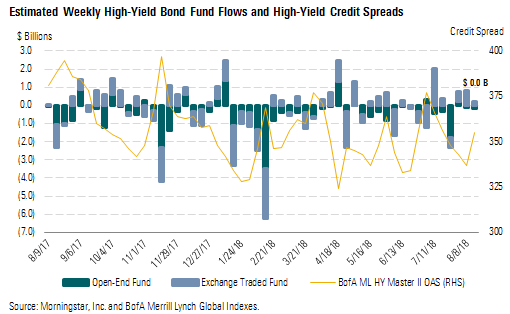
Weekly High-Yield Fund Flows Net fund flows in the high-yield asset class were unchanged last week as the $0.2 billion of net unit creation across high-yield exchange-traded funds was offset by $0.2 billion of outflows among open-end high-yield mutual funds. Year to date, fund flows have registered a total outflow of $15.2 billion, consisting of $2.8 billion of net unit redemptions across ETFs and $12.3 billion of redemptions among open-end funds.
Morningstar Credit Ratings, LLC is a credit rating agency registered with the Securities and Exchange Commission as a nationally recognized statistical rating organization ("NRSRO"). Under its NRSRO registration, Morningstar Credit Ratings issues credit ratings on financial institutions (e.g., banks), corporate issuers, and asset-backed securities. While Morningstar Credit Ratings issues credit ratings on insurance companies, those ratings are not issued under its NRSRO registration. All Morningstar credit ratings and related analysis contained herein are solely statements of opinion and not statements of fact or recommendations to purchase, hold, or sell any securities or make any other investment decisions. Morningstar credit ratings and related analysis should not be considered without an understanding and review of our methodologies, disclaimers, disclosures, and other important information found at https://ratingagency.morningstar.com.

 United States