
Corporate Bonds Hold Steady in Face of Rising Rates as Credit Spreads Tighten
European Central Bank releases program outline to begin purchasing corporate bonds.

Despite rising interest rates in the Treasury bond market, corporate bond prices were essentially unchanged last week. The amount that credit spreads tightened offset much of the rise in underlying interest rates. The yields on longer-dated Treasuries rose 14-15 basis points during the week, resulting in the 5-, 10-, and 30-year U.S. government bonds ending the week at 1.36%, 1.89%, and 2.71%, respectively. The average credit spread of the Morningstar Corporate Bond Index continued its multimonth tightening trend, declining 10 basis points to end the week at +146. Thus far this year, investment-grade credit spreads have tightened 22 basis points, bringing our index down to its lowest level since June 2015, when oil was still $60 a barrel. In the high-yield market, the average spread of the Bank of America Merrill Lynch High Yield Index tightened 33 basis points to +629. Thus far this year, high-yield credit spreads have tightened 66 basis points to their lowest level since November 2015.
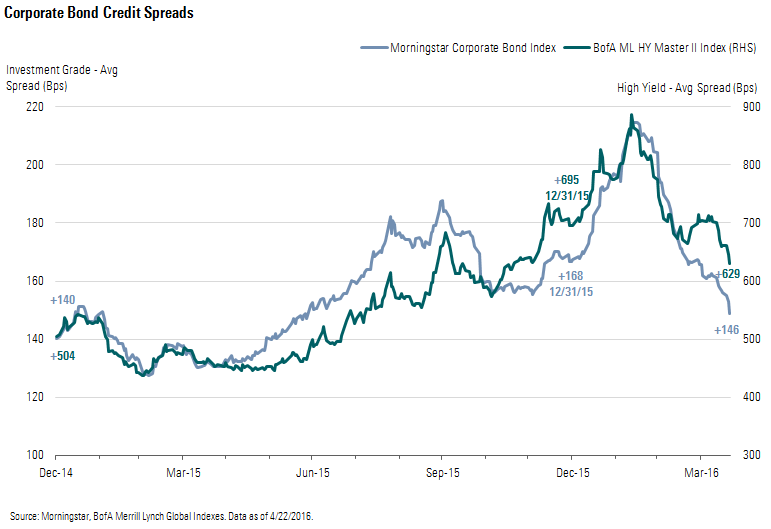
Investors have been willing to accept lower compensation for credit risk as economic indicators show that domestic economic growth remains positive, first-quarter earnings reports have not been as bad as feared, and oil prices steadily rise. While we expect the first-quarter real GDP report, which will be released Thursday, will indicate that the economy expanded at a sub-1% rate, economic indicators released last week show that the U.S. economy is still on track for better growth rates later this year. In fact, some indicators such as weekly jobless claims have fallen to multidecade lows. Oil prices have continued to rise (increasing more than $3 a barrel to $43.73 last week) even though oil producers were unable to come to any kind of agreement to freeze production levels at current rates. Many market prognosticators have posited that the rise in oil prices indicates a stronger global economic recovery. The near-term impact in the high-yield market has been to lower the probability of default of some producers and improve recovery values of those already in bankruptcy.
As oil prices have rebounded, the credit spread for the energy sector within the Morningstar Corporate Bond Index tightened another 10 basis points, reaching +203, its lowest level since July 2015. Year to date, investment-grade energy has been one of the best-performing sectors, having tightened 46 basis points while the overall index has tightened 22 basis points. In the high-yield market, the energy sector within the Bank of America Merrill Lynch High Yield Index has tightened 92 basis points to 1,064, its lowest reading since November 2015. Yet while index levels have rebounded, we remain concerned that oil prices could once again experience a sharp decline. In addition, at current oil price levels, the pain in the energy sector will continue to be felt over the next few quarters. For example, Schlumberger SLB (rating: A+, wide moat) reported that demand for oil field services continued to weaken in the first quarter, resulting in broad pricing pressure across all of its global operations. Geographically, North America experienced the most severe decline, centered on land-based activity and resulting in a negative domestic operating margin. Schlumberger expects its end markets to continue to deteriorate over the coming quarter. Extrapolating from management guidance for the second quarter, we estimate full-year revenue to be as much as 35% lower compared with last year and the gross margin to be about 400 basis points lower.
European Central Bank Releases Program Outline to Begin Purchasing Corporate Bonds The corporate bond market has also benefited from the European Central Bank's plan to expand its asset-purchase program to corporate bonds. The ECB released the outline of its plan to purchase nonbank, euro-denominated corporate bonds. The wide-ranging plan allows the central bank to purchase bonds with maturities ranging from 6 months to 30 years and includes nonbank bonds that have an investment-grade rating of BBB- or better. We previously opined that the immediate near-term impact of this announcement was to tighten corporate credit spreads in the European market. Unlike conventional buyers of corporate bonds, the ECB will not be price-sensitive. Its purchases are intended to implement an easy monetary policy, as opposed to conventional purchasers, which look to maximize return for a given risk. As such, the ECB's purchases are likely to distort the normal market discounting function and will artificially suppress credit spreads. We think the ECB's purchase of corporate bonds will have international implications as well. Many issuers have bonds outstanding in other currencies besides euros. For example, for issuers with both euro- and U.S. dollar-denominated bonds outstanding, as the euro bonds' credit spreads tighten, the credit spread on the dollar-denominated bonds will also tighten. Investors with the ability to purchase either denomination will swap euro bonds for dollar bonds if the dollar spreads are meaningfully wider.
Later this week, the Federal Open Market Committee will meet to discuss monetary policy. In our view, it is highly unlikely that the FOMC will make any changes to monetary policy at this meeting. However, it may make changes to its meeting statement that may indicate the committee is close to implementing an additional hike in the federal funds rate at the June meeting.
First-Quarter Earnings Reports a Mixed Bag: Weaker, but Not as Bad as Feared First-quarter earnings reports thus far have been a mixed bag. Generally, revenue growth has been constrained, and in many cases, corporations are reporting declines. However, earnings have held in better than expected as margins have increased or the impact from lower share counts has bolstered earnings per share. For example, the economically sensitive rail sector held up well. Norfolk Southern NSC (rating: BBB+, wide moat) reported strong first-quarter results, driven by an improvement in its operating ratio because of productivity initiatives, such as streamlining its operation regions and improving speed and dwell times to lower expenses. Canadian Pacific CP (rating: BBB+, wide moat) reported firm first-quarter earnings, highlighted by its lowest ever operating ratio. Union Pacific UNP (rating: A, wide moat) reported mixed first-quarter earnings as plummeting coal revenue and a fall in carloads hurt its operating ratio, but less than generally feared.
To the downside, results have been lower-than-expected in the technology sector. Alphabet GOOGL (rating: AA, wide moat) and Microsoft MSFT (rating: AAA, wide moat) disappointed investors, and their shares sold off. On the basis of factors both external (weak global operating environment) and internal (high leverage incurred from debt-financed share-buyback programs), we downgraded several tech companies last week. We downgraded our corporate credit rating on Intel INTC (rating: AA-, wide moat) by one notch to AA- with a stable outlook. Our action takes into consideration a gradual weakening of model pillars over the past year resulting from higher leverage and slower revenue growth. Our rating action also reflects our expectation for more challenging operating conditions as the company manages its ongoing transition away from personal computing. We lowered our rating on Applied Materials AMAT (rating: A+, wide moat) one notch to A+ with a stable outlook to reflect a modest weakening of the credit pillars in recent quarters on weak cash flows and increased leverage to fund shareholder returns. Lastly, we downgraded our credit rating on Maxim Integrated Products MXIM (rating: A, wide moat) one notch to A with a stable outlook to reflect a moderate weakening in Business Risk as well as a decline in the company's returns on invested capital. Over the past year, Maxim's revenue growth has slowed and margins have narrowed as a result of a cyclical slowdown in global technology spending.
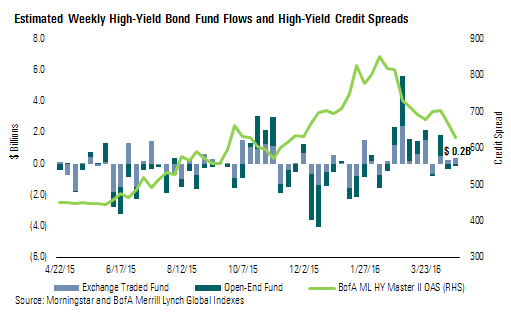
Fund flows into high-yield open-end mutual funds and exchange-traded funds bounced back after posting outflows the prior week, but at only $0.2 billion, they were not able to gain much momentum.

 United States