
Corporate Bond Relief Rally Continues as Wide Credit Spreads Attract Investors
Economic metrics bounce back; continued strength could prompt Fed to raise rates in March.

Financial markets continued to rise last week as investors hoped policymakers at the G-20 meeting would agree to a coordinated global economic and monetary stimulus plan that would bolster the currently anemic global economic growth rate. On a week-over-week basis, the average spread of the Morningstar Corporate Bond Index (our proxy for the investment-grade corporate bond market) tightened 6 basis points, decreasing to +205. The spread of the Bank of America Merrill Lynch High Yield Master II Index tightened 43 basis points to +780. In the equity market, the S&P 500 rose 1.6%, and in the commodity markets, oil rose almost $1 a barrel to $32.86. As investors rotated back into risk assets, Treasury bond yields rose slightly; the yield on 5-year and 10-year Treasury bonds rose 1 basis point and the 30-year bond yield rose 3 basis points.
While the recent two-week bounce has reduced some of the losses among corporate bonds since the end of last year, credit spreads remain significantly wider year to date. The credit spread of the Morningstar Corporate Bond Index is 37 basis points wider than on Dec. 31, 2015, and 65 basis points wider than at the end of 2014. In the high-yield asset class, the credit spread of the Bank of America Merrill Lynch High Yield Master II Index is 85 basis points wider than on Dec. 31, 2015, and 276 basis points wider than at the end of 2014.
Even though credit spreads have widened out in the investment-grade sector, declining interest rates have offset much of the widening. Year to date, the Morningstar Corporate Bond Index has returned 0.88%. However, declining interest rates have not been able to offset the significant amount of widening in the high-yield asset class. Year to date, the Bank of America Merrill Lynch High Yield Master II Index has lost 1.70%. Equities have lost even more as the S&P 500 has declined 4.69%.
Economic Metrics Bounce Back; Continued Strength Could Prompt Fed to Raise Rates in March Economic data showed that the malaise experienced at the end of the fourth quarter is behind us as activity picked up steam in January. In fact, on the basis of higher-than-expected readings on inflation, wage growth, home price appreciation, and durable goods orders, Robert Johnson, Morningstar's director of economic analysis, thinks any further improvement in the economic metrics in March could force the Federal Reserve's hand to raise interest rates at the March Federal Open Market Committee meeting.
The personal income report revealed a healthy gain in January. The month-over-month rate of change increased 0.5%, which on an annualized basis is more than a 6% growth rate. Consumer spending rose at a 0.5% monthly pace as well. With the increases in wages and spending, inflation has begun to pick up steam, even though oil prices are 30% lower than this time last year. In January, the PCE price index rose 1.3% on a year-over-year basis. Excluding the impact of energy and food price volatility, the core PCE price index rose an even higher 1.7%, which is not that far from the Fed's 2% inflation target. Unless oil prices fall further, over the course of the year as the impact from the decline in energy subsides, the headline inflation rate should converge upward toward the core rate.
The durable goods orders report bounced back from disappointing December results. In January, the monthly headline durable goods orders surged 4.9%. Even stripping out the volatile transportation sector, durable goods orders rose a healthy 1.8% and core durable goods orders increased 3.9%. On a year-over-year basis, durable goods orders continued to post a decline; however, we expect the report to turn positive over the next few months as the calendar laps strong results in early 2014 and 2015. Even the disappointing report for fourth-quarter GDP growth was revised up to a 1% growth rate. While not a stellar report in and of itself, the gain was a surprise to the Street consensus, which expected a downward revision.
With the Fed's preferred metric for core inflation running near its target and economic activity looking healthy, the deciding factor in whether the Fed raises the federal funds rate in March or holds steady until later in the year may come down to the payroll report this Friday. Currently, the Street consensus is an increase of 190,000 jobs; given the strong consumer and initial claims data, Johnson expects payrolls to increase between 200,000 and 210,000.
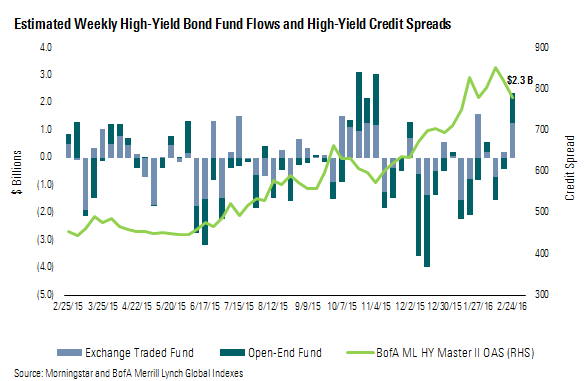
Investors Flock Back to High Yield As the markets continued their climb higher, investors came racing back into the high-yield asset class. Inflows into high-yield mutual funds and exchange-traded funds totaled $2.3 billion over the course of last week, one of the strongest weekly inflows in the past year. Considering that credit spreads are near levels more consistent with recessionary periods, if the economy continues to improve and oil prices remain stable or move higher, the snapback rally in high yield has further to go.

 United States