
Corporate Bond New Issue Market Roars Back to Life
Investors continue to dump high-yield exchange-traded funds.

The new issue market shifted into high gear last week as earnings season came to a close and issuers rushed to market to take advantage of investor demand for corporate bonds. The issuers we cover raised more than $40 billion in the new issue market last week, representing the fourth-highest weekly total over the past 52 weeks. Yet even after seeing such a large amount of proceeds, we expect that the new issue market will continue to run full steam ahead over the next few weeks. Numerous large acquisitions still need to be funded, and the combination of low interest rates and tight credit spreads is likely to tempt issuers to lock in cheap financing to conduct share-buyback programs.
While the corporate bond markets have rebounded sharply off their February lows, we had been concerned that the technical backdrop of the market had become tenuous over the past few weeks. While demand has been robust, we believed that if too much new issue supply were to be brought to market too quickly, the market could experience some indigestion. In the investment-grade market, the significant amount of new issue supply weighed on the market last week, and the average spread of the Morningstar Corporate Bond Index widened 3 basis points to an average spread of +151. While the weakness was across the board, the retail sector suffered greater-than-average widening. The average spread for retailers widened 8 basis points to +128 after several retailers reported weaker-than-expected same-store sales and lowered their expectations. New issuance was lighter in the high-yield market, which allowed the average credit spread in the Bank of America Merrill Lynch High Yield Index to tighten 7 basis points to +641.
The next major test for the corporate bond markets will be to see how they absorb Dell's $16 billion bond offering to help support its acquisition of EMC EMC (rating: A+/UR-, narrow moat). Dell's proposed notes are being marketed with a first lien on certain assets, as well as guarantees by domestic operating subsidiaries of both Dell and EMC, excluding VMware. If completed, the transaction would mark the second-largest investment-grade debt issuance this year and the only secured debt issuance in investment grade. This transaction is the second piece of Dell's complex $50 billion debt package to fund the acquisition. In February, Dell began marketing a $7 billion secured investment-grade term loan package consisting of equal tranches of 3- and 5-year term loan A's. It has been reported that these first-lien loans are being marketed at rates of Libor+200 and L+225, respectively. In our view, the transaction appears highly disadvantageous to existing EMC bondholders. Although EMC's notes contain a limitation on secured assets of 20% of consolidated net worth, we believe Dell will be able to skirt this restriction through a write-up of EMC's assets using purchase accounting, as well as through the limitation on liens clause being applicable only to secured debt against principal property, which EMC defines as real estate and data and manufacturing facilities.
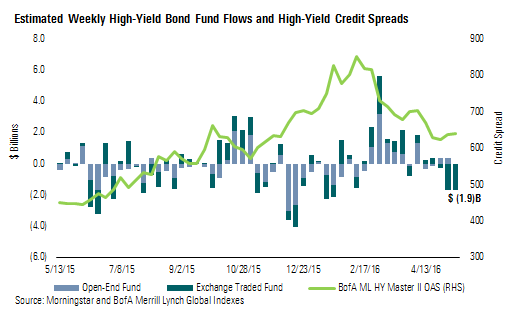
Investors Continue to Dump High-Yield Exchange-Traded Funds Fast-money accounts continued to dump high-yield exchange-traded funds as another $1.7 billion of proceeds were redeemed last week. In addition, open-end mutual funds experienced a withdrawal of $0.2 billion, resulting in a total outflow of $1.9 billion in the asset class for the second consecutive week.

 United States