
Corporate Bond Market Takes a Breather Before Earnings Season Turns to Full Throttle
Return of the megamergers.

From a trading point of view, last week was relatively uneventful. The average spread of the Morningstar Corporate Bond Index widened 1 basis point to +177 bps over Treasuries. After tightening an astounding 70 basis points the prior week, the Bank of America Merrill Lynch High Yield Master Index took a breather and widened a modest 5 basis points to end the week at +618. Investors were comforted by the stabilization and subsequent rebound in commodity prices and attracted to the wide credit spreads caused by the weakness over the past few months; however, they were unwilling to push credit spreads tighter in the face of third-quarter earnings reports, which begin in earnest this week. The bad-news-is-good-news meme prevailed in the equity market, as stocks rose about 1%, but the sentiment did not carry over into the corporate bond market. Weak economic metrics are being construed by some investors as weak enough to force central banks to keep the liquidity spigot open, but yet not so weak as to impair earnings growth. Since the September Federal Open Market Committee meeting, the market continues to price in a higher probability that the Fed won't begin to raise the federal funds rate until well into 2016. Considering that the FOMC does not have a press conference scheduled for the January meeting, if it does not raise rates in December then the next most likely action would not be until March. In addition, reports are becoming even more pervasive that both the European Central Bank and Bank of Japan are evaluating increases to their respective ongoing quantitative easing programs.
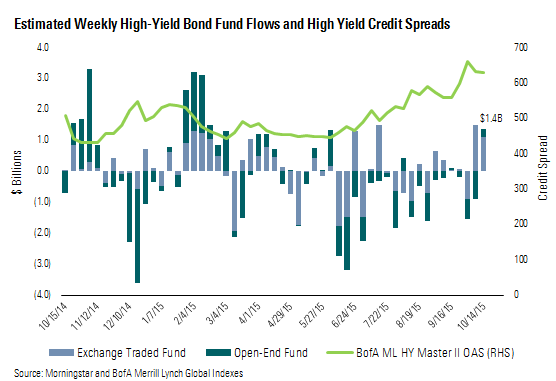
The wider credit spreads afforded by the high-yield market continued to attract investors as weekly high-yield fund flows again rose over $1 billion. After suffering outflows for much of the year, this is the first time since January that the asset class has registered two consecutive weeks of over $1 billion in inflows. Inflows into high-yield exchange-traded funds subsided slightly last week, but the slight reduction in ETF inflows was made up by open-end mutual funds, which saw their first weekly gain over the past month. Between ETFs and open-end mutual funds, the combined amount of inflows into the high-yield sector was $1.4 billion last week.
Return of the Megamergers Over the past couple of years, Anheuser-Busch InBev BUD (rating: A-/UR-, wide moat) was rumored to be evaluating a way to purchase global rival SABMiller SBMRY (rating: A/UR-, wide moat). The rumor finally came to fruition, and the boards of the respective companies have agreed in principle to an offer by AB InBev to acquire SABMiller with a transaction value of over $100 billion. AB InBev's management said it intends to fund the cash portion of the transaction with internally generated funds and debt, but also said it continues to believe that its optimal capital structure is 2 times net debt leverage. Similar to its past precedent, we expect AB InBev will increase debt leverage in the short term and then quickly repay debt in order to reduce its leverage within several years after the acquisition closes. Based on our preliminary pro forma estimates, we expect that debt leverage will climb to well over 4 times when the acquisition occurs. In that scenario, we would most likely downgrade the credit rating of both entities. Based on the significant amount of debt that AB InBev will need to raise in the bond market to fund this transaction, we think this technical overhang will limit appreciation of the bonds until that funding clears the market.
Not to be outdone, Dell announced that it will acquire EMC EMC (rating: A+/UR-, narrow moat) in a $67 billion takeover. We placed EMC's corporate credit rating under review with negative implications given the size and complexity of the deal, exacerbated by a dearth of disclosures regarding target capital structure, profitability, and long-term debt financing expectations. At present, the transaction appears highly disadvantageous to existing EMC bondholders. From limited disclosures, we estimate that initial pro forma debt leverage of the combined entities is likely to exceed 5 times based on our estimate of combined trailing 12-month EBITDA (fully consolidated, including VMware). At present, we assume that EMC's existing notes will remain outstanding and will be partially or even fully subordinated to the new secured debt. As a result, we may reduce our credit rating below investment grade. Dell management has indicated that it expects to "rapidly" deleverage the balance sheet in 18-24 months, though it declined to provide any specifics.
3Q Universal Bank Wrap-Up Earnings of the five large U.S. banks that reported last week were generally in line with the prior quarters of the year and largely devoid of material litigation or restructuring expenses, costs that have marred bank results during recent years. Other than Wells Fargo WFC (rating: A, wide moat), revenue trended downward as lower interest rates and muted loan growth negatively affected interest income. Noninterest income decreased modestly during the period as a result of lower principal transactions and other types of fee revenue. Bottom lines were aided by cost-cutting as operating expenses decreased year over year or were held to minimal increases. Annualized return on equity for the quarter ranged from 7.0% for Goldman Sachs GS (rating: BBB+, narrow moat) and Bank of America BAC (rating: BBB, narrow moat) to 13.0% for Wells Fargo, rates of return that were generally consistent with the prior quarter.
As we had expected, most of the banks reported higher provisions expense for loan losses, and two of them attributed the increase to building reserves for energy loans. We see this action as precautionary since the banks charged off similar or lower amounts of loans in the third quarter as they did in the second. Credit quality overall remained at the strong levels reached in the prior quarter and significantly better than year-earlier levels, as nonperforming loans continued to trend lower toward 1% of total loans—or lower, in the case of JPMorgan JPM (rating: A-, narrow moat).
Despite capital returns to shareholders, all members of the group built capital during the period. Citigroup C (rating: A-, narrow moat), our Best Idea in the banking sector, increased tangible common equity relative to tangible assets 20 bps sequentially (+66 bps year over year) to an impressive 10.1%. The global bank also reported the highest regulatory capital of the peer group with fully phased common equity Tier 1 capital of 11.6%, 20 bps higher sequentially and 100 bps higher year over year. We were also impressed by capital growth at JPMorgan Chase, which improved tangible capital by an amount similar to Citigroup but made larger strides in regulatory capital where its CET1 ratio increased 40 bps to 11.4% at quarter-end. This improvement as well as the bank's solid profits led us to maintain our overweight bond recommendation on the company's debt. However, Bank of America disclosed that its fully phased CET1 ratio could fall to a subpar 9.7% if it agrees to capital model changes sought by regulators. This outcome could place B of A in a position to issue over $70 billion of holding company debt under emerging total loss-absorbing capacity regulation, a factor the influences our underweight bond recommendation.

 United States