
Corporate Bond Market: Summer Starts to Slip Into Fall
Corporate Bond Market: Summer Starts to Slip Into Fall

Corporate Bond Market: Summer Starts to Slip Into Fall
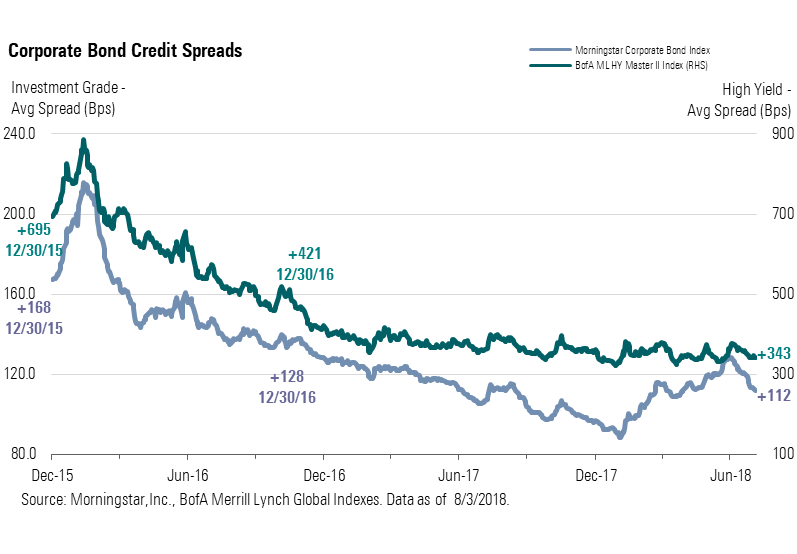
Activity in the corporate bond market has begun its typical seasonal summer slowdown as market participants gear up to take their remaining summer vacations before school resumes. Even though second-quarter earnings reports continue to be strong and the S&P 500 rose by 0.75% last week, corporate credit spreads ended the week relatively unchanged. The average spread of the Morningstar Corporate Bond Index (our proxy for the investment-grade market) tightened one basis point to +112. In the high yield market, the BankAmerica Merrill Lynch High Yield Master Index widened one basis point to end last week at +343. Similarly, in the U.S. Treasury bond market, volatility was muted. The 2-year and 5-year Treasury bonds tightened 3 basis points each to end the week at 2.64% and 2.81%, respectively, whereas the 10-year was unchanged at 2.95% and the 30-year rose only one basis point to 3.09%.
In the new issue corporate bond market, according to Bloomberg, the amount of new issuance slipped to $7.8 billion last week as compared with its forecast of $20 billion. While activity was muted, those companies that came to market found a receptive investor base and those new issues were heavily oversubscribed. That allowed those companies to tighten price talk and issue their new bonds on top of the levels where their existing bonds were trading as opposed to typically having to issue new bonds at a concession. The new issue market is expected to remain subdued over the next few weeks as the corporate bond market typically slows down during August.
- source: Morningstar Analysts
As we have highlighted in our credit notes over the past few weeks (available at
), second-quarter earnings reports have continued to be robust. Companies in economically sensitive sectors showed the greatest top-line increase, often well into double-digit percentage gains on a year-over-year basis. For example,
Similar to the energy sector, the basic materials sector is highly correlated to economic activity and experienced strong growth.
However, while an expanding economy lifted all boats in the cyclical sectors, there have been companies that experienced idiosyncratic issues last quarter. To the downside,
Morningstar Credit Ratings issues credit ratings on over 250 corporate and financial institutions. For detailed analysis and research, please see our credit notes published under the Research tab at: www.morningstarcreditratings.com.
Weekly High Yield Fund Flows
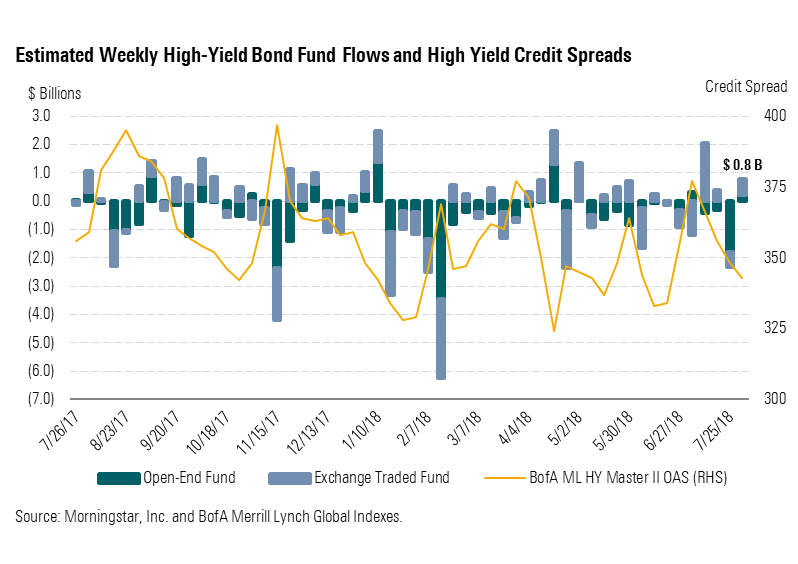
Investors returned to the high yield market as high yield fund inflows reached $0.8 billion, consisting of $0.6 billion of net unit creation among the high yield exchange traded funds and inflows of $0.2 billion into high yield open end mutual funds. Year to date, fund flows have registered a total outflow of $15.9 billion, consisting of $3.9 billion of net unit redemptions across the ETFs and $12.1 billion of redemptions among the open-end funds.
- source: Morningstar Analysts
Morningstar Credit Ratings, LLC is a credit rating agency registered with the Securities and Exchange Commission as a nationally recognized statistical rating organization ("NRSRO"). Under its NRSRO registration, Morningstar Credit Ratings issues credit ratings on financial institutions (e.g., banks), corporate issuers and asset-backed securities. While Morningstar Credit Ratings issues credit ratings on insurance companies, those ratings are not issued under its NRSRO registration. All Morningstar credit ratings and related analysis contained herein are solely statements of opinion and not statements of fact or recommendations to purchase, hold, or sell any securities or make any other investment decisions. Morningstar credit ratings and related analysis should not be considered without an understanding and review of our methodologies, disclaimers, disclosures and other important information found at www.morningstarcreditratings.com.

 United States