
Corporate Bond Market Steadies After Italian Political Turmoil Subsides
Global asset markets had a wild ride at the beginning of last week as political turmoil roiled Italy's sovereign bond market.

Global asset markets had a wild ride at the beginning of last week as political turmoil roiled Italy's sovereign bond market. After Italy's president rejected the formation of a new government by the recently elected prime minister, the country's sovereign bonds plummeted, sending their yields soaring. At the short end of the curve, the yield on the Italian 2-year bond surged from 0.25% to peak at 2.50% midweek. Along the longer end of the curve, the interest rate on the 10-year bond rose from 2.40% to 3.10%. This represented the greatest weekly volatility since the onset of the European debt crisis in 2011. As Italian bonds sank, many investors across the globe had flashbacks to the 2011-12 European sovereign debt and banking crisis, which led them to sell risky assets first and ask questions later.
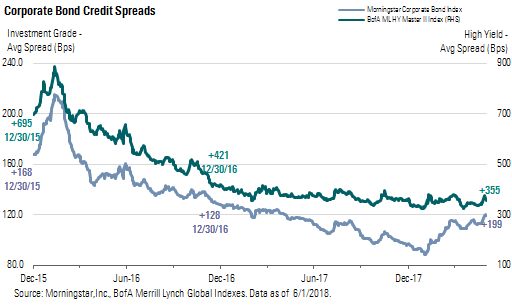
Contagion from the selling wave spread to the U.S. asset markets, where credit spreads on investment-grade corporate bonds widened as much as 5 basis points, high-yield spreads widened as much as 22 basis points, and the S&P 500 fell as much as 1.15%. However, by the latter half of the week, markets began to calm as the Italian prime minister was able to form a government that was approved by the president. As the political turmoil dwindled, asset markets quickly ramped up and regained much of the lost ground. In the United States, strong economic indicators fueled a strong rally Friday, and most assets in the U.S. ended the week near where they started. The average credit spread of the Morningstar Corporate Bond Index ended the week at +199, 4 basis points wider from the prior week. In the high-yield market, the average spread of the BofA Merrill Lynch High Yield Master Index ended the week at +355, only 2 basis points wider. In the equity market, the S&P 500 ended the week unchanged.
In addition to trying to predict the impact of Italian politics, investors had to contend with plummeting oil prices. Oil prices had steadily risen over the past year after Saudi Arabia hinted to the markets that it was targeting $80 per barrel. After reaching $72.50 per barrel May 21, oil declined about 9% to $67.70 last Friday. The pullback was instigated by trial balloons floated across the news media earlier in the week by OPEC and Russia, reporting that those oil producers were considering easing output restrictions and allowing increases in production.
Interest rates have marched higher over the past year, hitting their highest levels since the 2008-09 credit crisis in mid-May, but quickly pulled back as investors bid up U.S. Treasury bonds in a flight to safety, away from the turmoil driven by the Italian political chaos. On the shorter end of the curve, the yield on the 2-year Treasury bond declined 1 basis point to 2.47% and the yield on the 5-year Treasury bond fell 2 basis points to 2.75%. Yields on the longer end of the curve declined slightly as the yield on the 10-year Treasury dropped 3 basis points to 2.90% and the 30-year fell 4 basis points to 3.05%. Although interest rates have come down from mid-May, they remain much higher than where they began the year. Since the end of last year, the 2-year, 5-year, 10-year, and 30-year bonds have risen 59, 54, 49, and 31 basis points, respectively.
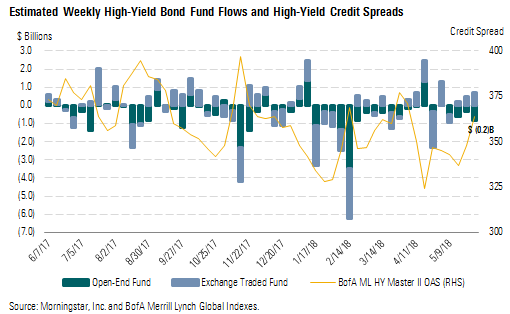
Weekly High-Yield Fund Flows While retail investors in the high-yield asset class headed for the exit, institutional investors flooded through the front door last week. Fund flows in the high-yield sector experienced a net outflow of $0.2 billion last week; however, the net outflow concealed the divergence between retail and institutional activity. Historically, open-end mutual funds have been viewed as a proxy for retail investors, while exchange-traded funds are considered a proxy for institutional investors. Last week, there was an outflow of $0.9 billion across high-yield open-end mutual funds. Among ETFs, there was net unit creation of $0.2 billion. Year to date through May 30, there has been a total of $12.6 billion of outflows across the high-yield sector. Net fund flows have consisted of $9.4 billion of outflows among open-end high-yield mutual funds but only $3.2 billion of net unit redemptions among high-yield ETFs.
Morningstar Credit Ratings, LLC is a credit rating agency registered with the Securities and Exchange Commission as a nationally recognized statistical rating organization ("NRSRO"). Under its NRSRO registration, Morningstar Credit Ratings issues credit ratings on financial institutions (e.g., banks), corporate issuers, and asset-backed securities. While Morningstar Credit Ratings issues credit ratings on insurance companies, those ratings are not issued under its NRSRO registration. All Morningstar credit ratings and related analysis contained herein are solely statements of opinion and not statements of fact or recommendations to purchase, hold, or sell any securities or make any other investment decisions. Morningstar credit ratings and related analysis should not be considered without an understanding and review of our methodologies, disclaimers, disclosures, and other important information found at https://ratingagency.morningstar.com.

 United States