
Corporate Bond Credit Spreads Continue to Widen
High-yield fund flows seesaw between inflows and outflows.

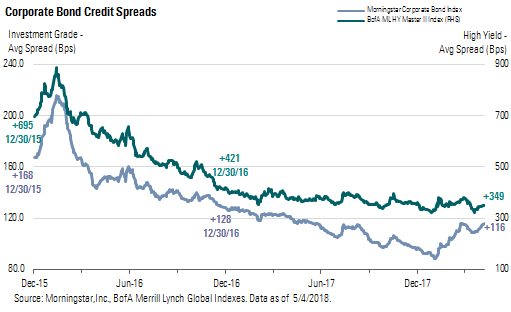
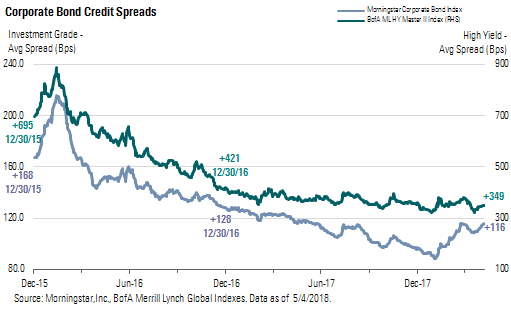
Credit spreads in the corporate bond market continued to widen last week. The average spread of the Morningstar Corporate Bond Index widened 4 basis points to +116, the widest spread it has registered this year and even with where it traded last summer. The average spread of the BofA Merrill Lynch High Yield Master Index widened 5 basis points to +349; however, while the average credit spread of the investment-grade index is back to its highs for the year, the widening in the high-yield sector has only returned to the average level that the index has registered this year. The S&P 500 rallied Friday following the employment report, but the gains only brought the equity market back to where it began the week.
There was very little movement in the Treasury bond market last week. Along the shorter end of the yield curve, the yield on the 2-year Treasury bond rose 2 basis points to 2.50%. In the belly of the yield curve, interest rates contracted slightly as the yield on the 5-year Treasury bond declined 2 basis points to 2.78% and the yield on the 10-year fell 1 basis point to 2.95%. At the longest end of the curve, the yield on the 30-year bond was unchanged at 3.12%.
Two weeks ago, we noted that activity in the corporate bond market felt more like the summer doldrums than a typical late April or early May, when volatility is often elevated by first-quarter earnings releases and prodigious amounts of new issue supply. This year, first-quarter earnings reports have generally been uneventful from a credit point of view, and new issue supply has been moderate and has lacked the megadeals of years past. While there have been several hits and misses among individual issuer earnings reports, none of these have affected our overall view of the trend for corporate credit quality. The technical underpinnings of the corporate bond markets have held steady as supply and demand in the investment-grade bond market remain balanced.
As expected, following the May meeting of the Federal Open Market Committee, the Federal Reserve held the federal-funds rate at 1.50%-1.75% and made only modest changes to its meeting statement. The Fed noted that while household spending has moderated, fixed investment has continued its strong growth. In addition, the Fed noted that inflation has moved toward its 2% target. As an indication of the current economic strength, the Atlanta Fed's GDPNow model forecast for second-quarter real GDP growth is 4.0%, which would be a strong acceleration from the 2.3% rate in the first quarter and the strongest quarterly growth rate since the third quarter of 2014.
The next FOMC meeting is scheduled for June 12-13. Following the meeting, the Fed is scheduled to release its next Summary of Economic Projections and conduct a press conference. According to the CME FedWatch Tool, the market is pricing in a rate hike with near certainty following this meeting. The market-implied probability of a 25-basis-point hike in June is 98%, and the probability of a 50-basis-point hike is 2%. The market-derived probabilities for additional rate hikes through the rest of the year have declined slightly but remain exceptionally high. The probability that the federal-funds rate will end the year at 200 basis points or higher slipped to 88% from 90%, and the probability that the federal-funds rate will end the year at 225 basis points or higher declined to 43% from 47%.
High-Yield Fund Flows Seesaw Between Inflows and Outflows After fleeing the high-yield market the prior week, institutional investors reversed course and drove $1.3 billion of new unit creation in high-yield exchange-traded funds. However, retail investors remained on the sidelines as fund flows were essentially unchanged among the open-end high-yield mutual funds. Historically, ETFs are considered a proxy for institutional investor demand, whereas open-end funds are considered a proxy for individual investors. Year to date through May 2, there has been a total of $11.3 billion of outflows across the high-yield sector, consisting of $7.1 billion of outflows among the open-end high-yield mutual funds and $4.2 billion of net unit redemptions among the high-yield ETFs.
Morningstar Credit Ratings, LLC is a credit rating agency registered with the Securities and Exchange Commission as a nationally recognized statistical rating organization ("NRSRO"). Under its NRSRO registration, Morningstar Credit Ratings issues credit ratings on financial institutions (e.g., banks), corporate issuers, and asset-backed securities. While Morningstar Credit Ratings issues credit ratings on insurance companies, those ratings are not issued under its NRSRO registration. All Morningstar credit ratings and related analysis contained herein are solely statements of opinion and not statements of fact or recommendations to purchase, hold, or sell any securities or make any other investment decisions. Morningstar credit ratings and related analysis should not be considered without an understanding and review of our methodologies, disclaimers, disclosures, and other important information found at https://ratingagency.morningstar.com.

 United States