
Central Bankers Telegraph Monetary Policy Changes
Commodity prices continued to sink across the board the last week.

Central bankers were out in force last week giving speeches and interviews in order to telegraph their next moves to the markets. While it appears increasingly likely that the U.S. Federal Reserve will lift rates in December, officials have gone out of their way to let the markets know that the rate of further future increases will be exceedingly slow. For now, it appears the most likely outcome will be "one and done" for the near term. Fed Vice Chairman Stanley Fischer telegraphed a rate rise during a speech to the Federal Reserve Bank of San Francisco by saying, "In the relatively near future, probably some major central banks will begin gradually moving away from near-zero interest rates." While he said no decision has been made yet, he did say the Fed has "done everything we can to avoid surprising the markets and governments when we move, to the extent that several emerging-market (and other) central bankers have, for some time, been telling the Fed to 'just do it.' "
European Central Bank President Mario Draghi gave a speech in Frankfurt during which he bolstered the case for expanding easy monetary policy in the eurozone. He said that he thought the ongoing easy monetary policy was the dominant force spurring economic growth, but noted, "Downside risks to our baseline scenario for the euro area economy have increased in recent months" and "The strength of the underlying recovery is modest....The present upswing which started in 2013 is the weakest euro area rebound since 1998." Summing up the current situation, he said, "The recovery remains very protracted," and concluded, "If we decide that the current trajectory of our policy is not sufficient to achieve that objective [2% inflation target], we will do what we must to raise inflation as quickly as possible." The combination of these statements appears to advocate the expansion of the ongoing asset-purchase program and even lower (or more negative, as the case may be) interest rates at the ECB's next monetary policy meeting Dec. 3.
With the expectation that the ECB will monetize even more sovereign debt, investors bid up the price on German sovereign bonds. Currently, the price is so high on Germany's 2- and 5-year bonds that the resulting yields are negative 0.38% and negative 0.16%. The yield on Germany's 10-year bond remains positive, but will result in only a 0.48% return. Comparatively, the yield on the 10-year U.S. Treasury bond is 2.26%. As a result of such low interest rates in Europe relative to the United States, the average yield of Morningstar's Corporate Eurobond Index is only 1.09% compared with 3.41% for the US Corporate Bond Index.
Over the past few months, we have highlighted the ongoing deterioration in the commodity markets because of lower global demand, rising supply, and the strengthening of the U.S. dollar. Commodity prices continued to sink across the board last week with some hard commodities hitting new multiyear lows. For example, nickel fell to $8,735 per metric ton, its lowest price in over 12 years. Nickel prices reflect the rapid decline in demand for stainless steel, as more than 70% of nickel consumption is used to produce stainless steel. After hitting its lowest price since mid-2009 earlier this month, copper sank a further 5% last week, dropping to $2.06 per pound. Because of copper's use across many different facets of the economy, its price is considered to be highly correlated to economic activity and consequently the metal has earned the moniker Dr. Copper, as it is reputed to have a Ph.D. in economics. Oil prices briefly dipped below $40 per barrel. Oil fell below $40 earlier this year, but otherwise, at its current price it too is at its lowest level since mid-2009. Thus far through the commodity downturn, commodity producers have failed to make any meaningful reduction in production, and unless global demand quickly rises in the near term, defaults in the commodity-oriented sectors will surge next year. With the price of commodities falling, the credit spreads in the metals and mining and energy sectors weakened. In the high-yield market, the credit spread in the metals and mining index widened 23 basis points to +1,365 and the spread in the energy sector widened 49 basis points to +1,104. As a comparison, the widest levels hit by these sectors earlier this year were +1,377 and +1,137, respectively.
The U.S. dollar has been strengthening versus other global currencies for the past two years, helping to drive lower the price of those commodities priced in dollars. This strengthening has been driven by the divergence of central bank monetary policy. Year to date, the U.S. dollar has appreciated over 12% against the euro and 3% against the yen. Since the Fed began to taper its asset purchases in late 2013, the U.S. dollar has appreciated over 21% against the euro and 23% against the yen.
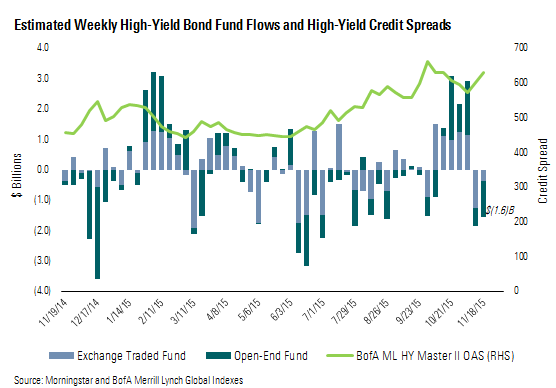
Throughout the year, we have noted that the strong demand for U.S. dollar-denominated investment-grade corporate bonds has been driven by several different sources, including foreign investors. Foreign investors are attracted by the higher yield that U.S. fixed-income securities provide, the steadily appreciating value of the U.S. dollar versus other currencies, and better supply dynamics. In addition, the ECB's purchase of sovereign debt has reduced the amount of euro-denominated bonds available for sale. Last week, we saw this demand play out in the divergence between credit spreads in the investment-grade market compared with the high-yield market. Even though lower commodity prices pushed credit spreads wider in the energy and metals and mining sectors, the average spread of the Morningstar Corporate Bond Index tightened 2 basis points to +156 bps over Treasuries, whereas the Bank of America Merrill Lynch High Yield Master Index widened 8 basis points to end the week at +632 bps. While trading desks reported that investment-grade buyers still had cash to put to work, high-yield mutual funds and exchange-traded funds continued to lose assets as outflows registered a $1.6 billion withdrawal.

 United States