
Buyers Are Back: Robust Earnings and Strong GDP Send Credit Spreads Tighter
GDP growth is likely to keep the Fed on track to raise rates.

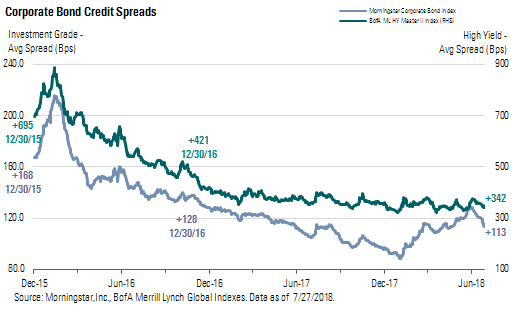
Between strong earnings and a resoundingly healthy GDP report, corporate credit spreads continued to tighten last week. The average spread of the Morningstar Corporate Bond Index (our proxy for the investment-grade market) tightened 7 basis points to +113. In the high-yield market, the BofA Merrill Lynch High Yield Master Index tightened 13 basis points to end last week at +342.
Other than a few high-profile misses in the technology sector, second-quarter results were robust, which has supported a general improvement in sentiment across the corporate bond markets. In the energy sector, rebounding oil prices lifted all boats. For example, National Oilwell Varco (BBB+, stable) reported second-quarter revenue of $2.1 billion, a $347 million (20%) increase over the $1.8 billion reported in the year-ago quarter. In the healthcare sector in the second quarter, AbbVie (BBB+, stable) reported adjusted top-line growth of 17.1%, Celgene's (A-, stable) total revenue jumped 16.6% year over year, Bristol-Myers Squibb (AA-, stable) announced an 11% increase in revenue, Biogen (A, stable) reported a 9.1% increase in revenue, and Merck (AA, stable) posted total revenue growth of 5%.
Among the real estate investment trusts we rate, Liberty Property Trust (BBB, stable) reported strong operating performance for the second quarter, which, combined with first-quarter performance and the robust fundamental environment for the industrial sector, suggests to us that the REIT will drive full-year results to the high end of its guidance range for operations. Equity Residential (A-, stable) reported second-quarter funds from operations growth of 5.2% against the same period in 2017; key sources of improvement were same-store net operating income and lease-up of properties, with a minor offset from higher interest expenses. The second quarter is peak leasing season for the REIT, so the strong results are relatively important, and we expect them to help drive full-year results toward the high end of guidance.
While earnings have been robust, some idiosyncratic catalysts could hurt credit quality. For example, Eli Lilly (AA, stable) announced that it is going to spin out its Elanco division, beginning with an initial public offering at the end of this year and disposing of its remaining interest in 2019. Management said debt leverage may increase following the IPO, as it does not expect to reduce debt to offset the loss of EBITDA derived from Elanco. Elsewhere in the healthcare sector, GlaxoSmithKline (A, stable) announced good second-quarter operating results with revenue rising 4%, which drove a 7% increase in adjusted operating profit; however, debt leverage jumped as the firm issued a significant amount of debt to fund the acquisition of its consumer product joint venture with Novartis. While 3M (AA-, negative) reported good second-quarter results driven by 5.6% organic revenue growth, it continues to execute on its plan to return substantially all of its cash to shareholders and incur incremental debt to do so, which explains our negative outlook; the company pushed up leverage during the quarter to nearly 2.0 times based on our estimate.
For detailed analysis, please see our credit notes published under the Research tab at www.morningstarcreditratings.com.
Exceptionally Strong GDP Growth Likely to Keep Fed on Track to Raise Rates As measured by gross domestic product, the U.S. economy expanded at a 4.1% annualized rate during the second quarter. This is the fourth-greatest quarterly increase of the past five years and the sixth-greatest increase since the beginning of 2010. The market is not expecting the Federal Reserve to boost the federal-funds rate following the Federal Open Market Committee meeting this week, but with the economy expanding at a robust rate, unemployment at multidecade lows, and inflation running at the Fed's targeted rate, the futures market is pricing in a 93% probability of a rate hike in September, according to the CME FedWatch Tool. The futures market is also pricing in a 68% probability that the fed-funds rate will end the year at 2.25% or higher.
While the Fed has been tightening monetary policy over the past few years, the European Central Bank is still at least six months away from wrapping up its quantitative easing program. At its meeting last week, the ECB held its main short-term rates steady at 0.00%, 0.25%, and negative 0.40% for the main refinancing operations, marginal lending facility, and deposit facility, respectively, and expects to hold these rates until summer 2019. The ECB will continue its purchases of debt securities at a rate of EUR 30 billion per month until the end of September, when it expects to reduce the pact to EUR 15 billion per month until the end of December. At that point, the purchases will end, except for the reinvestment of principal payments from maturing securities, which will continue.
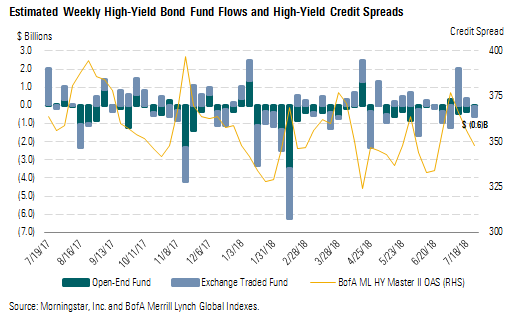
Weekly High-Yield Fund Flows High-yield fund flows contracted $0.6 billion last week, consisting of $0.5 billion of net unit redemptions across exchange-traded funds and $0.1 billion of redemptions in open-end funds. Year to date, fund flows have registered a total outflow of $15.0 billion, consisting of $4.4 billion of net unit redemptions across ETFs and $10.5 billion of redemptions among open-end funds.
Morningstar Credit Ratings, LLC is a credit rating agency registered with the Securities and Exchange Commission as a nationally recognized statistical rating organization ("NRSRO"). Under its NRSRO registration, Morningstar Credit Ratings issues credit ratings on financial institutions (e.g., banks), corporate issuers, and asset-backed securities. While Morningstar Credit Ratings issues credit ratings on insurance companies, those ratings are not issued under its NRSRO registration. All Morningstar credit ratings and related analysis contained herein are solely statements of opinion and not statements of fact or recommendations to purchase, hold, or sell any securities or make any other investment decisions. Morningstar credit ratings and related analysis should not be considered without an understanding and review of our methodologies, disclaimers, disclosures, and other important information found at https://ratingagency.morningstar.com.

 United States