
The Bounce Everyone Was Waiting For
Economic strength could prompt Fed to raise rates.

The corporate bond market had been recuperating for the past few weeks, but last week was the bounce that everyone was waiting for. In the investment-grade market, the average spread of the Morningstar Corporate Bond Index tightened 15 basis points to +190, and in the high-yield market the Bank of America Merrill Lynch High Yield Master II Index tightened 72 basis points to +708. The equity market was not to be left out of this rally; the S&P 500 rose 2.7%. Oil also continued to move higher and rose about $3.50 a barrel to $36.32. While investors clamored for the extra yield in the corporate bond markets, they dumped U.S. Treasury bonds en masse. The yield on the 5-year Treasury surged 15 basis points higher to 1.38%, the 10-year Treasury rose 12 basis points to 1.88%, and the 30-year increased 6 basis points to 2.70%.
The rally was more than enough to offset losses incurred among fixed-income indexes earlier this year. Year to date, the Morningstar Corporate Bond Index has risen 1.05% and the Bank of America Merrill Lynch High Yield Master II Index has increased 1.35%. Among other fixed-income indexes, the Morningstar Core Bond Index (our broadest measure of the bond market) has risen 1.79%. The greatest gains thus far this year have been generated in the long end of the curve as represented by the Morningstar Long Term Core Bond Index, which has risen 3.25% just within the past two months. Also performing well this year is the Morningstar TIPS Index, which has risen 2.48% as investors have once become concerned that inflation could pick up as soon as the second half of this year. However, not all asset classes have recouped their year-to-date losses. Although the S&P 500 bounced higher last week, it remains down 2.15% for the year.
Economic Strength Could Prompt Fed to Raise Rates Friday's payroll report surprised everyone to the upside. Nonfarm payrolls rose by 242,000, easily surpassing the Street consensus of a 190,000 increase and even exceeding Morningstar director of economic analysis Robert Johnson's above-consensus estimate of 200,000-210,000. In addition, the Bureau of Labor Statistics revised the prior employment reports higher by 30,000. The unemployment rate held steady at 4.9% as the gain in new jobs was offset by a two-tenths increase in the labor participation rate to 62.9% as the rebounding economy attracted new entrants to seek employment. Partially offsetting some of the good news, average hourly earnings dipped 0.1% and the average workweek declined 0.2 hour; however, the pullback in both of these metrics is mainly an offset to stronger hourly earnings and workweek experienced over the prior few months.
Between the strong employment report, low unemployment rate, and rising rate in the core personal consumption expenditures index (the Federal Reserve's preferred metric for measuring inflation) toward the Fed's target level, it is difficult to see how the Fed would rationalize holding off on raising the federal funds rate at the March meeting. Economic data has showed that the economic malaise experienced at the end of the fourth quarter is behind us, as activity picked up steam in January and continued in February. For example, February auto sales held at a 17.5 million-unit selling rate, personal income and consumer spending picked up to a 0.5% pace in January, and core durable goods orders rose 3.9%. With the increases in wages and spending, inflation has begun to pick up steam, even though oil prices are 30% lower than this time last year. In January, the core PCE price index rose 1.7%--not that far from the Fed's 2% inflation target. Unless the rising trend in oil prices reverses, once the impact from the decline in energy subsides over the remainder of the year, the headline inflation rate should converge upward toward the core rate.
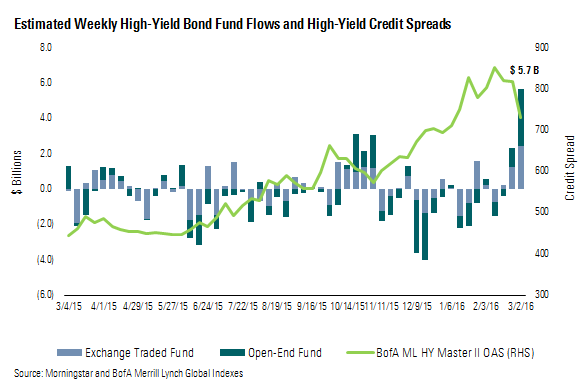
Weekly High-Yield Inflows Post New Record Last week, more than $5.7 billion of inflows surged into high-yield exchange-traded funds and open-end mutual funds. According to our data going back to June 2009, this represents the single-greatest weekly inflow into high yield. The second-greatest weekly inflow was $4.3 billion, which occurred in October 2011, shortly after the Fed launched Operation Twist and the equity markets were on their way higher.
Two weeks ago, we highlighted that investors flocked back into the high-yield asset class as over $2.3 billion of funds flowed into high-yield ETFs and open-end mutual funds. We wrote that considering credit spreads were near levels more consistent with recessionary periods, if the economy continued to improve and oil prices remained stable or moved higher, the snapback rally in high yield had further to go. Little did we realize how much that statement underestimated the situation.

 United States