
Bond Strategist Oct. 17, 2016: Market Data and Insights
Market Data and Insights

Interest rates continued to rise last week as the yield on the 5-year Treasury rose 3 basis points to 1.29%, the yield on the 10-year rose 8 basis points to 1.80%, and 30-year rose 11 basis points to 2.56%, respectively. After hitting their recent lows in early July, long-term interest rates have generally been on an upward trend. The impetus for rising yields has been a combination of the European Central Bank holding its monetary policy unchanged (as opposed to loosening it further as expected by the market), as well as mounting expectations that the U.S. Federal Reserve may resume increasing the federal funds rate in the near term. Currently, the market implied probability that the Fed will lift the federal-funds rate at the December FOMC meeting has risen to 69%, up from a 50% probability at the beginning of September.
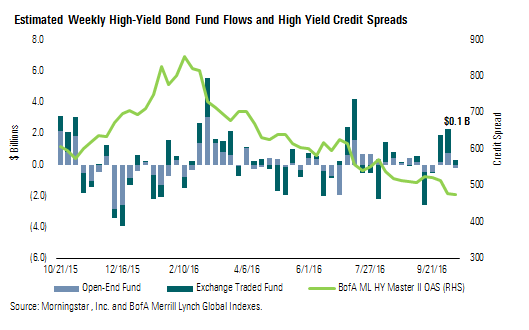
In the corporate bond markets, the average credit spread for both investment-grade and high-yield bonds have rallied significantly since they peaked in early February. The rally has occurred in conjunction with the recovery in the energy and commodity markets. More recently, however, this trend appears to be losing steam. In the investment-grade markets, on average credit spreads only tightened about one basis point last week, and in the high-yield markets, credit spreads only tightened four basis points.
The market's appetite for taking on additional corporate credit risk may soon be tested as corporations begin to release their third-quarter earnings reports. Currently, both investment-grade and high-yield bonds are trading at levels that are significantly tighter than their long-term averages; however, economic indicators for the third quarter have been generally weaker than many economists had originally forecast and many projections for third-quarter GDP growth have been reduced. For example, the Federal Reserve of Atlanta's GDPNow forecast was lowered last Friday to 1.9%. The original forecast made at the beginning of August was 3.6% as the forecast has steadily declined over the course of this quarter. In addition, according to a report published by Factset, the estimated third-quarter earnings for the S&P500 is forecast to decline by 2.3%. If this comes to fruition, that would mark six consecutive quarters of year-over-year earnings declines. Factset further reported that would be the longest running consecutive decline in earnings since it began tracking the data in the third quarter of 2008.
In addition, the market's appetite for corporate bonds may further be tested by a surge in new corporate bond issuance. The pace of new issuance has slowed dramatically over the past few weeks as issuers have entered their quiet periods prior to releasing third-quarter earnings. However, we expect the pace will accelerate over the next few weeks after earnings reports as corporations look to capitalize on interest rates that still remain near the lowest in history, credit spreads remain tighter than the historical average, and CFOs may look to lock up funding before any heightened uncertainty driven by the upcoming U.S. presidential election. In addition, there remains several large acquisitions that will require a substantial amount of funding in the debt capital markets. For a list of those issuers that we believe may look to tap the debt capital markets in the near term, please refer to our publication, “Potential New Issue Supply,” dated Sept. 22, 2016.
After two consecutive weeks of significant inflows, high-yield fund inflows barely remained positive last week. The amount of fund inflows into high-yield ETFs were only marginally able to overcome the outflows in high-yield open end mutual funds. Without any meaningful demand driven by inflows and with third-quarter earnings season beginning, corporate credit spreads in the high-yield sector ended relatively flat on a weekly basis, only having tightened a few basis points last week. It appears that the market is taking a wait and see attitude to hear from management teams as to the outlook for the fourth quarter before making any investment decisions prior to either committing additional funds or withdrawing funds from this asset class.
Morningstar Credit Ratings, LLC is a credit rating agency registered with the Securities and Exchange Commission as a nationally recognized statistical rating organizations ("NRSRO"). Under its NRSRO registration, Morningstar Credit Ratings issues credit ratings on financial institutions (e.g., banks), corporate issuers and asset-backed securities. While Morningstar Credit Ratings issues credit ratings on insurance companies, those ratings are not issued under its NRSRO registration. All Morningstar credit ratings and related analysis contained herein are solely statements of opinion and not statements of fact or recommendations to purchase, hold, or sell any securities or make any other investment decisions. Morningstar credit ratings and related analysis should not be considered without an understanding and review of our methodologies, disclaimers, disclosures and other important information found at https://ratingagency.morningstar.com.

 United States