
Bond Ladder ETFs Can Help Investors Climb a Steepening Yield Curve
Putting money in ETFs with staggered maturities can preserve and even grow wealth in a higher-interest-rate environment.


The most awaited change in the bond market’s favorite indicator is finally here: the Treasury yield curve has steepened owing to a drop in short-term yields and an increase in intermediate- and long-term yields. Here, we’ll explain what the change in that indicator means and how investors with a do-it-yourself preference can take advantage through a bond ladder of exchange-traded funds.
What Is the Yield Curve?
The Treasury yield curve represents the US government’s cost of borrowing money on a particular date for different periods, or terms, ranging from one month to 30 years. The line connecting the cost of borrowing for each term is typically curved and upward-sloping, meaning that investors require more yield to loan money to the US government for longer terms than shorter ones. The curve is steep to the extent that borrowing costs at longer maturities exceed those of shorter maturities, with many market participants focusing on the difference between the yields of 10- and two-year Treasuries as a gauge of the curve’s “steepness.”
A comparison of the cost of borrowing between mid-2023 and early 2025 (Feb. 28, 2025) shows the steepening effect. Short-term yields fell, while intermediate and longer-term yields rose. On June 30, 2023, the 10-year Treasury’s 3.81% yield, for example, was 106 basis points less than the two-year Treasury’s 4.87%, meaning the typically upward slope of the yield curve was inverted. While this period of inversion lasted more than two years, it has since reversed: On Feb. 28, 2025, the 10-year Treasury’s 4.24% yield was 25 basis points higher than the two-year Treasury’s yield.
Exhibit 1: Treasury Yield Curve Comparison

Locking in Attractive Yields
With Treasuries now yielding around 4% across all maturities and with the yield curve sloping upward again for intermediate- and long-term maturities, yields are high enough that investors may want to consider bonds for their income if not their total return potential. Assuming inflation does not surge, a bond ladder can help them do just that while preserving and even growing wealth amid higher rates. In a market with a typically steep yield curve, where short-term rates are lower than long-term rates, a laddered portfolio is especially attractive to lock in those higher rates. And it is easy to implement through defined-maturity exchange-traded funds like those offered by iShares and Invesco. Investors now also have an option to invest directly in a bond ladder ETF by Global X and BlackRock without having to go through the process of making one themselves.
What Is a Traditional Bond Ladder?
A traditional bond ladder involves building a portfolio of individual bonds, typically noncallable, that mature at regular intervals and reinvesting the principal in a new longer-term bond every time the nearest-term bond matures. Assuming no defaults, a traditional bond ladder generates a predictable income stream and immunizes the portfolio against permanent losses—provided the bonds are held to maturity and redeemed at par. Moreover, if interest rates rise in the interim, investors can reinvest the principal of their maturing bonds at new higher prevailing rates. If rates fall, on the other hand, the reinvested principal won’t earn as much as previously, but the bonds in the ladder that have yet to mature will still have the same (now higher rates) locked in.
Exhibit 2: Bond Ladder
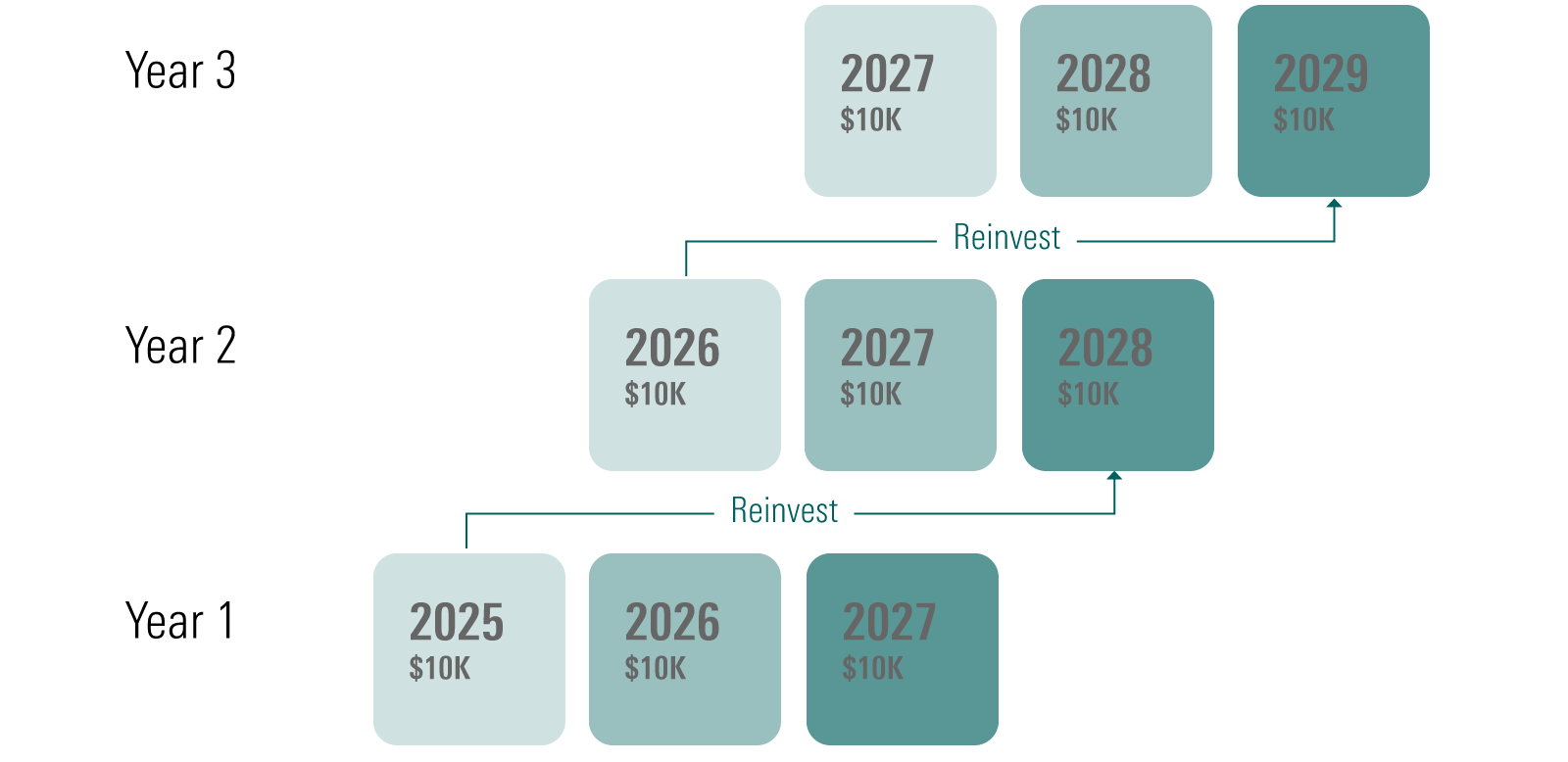
Defaults can put a dent in what traditional bond ladders return, but that isn’t their only potential drawback. Most center on the challenge of holding individual bonds: Research complexity, the need for ample diversification to guard against defaults, and high trading costs are all impediments. Building and maintaining a traditional bond ladder can require a ton of leg work and prove to be such an expensive and time-consuming affair that it can be out of reach for most investors.
Inflation can also erode the purchasing power of what bond ladders return. A 4% yield each year for the next five years would more than compensate investors for the bond market’s current expectation of about 2.59% inflation, as measured by the five-year Treasury breakeven inflation rate. But the bond market has been wrong before. In early October 2018, for example, the market anticipated a 2.04% annualized five-year inflation rate, about 2 percentage points less than what proved to be the case. Another mispricing of inflationary prospects over the next five years could lead to less wealth in real terms for bond ladder investors, though the cushion now is much greater than it was then.
Bond Ladder ETFs
For those undeterred by the risk of inflation, defined-maturity ETFs can overcome many, though not all, of the problems associated with building a bond ladder through individual bonds.
Unlike a typical bond fund that holds bonds with a range of maturities and buys new ones when the old ones mature, defined-maturity ETFs try to mimic the behavior of an individual bond. Each ETF sticks to a predefined maturity date by buying bonds from a purpose-built index that mature in the year the ETF terminates. iShares iBonds Dec 2025 Term Corporate ETF IBDQ, for example, holds only investment-grade corporate bonds that mature between Jan. 1, 2025, and Dec. 15, 2025. The fund terminates on the latter date, returning its assets to investors. It does not have a stated “par value” but returns its proceeds to investors at the termination day’s closing net asset value.
A defined-maturity ETF behaves differently from a traditional bond mutual fund. The latter generally targets a particular duration range (a measure of price sensitivity to an abrupt change in interest rates) and will buy or sell bonds through its life to keep it in that neighborhood. A defined-maturity ETF, however, will replace bonds only if they are called or default, otherwise holding them until maturation in the year the ETF terminates. Thus, as each ETF approaches maturity, its duration will decline like an individual bond. The overall duration of an ETF bond ladder portfolio, however, will remain mostly stable as long as the maturing proceeds keep rolling into newer, longer-maturity ETFs.
ETF bond ladders aren’t without risks. Like a long-dated bond in a traditional ladder, the price of a defined-maturity ETF with years until termination will likely change significantly if interest rates spike early in its life, or in the case of more credit-sensitive funds, if the economy falters. An investor would lock in a loss if forced to sell during that period.
Even for investors able to stomach price volatility, the potential for defaults to destroy capital in riskier strategies remains. The credit ratings agency Fitch, for example, currently anticipates a 2025 default rate of 2.5%-3.5% for non-investment-grade or high-yield bonds, and emerging-markets ETFs can be vulnerable as well. Investors wary of defaults would do well to stick to defined-maturity ETFs holding investment-grade bonds or Treasuries.[1]
Should a defined-maturity ETF provider try to enhance its ETFs’ yields by loading them with callable bonds, the actual return could be much lower if those bonds are called away. Most municipal and corporate bonds have a call option that lets borrowers pay them off early after an initial period. That can be problematic for investors who want to put that money back to work as most bonds—like home mortgages being refinanced—are called when prevailing rates are low enough to make it worthwhile.
Investors can gauge call risk by paying attention to the yield-to-worst metric. It shows what the portfolio’s annualized yield would look like if all of its callable bonds were called at their issuers’ first opportunity.
Other risks are unique to the ETF structure itself. Not all bonds in the ETF’s portfolio mature at the end of the year. So, if a bond matures, or is called after the final rebalancing in the fund’s termination year, the amount is kept in Treasury bills until the ETF liquidates. Since investors cannot reinvest the principal here, there’s an opportunity cost incurred by those cashlike holdings. The income generated by the ETFs can also be affected by the magnitude of other investor flows into and out of the ETF combined with the level of yields at the time of those flows. For all these reasons, the payout at maturity could be less than the initial investment amount because of the ETFs’—albeit modest—expense ratios.
Building Bond Ladder ETFs
Their risks notwithstanding, ETF bond ladders remain a worthy option to consider, especially those with a maturity of between five and 20 years. Beyond 20 years, rates are less attractive right now given that the yield of 30-year Treasuries is slightly less than that of 20-year Treasuries.
Building an ETF bond ladder is not difficult, and we can illustrate how a three-year ladder built in 2018 would have performed. IShares and Invesco both offer an array of defined-maturity ETFs, each of which holds a variety of individual bonds, ensuring sufficient diversification. Their expense ratios are generally reasonable, and their purchase minimums are modest, making them quite accessible.
An investor at the beginning of 2018, for example, could have put $10,000 each in Invesco’s BulletShares corporate-bond focused ETFs maturing in 2018, 2019, and 2020. When the earliest ETF liquidated on Dec. 15, the amount could have then been reinvested at the longest end of the ladder—so when Invesco BulletShares 2018 Corporate Bond ETF terminated, its maturing proceeds would have been invested in Invesco BulletShares 2021 Corporate Bond ETF, and so on. A similar bond ladder could have been created using iShares iBonds corporate bond ETFs.
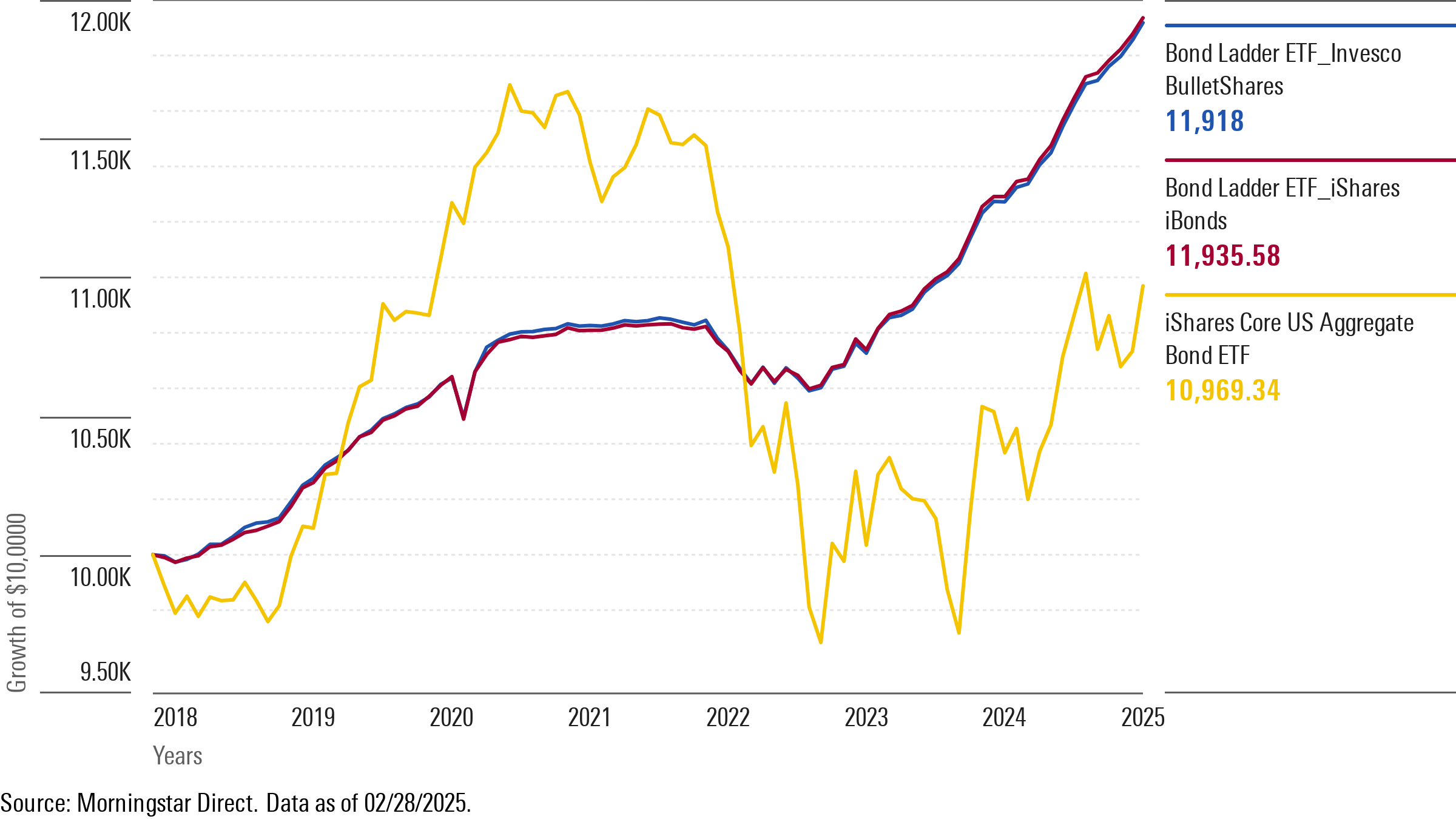
Exhibit 3 assumes the reinvestment of income and compares the growth of $10,000 invested in both these bond ladder ETF portfolios on Jan. 1, 2018, through Feb. 28, 2025, against iShares Core US Aggregate Bond ETF AGG (an investable ETF that tracks the Bloomberg US Aggregate Bond Index). While it is hard to differentiate the blue line (the Invesco portfolio) from the red one (the iShares portfolio), they both show that an investor in either would have been better off at period end than in iShares Core US Aggregate Bond ETF. That’s because those corporate ETFs then took more credit risk and had less interest-rate risk, which worked well over that stretch.
Exhibit 3
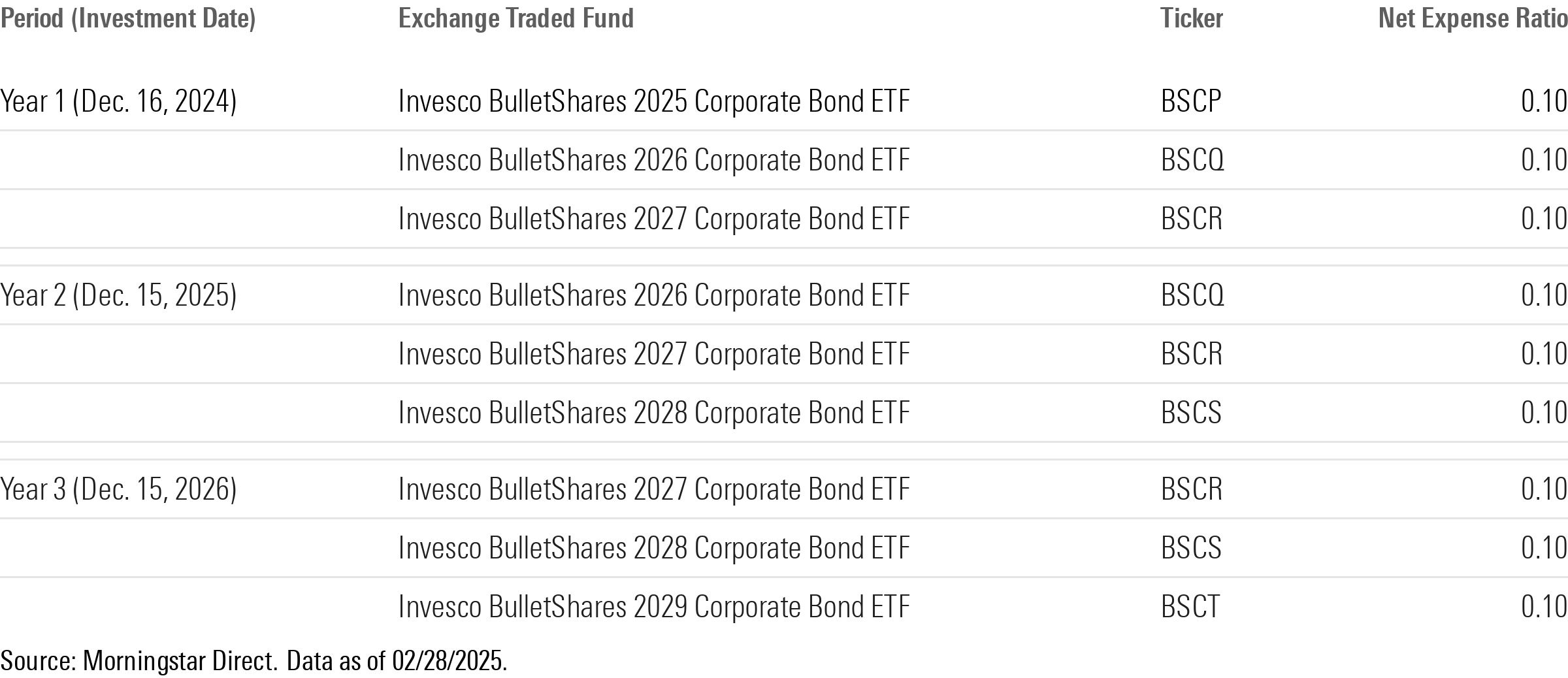
The accompanying tables show how to build a three-year bond ladder portfolio using corporate-bond-focused defined-maturity ETFs currently available in the market:
Exhibit 4
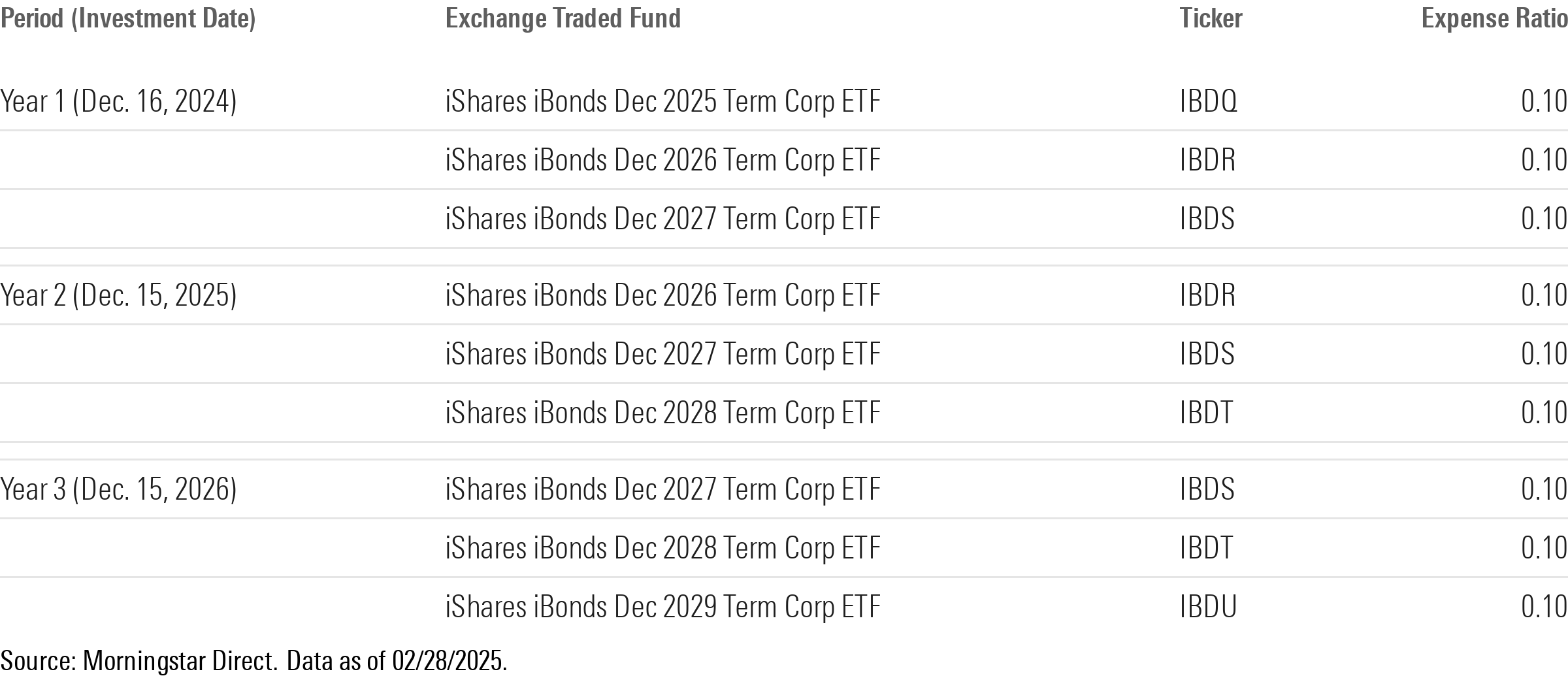
Exhibit 5
Investors can build more complex ETF bond ladders than the ones illustrated here. At present, BlackRock through its iShares’s iBonds offers 49 defined-maturity ETFs and Invesco through its BulletShares offers 27. These cover various sub-asset classes including Treasuries, municipals, investment-grade and high-yield corporates, and in BlackRock’s case, Treasury Inflation-Protected Securities. Complicated ladders can obviously expose investors to additional risks, though.
In September 2024, Global X launched three laddered ETFs that invest in Treasury bonds: Global X Short-Term Treasury Ladder ETF SLDR, Global X Intermediate-Term Treasury Ladder ETF MLDR, and Global X Long-Term Treasury Ladder ETF LLDR. These ETFs essentially replicate the bond ladder we created above using defined-maturity ETFs. For example, the Global X Short Term Ladder ETF invests in a portfolio of Treasury securities in two equal-weighted rungs, with the first holding maturities ranging from one to two years and the second holding maturities ranging from two to three years. This portfolio is rebalanced every year on the last business day of February to effectively remove the holdings previously in the maturity range of one to two years and add new holdings in the two- to three-year maturity range. While these offerings by Global X invest in Treasury securities and thus have a minimal default risk, they do come with risks associated with the fluctuation of the net asset value of the ETFs themselves. To add to the plethora of options, BlackRock now also offers laddered ETFs investing in Treasuries, TIPS, corporates, and high-yield bonds.
Bond ladder ETFs are not a cure-all. But for investors trying to maintain some stability in a volatile interest-rate environment and who are comfortable with the structural risks that come with these defined-maturity ETF bond ladders and laddered ETFs, they can be an easier alternative to building a ladder with individual bonds.
[1] A defaulted bond in Invesco’s BulletShares defined-maturity ETF would be deleted from the BulletShares underlying index at month-end. Invesco portfolio managers would then sell out of that bond, though they would have discretion to sell at the most suitable time for shareholders, generally within a month after the bond’s removal from the index. That could hurt, though. Active managers often hang on to defaulted bonds in the expectation of eventually recovering some losses by getting issued new bonds, equity, and/or equity warrants of a reorganized entity. Selling defaulted bonds out of the ETF portfolio could lock in the worst losses.
The author or authors do not own shares in any securities mentioned in this article. Find out about Morningstar’s editorial policies.

 United States