
Bond Funds Hurt By Rising Yields in Q4 2024
Losses in 2024’s fourth quarter led to lackluster results for the year.


The fourth quarter of 2024 proved tough going for most bond investors and led to lackluster results for the whole year, made worse when adjusted for inflation.
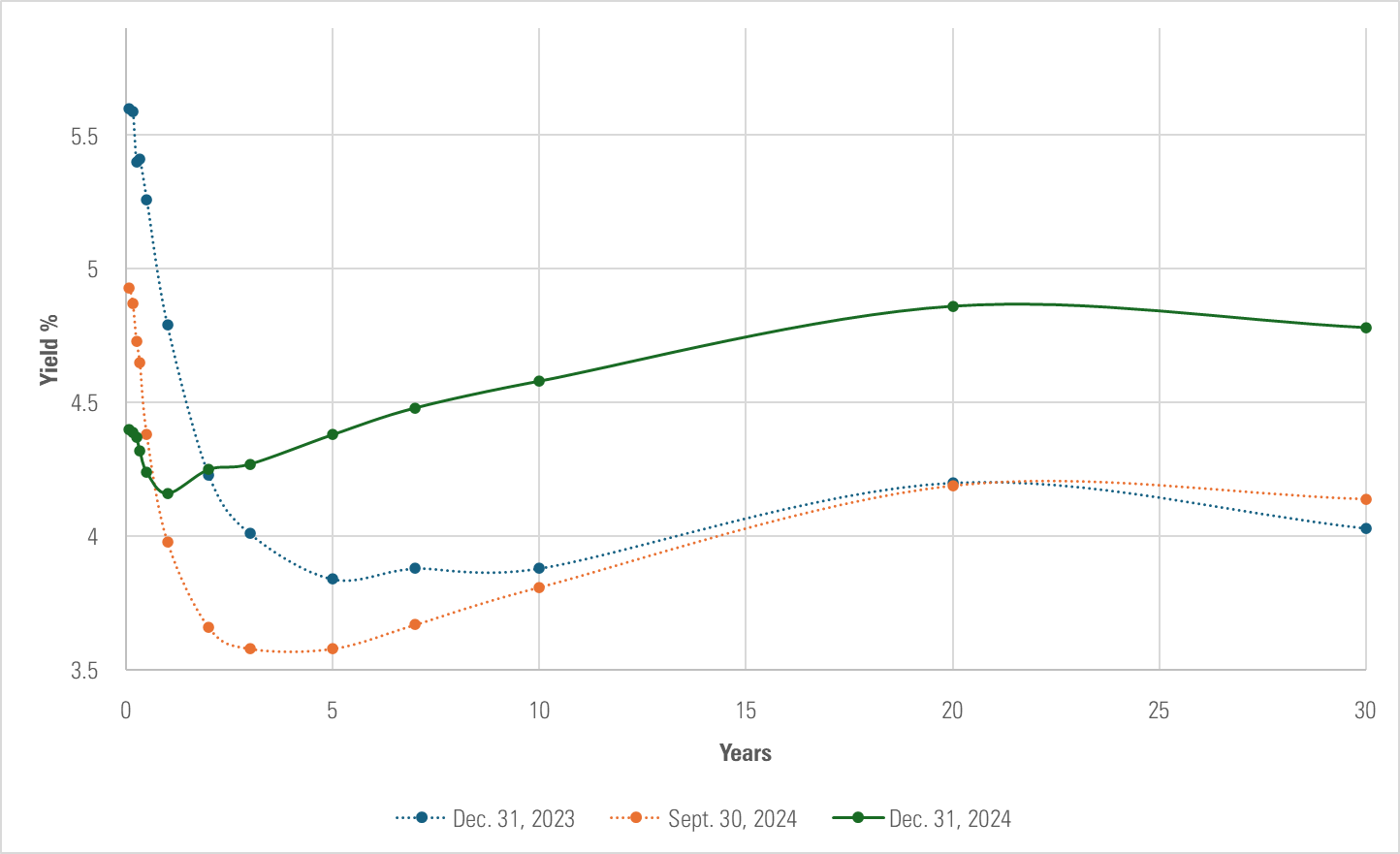
As recently as mid-September, the investment-grade bond market as represented by the Morningstar US Core Bond Index was on pace for a calendar-year return of more than 5% for the second year in a row. But then worries about the stickiness of inflation combined with a more cautious rate-cutting stance from the Federal Reserve led to rising yields and falling prices for intermediate and long-term bonds. The Morningstar US Core Bond Index lost 3.04% in 2024’s final three months. So, while it ultimately eked out a 1.36% gain for the year, that wasn’t enough to keep pace with the rising cost of goods and services over 2024. The most recent reading of the Consumer Price Index put year-over-year inflation at 2.75% through November.
US Treasury Yield-Curve Comparison
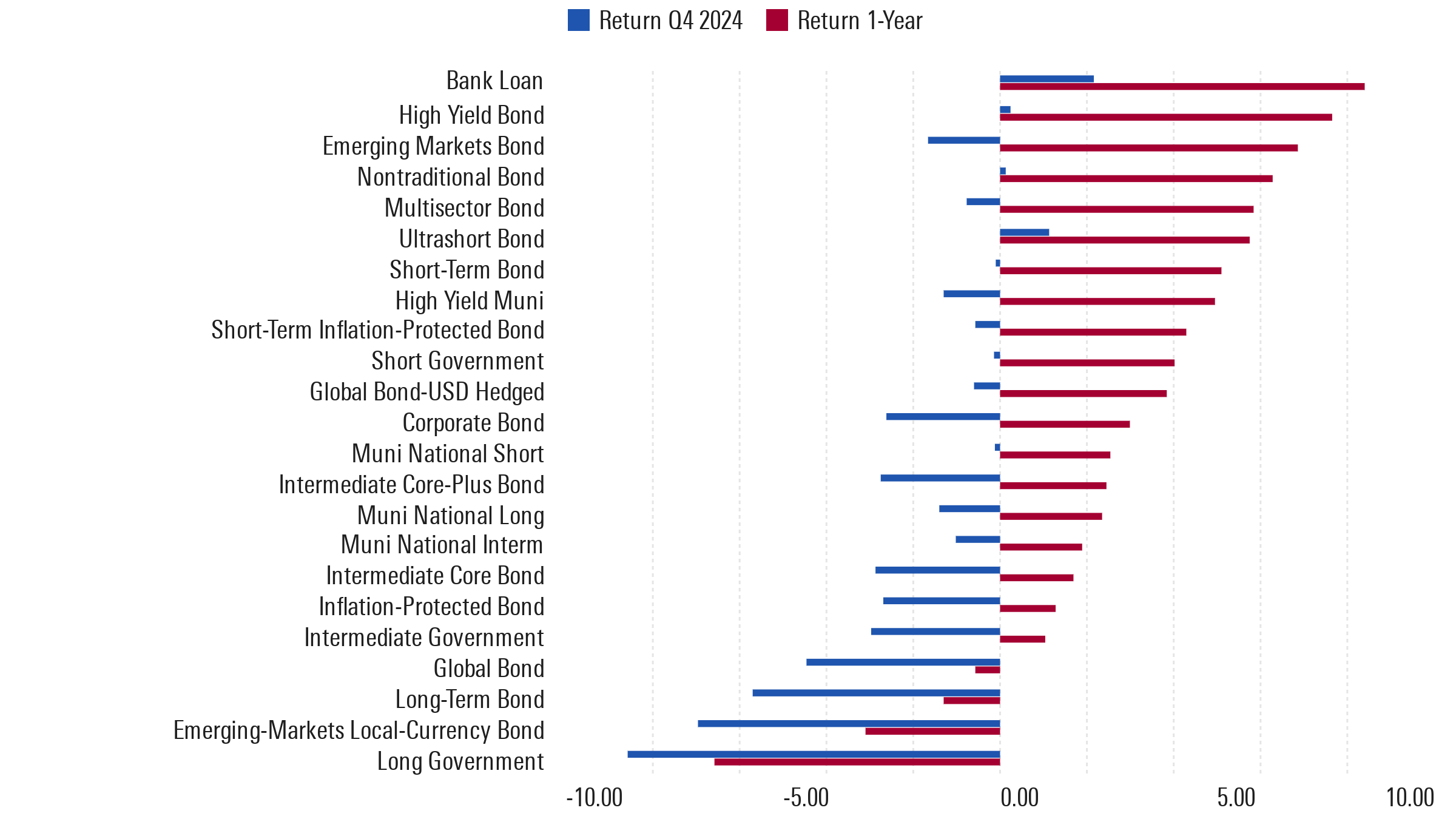
Ultrashort Bond and Leveraged Bank-Loan Funds Led the Way in the Fourth Quarter
Fixed-income Morningstar Categories with the least interest-rate sensitivity performed the best in 2024’s fourth quarter, in part because interest rates for US government bonds with maturities of six months or fewer fell in the quarter, in line with the Federal Reserve’s two 25-basis-point cuts to its overnight federal-funds rate on Nov. 8 and Dec. 19, respectively.
The typical ultrashort bond fund gained 1.13% in the quarter and 5.75% for the year. Pimco Short-Term PTSHX, which has a Morningstar Medalist Rating of Silver, was one of the peer group’s top performers. Longtime lead manager Jerome Schneider once again leveraged liquidity specialists and a small army of credit and structured products research teams to produce standout results while keeping risk in check. The fund returned 1.68% in 2024’s final three months and 6.41% for the year.
Leveraged bank-loan funds fared the best out of all bond Morningstar Categories. The floating-rate nature of their loans provided some protection against rising intermediate and long-term interest rates, and they also benefited from an environment in which the market rewarded credit risk. They gained 2.16% on average in the quarter and 8.40% for the year. Gold-rated Fidelity Advisor Floating Rate High Income FIQSX, whose Process rating Morningstar raised to High from Above Average in February, had one of the top showings for the quarter and competitive results for the year with gains of 2.67% and 8.73%, respectively.
Fixed Income Morningstar Category Average Returns
High-Yield Bond Fund Delivered, But Beware Tight Credit Spreads
High-yield bond funds stayed positive for the quarter—albeit barely—but for the year gained 8.20% on average, coming in second only to leveraged bank-loan funds. In general, the more credit risk a fund took, the better it did because lower-rated bonds tended to return more than their higher-rated counterparts. Silver-rated Fidelity Capital & Income FAGIX benefited from an aggressive stance that included an equity allocation that grew to nearly 24% entering the fourth quarter, from 16.5% at the beginning of 2024. Its 10.68% return for the year included a 1.16% gain in the final three months. Fidelity Capital & Income’s managers Mark Notkin and Brian Chang have shown a knack for taking risk when the market is poised to reward it, which is why we raised this fund’s People rating to High from Above Average in July.
It would be a mistake to become complacent regarding funds that take credit risk, however. Option-adjusted spreads for high-yield bonds over comparable Treasury securities, a point-in-time measure of the market’s perception of credit risk, tightened further in the quarter and are now within the tightest decile relative to their history dating the mid-1990s. That suggests their valuations are unusually high, and a severe selloff could blow out that spread and eliminate years of return as a result. The Morningstar US High-Yield Bond Index’s peak-to-trough 33.4% loss from mid-2007 to late 2008, for example, meant that investors on average lost everything they had gained in that asset class since early 2003.
Core and Core-Plus Bond Funds Fall Short of Inflation
Intermediate core-plus bond funds focused on mortgage-backed securities did especially well in 2024. Neutral-rated Putnam Mortgage Securities’ POLYX 4.83% calendar-year return was one of that peer group’s best, though that was not enough to lift its record out of the bottom decile over the trailing five years. While the typical intermediate core and core-plus bond funds both lost money in the fourth quarter, they generated modest gains for the year of 1.69% and 2.45%, respectively. Yet, neither average gain was enough to offset the loss of purchasing power through inflation.
Inflation-Protected Bond Categories Disappoint
Inflation-protected bond funds’ typical 1.28% calendar-year return was even worse than either the intermediate core or core-plus average. Despite Treasury Inflation-Protected Securities’ embedded inflation adjustments, the longer-maturity portfolios comprising the category were still sensitive to the fourth-quarter’s yield spike. Members of the short-term inflation-protected bond category, which debuted in April 2024, did better. Shorter-term inflation-adjusted bonds are much less sensitive to longer-maturity bond yield shifts, and they gained 4.29% on average for the year. Still, that fell short of the short-term bond category norm of 5.10%.
Emerging-Markets Bond Funds
Funds within the emerging-markets bond category fared well for the year as a whole in 2024’s credit-friendly environment, though the yield spike and a surge of the value of the US dollar versus other currencies in the fourth quarter shaved some of their earlier gains from the year. They lost 1.66% on average during the quarter, and American Funds Emerging Markets Bond’s REGGX 5.26% loss in the final three months was the category’s worst as was its meager 0.68% gain for the year.
These funds invest in developing countries’ debt denominated in developed-markets currencies, including the US dollar, and gained 6.86% on average for the year despite the fourth-quarter trouble. Silver-rated Pimco Emerging Markets Bond PEBIX, whose Process rating we raised to High from Above Average in March, finished near the top third of distinct rivals as measured by their low-cost share classes with a 7.78% calendar-year gain.
The dollar’s strength was much more of a problem for emerging-markets local-currency bond funds though, whose local-market returns are converted back to dollars for US investors. As such, the dollar’s 2024 hot streak against most other currencies generally wiped out whatever local-market returns the funds might have otherwise enjoyed.
Municipal-Bond Funds
Municipal-bond Morningstar Categories resembled the performance of their taxable-bond analogues. Among national muni peer groups, high-yield muni funds finished first for the year with a 4.95% gain and the muni-national short group second with a 2.54% return. The muni-national long average of 2.35%, however, beat the muni-national intermediate norm of 1.89%. Within the latter category, Baird Strategic Municipal Bond BSNIX had another strong showing. Its top-decile 3.17% calendar-year gain added to its standout record over the past five years, which ranked first out of roughly 90 distinct rivals.
The author or authors do not own shares in any securities mentioned in this article. Find out about Morningstar’s editorial policies.

 United States