
Bond Buyers and Sellers Fail to Find Common Ground in Brexit Turmoil
Fed Funds futures starting to price in potential rate cut.

Even after accounting for the fact that it was a Friday during the summertime, trading volume in the corporate bond market was especially light after Britain’s vote to exit the European Union shocked the capital markets. Only $8 billion of corporate bonds traded hands last Friday, compared with approximately $14 billion on a “good” trading day. There were traders looking to make trades, but there was a significant disconnect between buyers and sellers. Buyers looked to buy bonds on the cheap and down bid offers, but sellers were unwilling to hit low bids and were comfortable holding their bonds on the expectation that the market will quickly rebound. While the risk-off trade was in full force across the globe, portfolio managers were not panicking or indiscriminately hitting down bids and the tone to the market trading activity remained orderly. In fact, one trader mentioned that some buy-side accounts that have been waiting for such a buying opportunity to present itself were unable to source bonds they were looking to buy. These buyers were so frustrated that they couldn’t find bonds to buy that they left to go home early. The market action on Monday and Tuesday this week is likely to be instructive as to whether the corporate bond market can shake off the uncertainty and recuperate or if the downturn will persist.
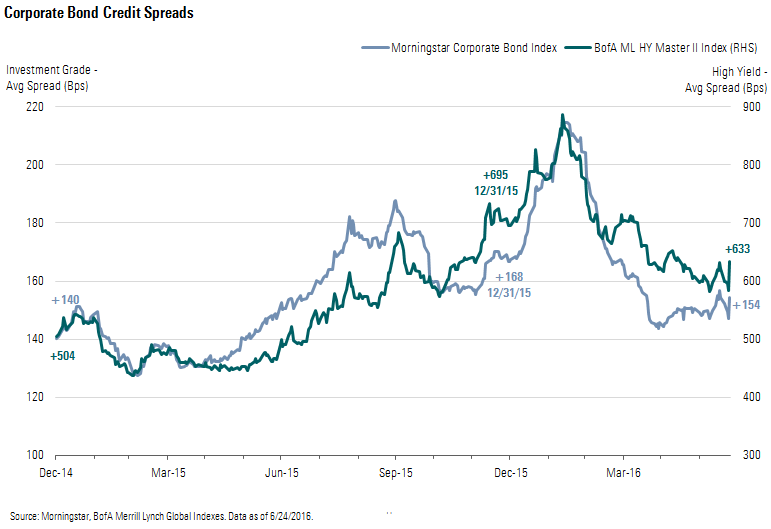
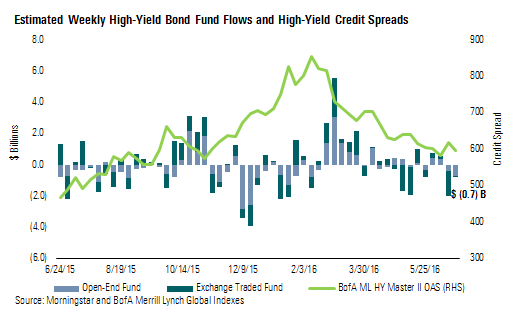
The average credit spread of the Morningstar Corporate Bond Index widened 7 basis points to +154 on Friday, yet ended the week unchanged from the prior week, since the widening on Friday only offset the tightening that occurred earlier in the week. In the high-yield market, the Bank of America Merrill Lynch High Master II Index widened 50 basis points Friday and ended the week 12 basis points wider at +633.
Yields on Treasury bonds rose early last week, only to reverse course Friday after investors realized the polls were wrong and the British were voting to leave the EU. The flight to safety drove Treasury and other sovereign bonds higher, sending yields back down to recent lows and in some cases new historical lows. The yield on the 10-year Treasury dropped to 1.58%, U.K. gilts dropped to 1.09%%, the 10-year German bund dropped to negative 0.05%, and the Japanese 10-year government bond fell even further, to negative 0.20%.
In the near term, the corporate bond market will be pressured by the uncertainty regarding the global economic outlook caused by Brexit; however, the impact of the European Central Bank’s asset-purchase program should at least partially offset this volatility. Corporate bonds will benefit from new demand spurred by the ECB’s expanded asset-purchase program, which started purchasing nonfinancial corporate bonds in June. If the ECB continues at the pace it has been so far, it will acquire EUR 8 billion-EUR 10 billion per month. These purchases will effectively remove supply of corporate fixed-income securities from the public markets and create new cash that must then be reinvested. As this cash is reinvested, bond traders may have to push prices up on European corporate bonds, thus lowering credit spreads, in order to buy bonds to reinvest the proceeds. Furthermore, companies will probably shift new bond issuance toward euro-denominated bonds to take advantage of the lower all-in yields. As credit spreads in Europe tighten and the new supply of U.S. corporate bonds diminishes, it will result in tighter credit spreads in the United States as well.
Fed Funds Futures Starting to Price In Potential Rate Cut Before the Brexit vote, the federal funds futures market was pricing in sequentially higher probabilities that the Federal Reserve will raise short-term interest rates sometime this year. After the news hit the tape that the British had voted to leave the EU, the probability of further increases in short-term rates fell precipitously. The pendulum has swung so far that the market-derived probability of a rate hike before December is essentially zero and the probability of a rate increase in December is approximately 25%. However, after pricing in no chance of a rate cut before the Brexit vote, the market derived probabilities now reveal a 5% probability of a cut in the fed funds rate as early as the July meeting, with the probability rising to 10% in December.

 United States