
Assessing the Election's Implications for Corporate Credit Risk in the Healthcare Industry
This week's activity may provide greater insight into the direction of the market.

It has been a roller-coaster market recently, and last week was no exception. Over the past few weeks, equity and fixed-income markets have traded up and down as investors attempted to gauge the outcome and consequences of the U.S. elections. Even so, the final election results and subsequent market performance last week was a scenario that very few people had anticipated. Donald Trump proved every single election poll wrong and captured enough electoral votes to become the president-elect. In the overnight markets, as the election results were being released, equity futures initially plummeted to limit down as traders headed for the exits and Treasury prices soared as the flight to safety was in full force; as the hours wore on, the markets bottomed out, then began to rebound before the official market open. As official trading began, stocks only fell modestly, and Treasury bonds gave up most of their gains. As the day wore on, investors reconsidered their original panic and began to bid equity prices up and sell Treasury bonds on the expectation that under a Trump administration, corporate earnings would benefit and inflation would increase as a result of lower government regulation, lower tax rates, and increased government spending on infrastructure programs. By the end of the day, the S&P 500 had risen 1.11%, and the yield on the 10-year Treasury rose 21 basis points.
Bond markets were closed Friday in observance of Veterans Day, but for the week through Thursday night, the yield on the 5-year, 10-year, and 30-year U.S. Treasuries widened between 33 and 38 basis points, with the longest-dated bonds selling off the most. The yield on the 10-year increased to 2.15% and the yield on the 30-year reached 2.94%. These are the highest rates these bonds have yielded since the beginning of the year. In the equity markets, the S&P 500 rose 3.80% to 2,164.45 over the course of the week, only 1.4% below its all-time high.
Even though oil prices (a major component of inflation) fell a dollar to $43.17 per barrel by the end of the week, inflation expectations also surged. According to the Federal Reserve Bank of St. Louis, the five-year, five-year forward inflation expectation rate rose 13 basis points to almost 2%, its highest level since August 2015. Similarly, the market-implied probability that the Federal Reserve will increase the federal funds rate after the December Federal Open Market Committee meeting rose to over 80% at the end of last Friday.
With interest rates surging, fixed-income sectors that are highly correlated to U.S. Treasury prices have given back much of their year-to-date gains over the past few days. For example, the Morningstar US Treasury Bond Index pared back 1.75% month to date and is now up only 2.13% year to date. In the corporate bond sector, credit spreads tightened, which helped to offset some of the impact of rising rates. The average spread of the Morningstar Corporate Bond Index tightened 6 basis points to +134, and the Bank of America Merrill Lynch High Yield Master Index tightened 27 basis points to +497. However, tightening credit spreads could only help investment-grade bonds so much, and thus far this month, the rise in interest rates overwhelmed tightening credit spreads as month to date, the Morningstar Corporate Bond Index has dropped 1.62%. In the high-yield sector, junk bonds have a lower correlation to interest rates and the Bank of America High Yield Master Index was able to mostly tread water, losing only 0.05% thus far this month.
Following the significant amount of redemptions the prior week, investors withdrew $1.8 billion from open-end high-yield mutual funds last week; however, this outflow was partially offset by $1.1 billion worth of inflows into high-yield exchange-traded funds, resulting in a net amount of withdrawals from the high-yield sector of $0.7 billion.
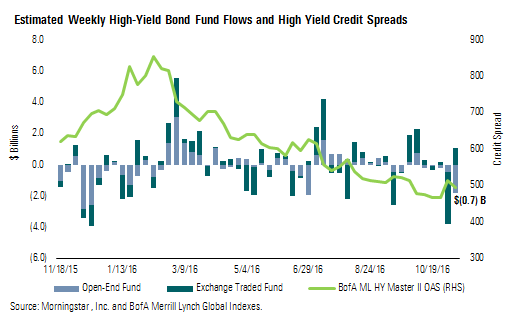
Over the past few weeks, a great number of factors have influenced market activity. These have included the elections, third-quarter earnings reports, the uncertain outlook for economic growth, and rising expectations for the Fed to raise interest rates. With the election behind us, earnings season over, and the market-implied probability of a rate hike over 80%, this week’s activity may provide greater insight into the direction of the market after investors have the weekend to contemplate their expectations.
Efforts Regarding ACA Could Have Widespread Impacts on Credit Risk Following the election, our healthcare corporate credit analyst team published a note highlighting the elevated uncertainties to corporate credit risk specific to that sector. While it is too early to gauge the ultimate impact to any specific bond issuer, Julie Utterback, our lead corporate credit analyst for the healthcare sector, expects that any efforts to repeal, replace, or revise the Affordable Care Act could have widespread impacts on credit risk across the sector. The hospital and managed-care sectors appear to face the most uncertainty in the near term, while pharmaceutical-related companies may get a short-term reprieve from the recent scrutiny on their pricing practices.
The Senate does not have a filibuster-proof supermajority to repeal the ACA outright, but it can pass reconciliation bills that could significantly alter it. If such reconciliation efforts were to lead to a widespread loss of insurance coverage, it could have negative fundamental implications for hospitals and the medical technology companies that serve them.
However, because of the potential political fallout that could result from the loss of health insurance by a large number of Americans, there is significant incentive to replace or revise the ACA. While we see the potential for less regulation on medical loss ratios as a potential positive to ACA reform on managed-care organizations, one new Republican proposal is to increase insurance competition and portability of coverage across state lines, which could have negative implications for managed-care companies in the long run.
For the pharmaceutical and drug supply chain sectors, there may be a short-term easing regarding pricing concerns; however, government policies to limit pharmaceutical cost inflation remain highly uncertain and variable. For example, some ideas discussed during the campaign may balance drug costs with value created from industry innovation. While pricing dynamics may presently be better than they would have been under a Hillary Clinton administration, they may not be in the long run. For greater detail, please see our Nov. 9 note, "Republican Victories on Election Night Create High Probability of Healthcare Reform."
Morningstar Credit Ratings, LLC is a credit rating agency registered with the Securities and Exchange Commission as a nationally recognized statistical rating organization ("NRSRO"). Under its NRSRO registration, Morningstar Credit Ratings issues credit ratings on financial institutions (e.g., banks), corporate issuers, and asset-backed securities. While Morningstar Credit Ratings issues credit ratings on insurance companies, those ratings are not issued under its NRSRO registration. All Morningstar credit ratings and related analysis contained herein are solely statements of opinion and not statements of fact or recommendations to purchase, hold, or sell any securities or make any other investment decisions. Morningstar credit ratings and related analysis should not be considered without an understanding and review of our methodologies, disclaimers, disclosures, and other important information found at https://ratingagency.morningstar.com.

 United States