
After Short Pause, Corporate Credit Spreads Resume Tightening Trend
They broke through the tight end of their narrow range last week.

Although earnings reports have been generally been mixed and fourth-quarter GDP was reported to be below the average consensus estimate, investors have continued to bid up the prices of risk assets in anticipation of faster economic growth. The equity markets pushed higher, and after struggling several times to break 20,000, the Dow finally cleared that psychological barrier. Corporate credit spreads had been in a holding pattern since the beginning of the year and traded in a narrow range, but they broke through the tight end of that range last week. The average corporate credit spread of the Morningstar Corporate Bond Index, our proxy for the investment-grade bond market, tightened 1 basis point to +126 last week. In the high-yield market, the credit spread of the Bank of America Merrill Lynch High Yield Master Index tightened 9 basis points to +393.
The levels in the corporate bond markets are the tightest that credit spreads have registered since the fall of 2014 and are significantly tighter than their long-term averages. The average spread of the Morningstar Corporate Bond Index is 42 basis points tighter than its long-term average of +168 since the end of 1998. The average spread of the Bank of America Merrill Lynch High Yield Master Index is currently 187 basis points tighter than its long-term average of +580 basis points since the end of 1996.
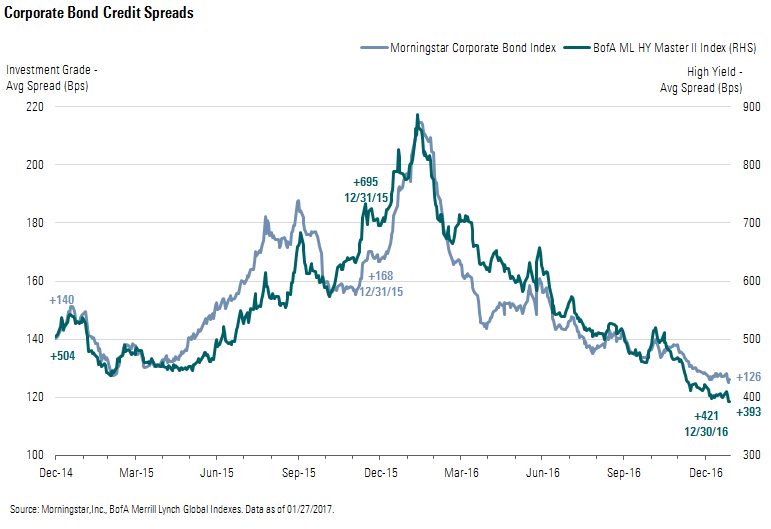
As investors bid up the price of risk assets, the prices of U.S. Treasury bonds have been drifting lower, and the entire yield curve rose approximately 2 basis points last week. At current levels, interest rates are near or in some cases slightly above their highest levels since late 2014, when corporate credit spreads were at the same levels as now. As expectations for an acceleration in economic growth and rising inflation have driven the market since the U.S. presidential election, the demand for safe-haven assets has diminished.
Robert Johnson, Morningstar, Inc.’s director of economic analysis, forecasts an acceleration in inflation but cautions that economic growth in 2017 may not rise much above the current run rate. In his first-quarter outlook, Johnson forecasts that inflation will continue to accelerate over the course of the year and the U.S. core inflation rate will rise to 2.4%-2.6% by the end of this year. He projects that real GDP for 2017 will average 1.75%-2%. Based on his analysis, Johnson expects that the interest rate on the 10-year Treasury bond has about 100 basis points further to rise this year and will end 2017 at approximately 3.50%.
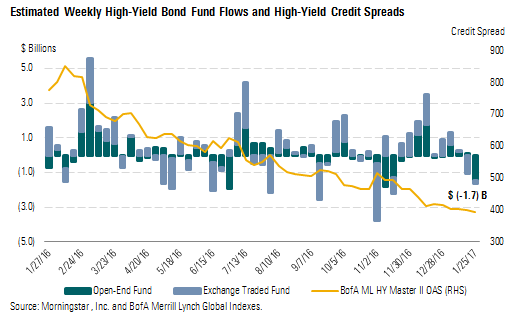
Although corporate credit spreads tightened over the course of last week, retail investors in open-end funds followed the lead of exchange-traded funds investors from the prior week and pulled $1.5 billion out of high-yield open-end funds last week. Combined with the amount of withdrawals from ETFs, outflows from the high-yield asset class totaled $1.7 billion.
Morningstar Credit Ratings, LLC is a credit rating agency registered with the Securities and Exchange Commission as a nationally recognized statistical rating organization (“NRSRO”). Under its NRSRO registration, Morningstar Credit Ratings issues credit ratings on financial institutions (e.g., banks), corporate issuers, and asset-backed securities. While Morningstar Credit Ratings issues credit ratings on insurance companies, those ratings are not issued under its NRSRO registration. All Morningstar credit ratings and related analysis contained herein are solely statements of opinion and not statements of fact or recommendations to purchase, hold, or sell any securities or make any other investment decisions. Morningstar credit ratings and related analysis should not be considered without an understanding and review of our methodologies, disclaimers, disclosures, and other important information found at https://ratingagency.morningstar.com

 United States