
After Seven Years, the Fed Is Finally Primed to Lift Rates
Chair Janet Yellen makes the case.

It has been an unprecedented seven years since the Federal Reserve lowered the federal funds rate to near zero. Since the recession ended 25 quarters ago, there have only been two quarters of negative real GDP growth (fourth quarter of 2010 and first quarter of 2014). Over the same time, unemployment has dropped from 10% to 5%. Thus far this year, GDP has risen at an average rate of approximately 2.25% and the monthly increase in payrolls has expanded at an average pace of over 200,000 per month. Wage growth has also finally started to pick up, rising 2.6% this year through November. Given recent commentary from Federal Reserve officials, we expect the Fed will make its first step toward normalizing monetary policy by raising the federal funds rate by a quarter percentage point at its Federal Open Market Committee meeting this month.
At her testimony to the Joint Economic Committee last week, Fed Chair Janet Yellen laid out what essentially was the argument to begin raising interest rates. She highlighted that economic growth and employment have recovered since the Great Recession, and in her outlook, the economy has expanded at a pace "that will be sufficient to generate additional increases in employment and a rise in inflation to our [the Fed's] 2% objective." In addition, she said, "The risks to the outlook for economic activity and the labor market as very close to balanced." Although inflation continues to run below the Fed's targeted 2% rate, she anticipates that "the drag due to the large declines in prices for crude oil and imports over the past year and a half will diminish next year. With less downward pressure on inflation from these factors and some upward pressure from a further tightening in U.S. labor and product markets, I expect inflation to move up to the FOMC's 2% objective over the next few years."
Two weeks ago, Fed Vice Chairman Stanley Fischer telegraphed a U.S. rate rise during a speech to the Federal Reserve's Bank of San Francisco, saying, "In the relatively near future, probably some major central banks will begin gradually moving away from near-zero interest rates." While he said no decision has been made yet, he said the Fed has "done everything we can to avoid surprising the markets and governments when we move, to the extent that several emerging-market (and other) central bankers have, for some time, been telling the Fed to 'just do it.' "
The need for the current zero interest rate policy is past. The original intent of the policy was as an emergency measure to support the entire financial system in December 2008 and pump liquidity into the markets when the economy and markets were in a free fall. This policy would only be kept in place during the financial crisis and would normalize soon thereafter. With the credit crisis well behind us, unemployment declining to its long-run central tendency, and positive economic growth ahead, this should be sufficient to persuade the Fed to begin raising short-term rates. Long-term interest rates should also begin to move higher as monetary policy starts to normalize. Historically, the yield of the 10-year Treasury bond has averaged more than 200 basis points over inflation, and with domestic economic growth expanding, albeit at a low-single-digit pace, the desire for the flight to safety of Treasury bonds should alleviate. However, the increase in long-term rates will be moderated by several factors, including heightened demand from foreign investors and the slow pace of future rate increases.
While it appears the Fed will lift rates following the Dec. 15-16 meeting, officials have gone out of their way to let the markets know that the rate of further increases will be exceedingly slow. At her testimony to the Joint Economic Committee last week, Fed Chair, Yellen said, "The committee anticipates that even after employment and inflation are near mandate-consistent levels, economic conditions may, for some time, warrant keeping the target federal funds rate below levels the committee views as normal in the longer run."
For now, it appears the most likely outcome will be "one and done" for the near term. We have noted throughout the year the strong demand for U.S. dollar-denominated fixed-income securities from foreign investors. Foreign investors are attracted by the higher yield that U.S. fixed-income securities provide, the steadily appreciating value of the U.S. dollar versus other currencies, and better supply dynamics. In addition, the European Central Bank's purchases of sovereign debt have reduced the amount of euro-denominated bonds available for sale. Although the euro strengthened and yields on European sovereign bonds jumped at the end of last week after the ECB's recent policy action, we suspect these same factors (stronger U.S. dollar and high interest rates in the United States) will continue through 2016.
Last week, the ECB lowered its deposit rate to negative 0.30% from negative 0.20% and announced that it would extend its EUR 60 billion per month asset-purchase program by six months to March 2017. The intent of the greater negative rate is to spur banks into lending excess reserves as opposed to paying the ECB to leave those reserves on deposit with the central bank, which in turn will stimulate economic activity. The extension of the asset-purchase program will result in an additional EUR 360 billion worth of bond purchases on top of the original EUR 1.1 trillion target. These changes underwhelmed the markets, which had expected even more monetary easing, and the markets sold off Thursday. However, the markets rebounded Friday after ECB President Mario Draghi calmed traders with statements he made at the Economic Club of New York. He asserted that the policy measures are having their intended affect and there is no limitation on deploying additional monetary tools if necessary. In response to questioning, he admitted that his statements were in response to, and intended to offset, the decline in the markets following the ECB's actions.
Subsequent to the ECB's policy actions and Draghi's statements, sovereign bonds sold off in the eurozone, sending yields higher (or less negative in the case of shorter-dated bonds). For example, the yield on Germany's 2-year bonds rose 12 basis points to a still negative 0.30%, the 5-year bonds rose 18 basis points, resulting in a negative 0.01% yield, and the yield on Germany's 10-year bond rose 22 basis points to 0.68%. In the foreign exchange markets, the euro strengthened against the dollar as the ECB's actions to stoke inflation fell short of expectations. While the euro rose about 3% to 1.09 compared with the U.S. dollar, it remains approximately 13% below the exchange rate at this time last year and 21% lower than two years ago.
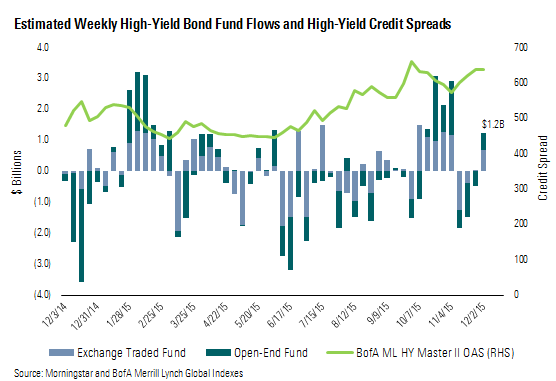
U.S. Treasury bond yields also rose last week, but to a much lesser degree. The yield on the 5-year Treasury rose 6 basis points to 1.71% and the 10-year Treasury rose 5 basis points to 2.28%. Corporate credit spreads remained largely unchanged last week. The average spread of the Morningstar Corporate Bond Index ended the week at +156 bps over Treasuries and the Bank of America Merrill Lynch High Yield Master Index ended the week at +637 bps.
After suffering three weeks of outflows, high-yield mutual funds and exchange-traded funds registered $1.2 billion of inflows last week.

 United States