
Chasing New Frontiers: We See Anthropic as Well Placed to Capture Value in an AI World
Our company report for Anthropic details our view on the AI lab’s economic moat, key risks, capital allocation and valuation.

What Does Anthropic Do, and How Does It Make Money?
Anthropic is in the business of building and selling intelligence. As such, the firm’s core strategy can be distilled into two equally important and reinforcing parts. First, the firm devotes considerable resources to building, or training, large language models. Second, once these models are trained, Anthropic sells access to them through a mix of its application programming interface, platform, and first-party applications such as Claude Code and Cowork.
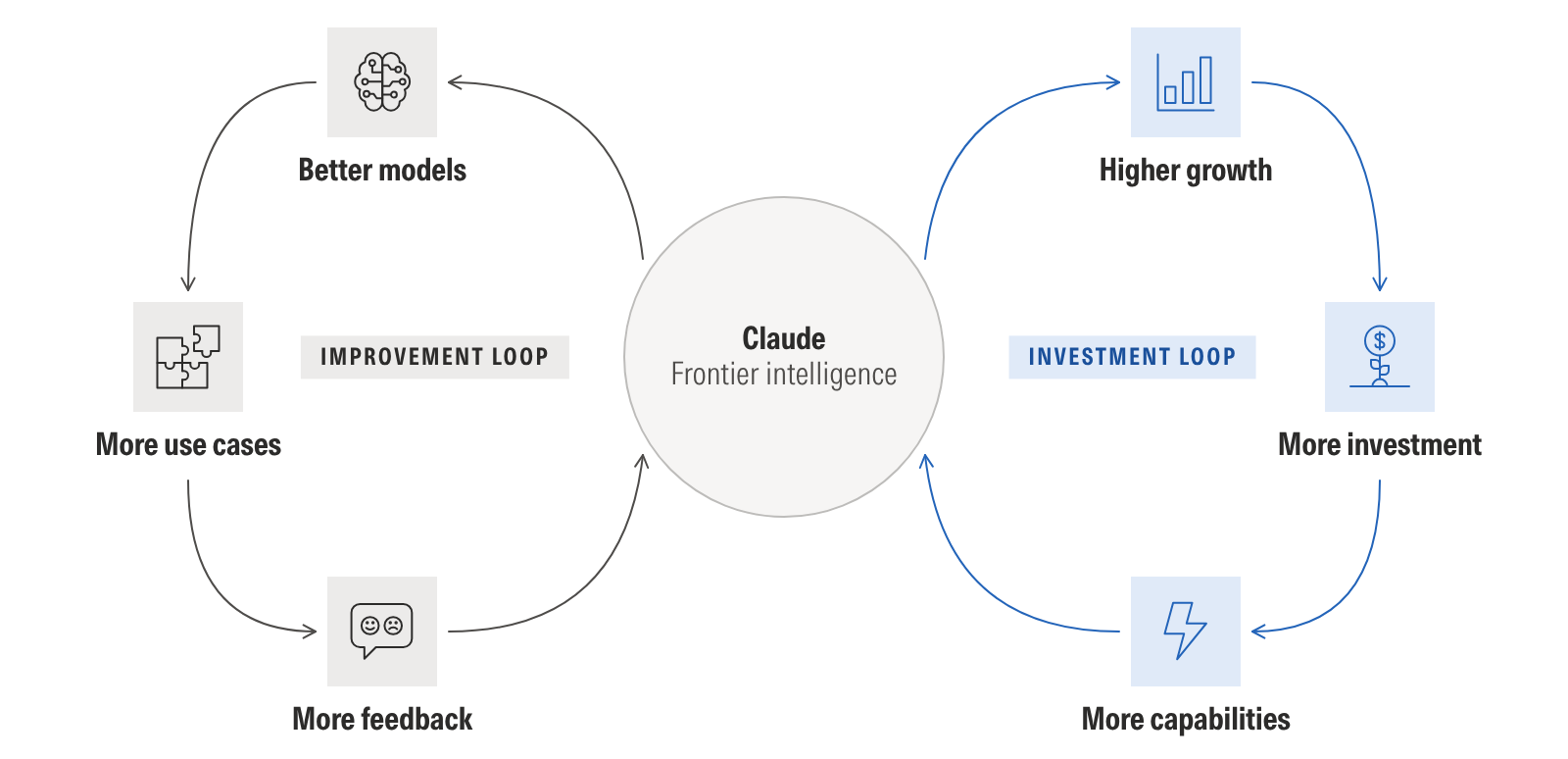
The mutual reinforcement of both training and subsequent monetization happens in an elegant manner. By building new models that unlock new capabilities and workflows, Anthropic can drive adoption and monetization. The dollar inflows from monetization are then channeled back into training the next series of models.
How We See Anthropic’s Training and Monetization Reinforce Each Other
The firm’s monetization engine itself is pretty straightforward, with enterprise-heavy consumption-based revenue, which is governed by how many tokens enterprises consume, supplemented by consumer-leaning subscription revenue, which is priced at a flat monthly subscription fee.
While we understand investor concerns around potential commodification of LLMs that could make Anthropic’s business and financial outlook bleak, we view the future differently. We have a positive outlook on Anthropic’s ability to remain at the frontier of AI model research, demonstrate capability leadership in key domains, and monetize these capabilities primarily by selling to enterprise customers.
Our view that Anthropic will continue to gain market share among enterprise customers is supported by three key factors:
- We believe AI adoption across enterprises remains in early stages, with enterprises increasingly looking to adopt AI to improve efficiencies and drive revenue. In our view, this low-penetration, high-appetite dynamic creates a secular tailwind that will boost Anthropic’s top line.
- We believe enterprises are willing to pay a premium for frontier-level intelligence. As model capabilities unlock new workflows, they expand Anthropic’s total addressable market, with each new capability driving more dollars to frontier intelligence. This preference for “best in class” is not isolated to AI models; we have more than two decades of enterprises demonstrating this behavior across a variety of software domains.
- We see Anthropic increasingly creating vertical applications in key domains, thereby attracting sticky software spending onto its platform. We have seen early evidence of this verticalization in software engineering, with Claude Code, and expect the firm to develop such first-party applications in other highly monetized domains such as legal research, financial research, healthcare, cybersecurity, and design.
The Quick Anthropic 101
Anthropic is an AI lab focused on building intelligent models that large organizations can deploy, with a key focus on enterprises. Founded in 2021 and based in San Francisco, it is a public benefit corporation, and it sells access through three routes: the Claude Platform for developers, Claude Code for software engineering, and Claude Cowork and Claude.ai for knowledge work and chat. Anthropic monetizes its AI models through consumption-based revenue, priced on usage, and subscription-based revenue, with subscribers getting access to Claude’s models for a flat subscription-based fee.
Has Anthropic Built an Economic Moat?
We assign Anthropic a Morningstar Economic Moat Rating of narrow, primarily owing to the firm’s intangible assets and cost advantage. We also see emerging customer switching costs and an indirect network effect further bolstering the firm’s competitive advantage.
Although building LLMs is compute and resource-intensive, the firm’s research velocity, enterprise pricing power as well as penetration, and signed multiyear compute deals give us confidence that Anthropic will be able to generate excess returns on invested capital over the next 10 years.
Intangible Assets
We view Anthropic’s intangible assets, in the form of frontier research know-how, recursive model development, and safety alignment training, as the primary moat source.
On the firm’s AI model research, we have seen Anthropic foster capability leadership in key domains, especially in agentic coding and cybersecurity. This leadership has translated directly into pricing power, with Anthropic’s models priced at a premium to other frontier labs while rapidly scaling enterprise customers. Recursive model development also sharpens the firm’s edge in model research. Recursive model development is a process in which Claude aids training and testing of new models by running experiments, generating and processing training data, and creating evaluations and safety audits for upcoming models.
Finally, while the firm has invested aggressively in model development, it has made safety and alignment a key part of its model development strategy. This messaging resonates well with companies in a heavily regulated industry such as financial services and healthcare. The firm’s model capability, along with its focus on safety, has helped it gain adoption in these regulated industries, with customers including nine of the 10 largest pharmaceutical companies, the 10 largest banks, nine of the 10 largest semiconductor companies, and eight of the 10 largest healthcare companies.
Cost Advantage
We believe Anthropic has a structural cost advantage relative to other model providers as well as enterprises seeking to self-host open-weight models. We view this cost advantage as being driven by four mechanisms.
First, training costs for models rise materially with each generation. As a result, a challenger entering today must not merely match the leaders’ current spending, but also have a novel method to “catch up” on all the accumulated learnings these model companies have made by iterating through various model architectures and methodologies. We see these high costs of training and the growing gulf between existing AI labs and new entrants as a contributing factor to the whittling of the model field from many dozens of model companies claiming to be leading-edge back in 2023 to just a handful being at the frontier in 2026.
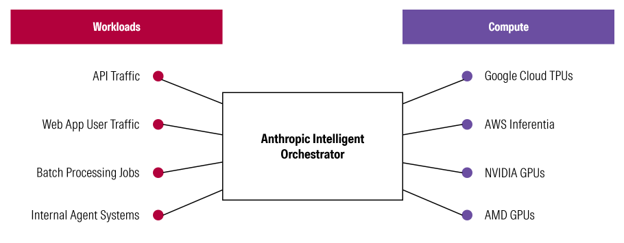
Second, Anthropic’s multichip hardware portfolio lets it dynamically route workloads to the lowest-cost silicon. This orchestration layer, which Anthropic built in-house, is incredibly hard to replicate, and Anthropic is the only frontier AI lab that has a fungible compute fleet across four hardware configurations (AWS Trainium, Google TPUs, Nvidia GPUs, and AMD GPUs).
Anthropic’s Hardware Abstraction Allows it to Improve its Compute Efficiency
Third, the firm’s emphasis on algorithmic and methodological improvements across training and inference has allowed it to increase its effective output of a given amount of compute. These “compute multipliers,” increasingly discovered with the help of Claude, enable the firm to train more-capable models and serve existing models more efficiently.
Fourth, because of Anthropic’s scale, it can procure compute from cloud infrastructure and hardware providers at attractive prices unavailable to smaller peers. Since Anthropic can commit to multiyear terms and offer to buy gigawatt-scale capacity from infrastructure providers, it can capture better unit economics than smaller peers that can only commit to smaller deals.
Switching Costs
While we do not see switching costs as a fully formed moat source for Anthropic as of yet, we are seeing increased evidence that Anthropic is entrenching itself in enterprise workflows that are hard to replace. We see two key ways in which Anthropic is building switching costs for its model ecosystem. One, the firm is pushing for multiproduct adoption, with more than half of its large customers, defined as those spending more than $100,000 annually, using both the Claude platform and a first-party app such as Claude Code or Cowork. Across our software universe, we see multiproduct adoption as stickier than single-product adoption.
Two, as enterprises increasingly shift to agentic workflows, we will see a rise in long-running, persistent agents. When deploying these long-running agents, enterprises need to set up intricate system prompts, tool-use definitions, and error-handling processes, all of which allow the agent to work autonomously for extended periods of time. This additional tooling is calibrated to specific models, with Anthropic’s forward-deployed engineers also playing a key role in building this tooling around Claude. Swapping a model out requires building the tooling again, which is both time- and cost-intensive.
Despite the above points, we do not attribute a switching cost moat source to Anthropic, as more than 80% of the firm’s revenue is consumption-based, and customers can reduce consumption relatively quickly. Also, for customers not leveraging more than a single product and building long-running agents, switching away from an existing model provider is relatively simple.
Network Effect
Finally, we see early signs of a network effect forming for Anthropic in two distinct ways. One, when prosumers/free users use products such as Claude Code, they generate multistep agentic workflows that are tracked and monitored by Anthropic. This includes tool calls, which code edits they accept, failure modes, as well as user feedback. All this data can then enable Anthropic to improve/fine-tune its upcoming models.
Two, by looking at usage patterns and telemetry data, Anthropic can gauge which workflows end-users are building on top of its existing models. This data can allow Anthropic to build first-party products in key areas, with Claude Code and Claude Design as two good early examples. As Anthropic expands the roster of pre-built tools, with product discovery being aided by usage of its models, it can expand its target market by unlocking new personas, thereby attracting more users to its platforms.
What Are the Key Risks and Uncertainties Facing Anthropic?
We assign Anthropic a Morningstar Uncertainty Rating of Very High. This rating reflects our view on the wide range of financial outcomes for a business investing heavily in large language models, a nascent technology.
We see two clear drivers of financial uncertainty for Anthropic.
One, we assume that training larger, more complex, models continues to expand their respective capabilities, especially in domains that are monetizable. While this assumption makes sense to many, including us, there is uncertainty worth unpacking here. Model improvements, for the better part of the last half-decade, have operated under a framework known as “Scaling Laws”. Put simply, the framework posits that an AI model’s intelligence scales predictably as you increase the volume of its training data, its post-training alignment, and the time it spends pondering over a specific problem.
We have seen these scaling laws work elegantly over the last few years, enabling models to get better and more economically useful as AI labs, such as Anthropic, worked to improve each scaling axis. We’d note, however, that the scaling laws framework is an observation, not an actual physical law, that could stop holding to be true at any point in the future. If scaling laws do stop “working”, model improvements may become incremental, not transformational, thereby potentially shrinking Anthropic’s total addressable market and allowing competitors the opportunity to catch up with Anthropic.
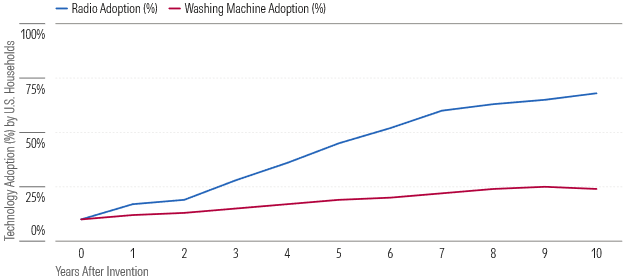
Two, there are a myriad of ways in which adoption curves of enterprises adopting AI could inflect in the coming years. A good historical analogy is the difference in adoption of radios, swift and widespread, versus washing machines, slow and gradual.
Adoption Curves of Radios and Washing Machines from Years 0-10
If AI adoption is fast across enterprises, Anthropic’s revenues, along with its margin profile, will likely inflect upward well faster than our base case forecast. AI bulls will point to the adoption of cloud computing, social media, and mobile as evidence that the AI adoption curve will be rapid, enabling AI labs that are building the LLMs to rapidly expand their toplines and profit pools.
On the flip side, AI adoption could be slow. Proponents of the slow adoption thesis point to the rearchitecting any enterprise needs to commit to in order to deploy AI at scale as well the friction created by incumbent vendors that won’t be displaced by AI labs without putting up a fight. All these factors, bears argue, will lead to a much more gradual adoption of AI, still enabling AI labs to grow revenues and even achieve profitability, albeit on a much longer timeline.
The gulf between the two states of this future world, one where AI adoption is fast and one where it is slow, is substantial. According to our own estimates, the 2031 revenue differential between the two future states is loosely $500 billion for the frontier model labs.
How is Anthropic’s Financial Condition?
We view Anthropic’s financial position as healthy. The firm has more than $130 billion in cash and marketable securities, having burned through less than $10 billion in cash since 2023.
While the business does have more than $850 billion in compute commitments, we’d remind investors that these commitments are structured over more than 10 years. With the firm’s existing cash balance, along with around $100 billion in expected IPO proceeds, it can cover its non-cancelable compute commitments for around 3 years, even if revenue growth stalls out in 2027.
This balance sheet strength is a key reason why Anthropic, instead of throwing more compute toward revenue-generating inference demand, has dedicated the majority of its compute toward training better models.
Longer term, we see these frontier AI labs building robust free cash flow generating businesses, with continuing model progress unlocking new pockets of demand, thereby allowing them to grow revenues even as compute bills also continue to expand.
Bulls Say
Anthropic is at the forefront of technological innovation arguably as big as the Industrial Revolution. The firm’s revenue is set to ramp up dramatically in 2027 and beyond as demand for AI remains robust.
The firm’s focus on key domains, including software engineering, cybersecurity, and natural sciences, allows it to embed itself in high-volume, price-insensitive workflows.
Anthropic’s market opportunity is knowledge work, a market worth more than $20 trillion annually. This is orders of magnitude greater than markets that software firms typically target, supporting higher growth for longer.
Bears Say
Model ranking and intelligence are fickle. We have seen other companies fall off the frontier; Anthropic could too.
While cloud providers serve as key Anthropic suppliers, they are also competitors, with every interest in commodifying the intelligence layer to capture value in the cloud infrastructure layer.
While the vast majority of Anthropic’s revenue is based on consumption, which can be variable, the firm’s costs are mostly fixed. Put another way, if variable revenue doesn’t scale to cover fixed costs, the company could face financial distress.
Is the Firm a Good Steward of Capital?
We assign Anthropic an Exemplary Capital Allocation Rating based on its sound balance sheet, exceptional investments, and appropriate shareholder distributions.
We view Anthropic’s financial position as healthy. The firm carries more than $130 billion in cash and marketable securities on its balance sheet, and the upcoming IPO will likely add another $100 billion to the firm’s cash pile.
While the firm does carry off-balance-sheet liabilities in the form of compute commitments, we see its cash pile, along with strong revenue generation, as more than strong enough to pay for the growing compute bills.
The firm’s investment strategy has been simple. Nearly all of the firm’s reinvestment over the past few years has been dedicated to compute. The return on this investment has been not only capability leadership in key domains such as software engineering and cybersecurity, but also a rapidly expanding top line driven by enterprises leveraging its models.
We expect the firm’s investments to be geared mostly toward compute, as it continues to train larger, more-complex models that unlock more economically useful tasks, thereby driving further adoption and enterprise penetration.
Finally, the firm has not returned capital to shareholders through share buybacks or a dividend. We won’t hold our breath for either capital return method anytime soon, with Anthropic seeking to leverage every incremental dollar toward building newer models or securing compute to serve customers. We see the firm’s focus on growth as appropriate given its stage in the company life cycle.
How Much Is Anthropic Worth?
Our fair value estimate values Anthropic’s equity at $1.7 trillion, implying a 2027 price/sales multiple of around 15 times.
We believe Anthropic is well positioned to increase its revenue rapidly, with our base-case forecast calling for a top-line compound annual growth rate of 47% over the next five years. We see three key drivers of this revenue growth.
One, we expect the firm to drive deeper into existing accounts. The firm has almost 12,000 customers spending more than $100,000 a year, more than 1,900 customers spending $1 million annually, and more than 250 accounts spending more than $10 million each year. We see Anthropic expanding deeper into these accounts by moving enterprises from simple, low-volume applications like Claude chat to integrating Claude into the agentic infrastructure large enterprises are trying to build. As Claude takes over more automated, long-running tasks, we see a natural inflection upward in total spending on Claude by enterprise customers.
To give some perspective on penetration, we’d note that out of Fortune 500 customers spending more than $100,000 on Anthropic’s models, their spending on Claude as a percent of their total expenditures was less than 0.1%. In other words, for every $1,000 a Fortune 500 client spends, only $1 currently goes to Anthropic. We see Anthropic being able to materially expand this number over time.
Second, while the firm has impressive enterprise penetration, new logo additions are far from over. The firm has more than 50% of the Fortune 500 as active customers. Put another way, almost 50% of the Fortune 500 still aren’t spending much, if at all, on Anthropic’s products. We’d imagine penetration for the Fortune 1000 and beyond is likely even lower. We view these customers, many of whom are still in early innings of broader AI adoption, as greenfield opportunities for Anthropic to target.
Third, instead of trying to build an enterprise sales team directly, the firm’s strategic distribution agreements with AWS and Google Cloud allow it to scale its revenue without linearly adding more sales reps. By incorporating its models within managed AI platforms such as AWS Bedrock and Google Vertex AI, Anthropic can attract net new dollars toward its products.
While we are fairly confident in Anthropic’s ability to execute across these three verticals and drive sales growth, we think it is also appropriate to consider both bull and bear cases for the firm.
In our bull case, we estimate Anthropic’s five-year revenue growth rate to be north of 60%, with a 2027 price/sales multiple of 26 times. In our bull case, we estimate Anthropic’s equity value at slightly north of $3 trillion, or almost twice our $1.7 trillion base-case estimate.
Our bull-case forecast is driven primarily by rapid AI adoption in large enterprises and Anthropic gaining significant market share against other frontier labs, including OpenAI and Google, as well as open-weight model providers.
Our bull case captures rapid adoption, with Anthropic’s sales capturing 14% of total software and IT services budgets in five years. Layered on top of this rapid adoption is also an increase in Anthropic’s monetization of available compute capacity, with compute efficiency also increasing rapidly.
On the other hand, our bear case calls for a much more gradual adoption curve, with Anthropic’s five-year revenue growth rate coming in at 22%. Our bear-case equity value for Anthropic is $500 billion, with the implied price/sales multiple of 6 times.
Our bear case’s gradual adoption curve has two implied assumptions. First, we see revenue scaling more gradually due to slow enterprise adoption, as existing switching costs and the risks associated with replacing traditional workflows with AI outweigh the potential AI-related benefits in a typical enterprise’s strategic calculus.
Second, in our bear case, alongside slow enterprise adoption, model capabilities also scale more gradually, opening fewer target markets for Anthropic and slowing the pace of adoption of Anthropic’s models.
The author or authors do not own shares in any securities mentioned in this article. Find out about Morningstar’s editorial policies.

 United States