
The Biggest Risk for New Retirees
Why bad returns at the wrong time can put your retirement spending plan in danger.


The process of saving for retirement is relatively straightforward. An investor who starts early, funnels at least 10% or 15% of income into retirement savings year after year, and focuses on low-cost equity investments generally has decent odds of amassing a sizable nest egg to support spending in retirement.
But things get more complicated after retirement. When you start making portfolio withdrawals, the value of your portfolio reflects both market performance and cash outflows, which can be a double whammy during extended market downturns.
Background
Let’s start with a couple of simple examples to see how this works in practice. If you start with a portfolio value of $10,000; withdraw $1,000 per year; and earn total returns of 10% one year, 10% the next year, and negative 10% the third year, you’d end up with about $7,900 by the end of the third year.
How Sequence of Returns Works
But if the returns happen in the reverse order, you’d end up with just $7,491, as shown below. Because the negative return happens at the beginning of the period (when more assets are in the account), it carries more weight in the overall results. At the same time, the portfolio doesn’t benefit as much in dollar terms from the two years of positive returns because there are fewer dollars remaining.
Different Sequence, Different Results
Historically, the US equity market has had a seriously negative sequence of returns only a few times over the past 92 years: 1929-32, 1939-41, 1973-74, and 2000-02. These were all periods with equity market losses that lasted at least two consecutive years.
But it’s worth being aware of this potential risk because of the havoc it can wreak for investors heading into retirement.
How Sequence of Returns Affects the Odds of Retirement Success
As part of our recently published State of Retirement Income 2025 report, my colleagues Christine Benz, Jason Kephart, Tao Guo, and I looked at the scenarios that are most exposed to sequence-of-returns risk: when a retiree invests entirely in stocks. Because stocks are more volatile than bonds, the risks of early-retirement losses are more acute when a retiree invests only in equities.
As in the past, we incorporated forward-looking asset-class return and inflation assumptions to arrive at a starting safe withdrawal rate for new retirees, excluding Social Security or other nonportfolio income sources. We found that an all-equity portfolio could support a 3.4% starting spending rate for retirees making fixed real withdrawals each year, assuming a 90% probability of having funds remaining at the end of an assumed 30-year retirement period.
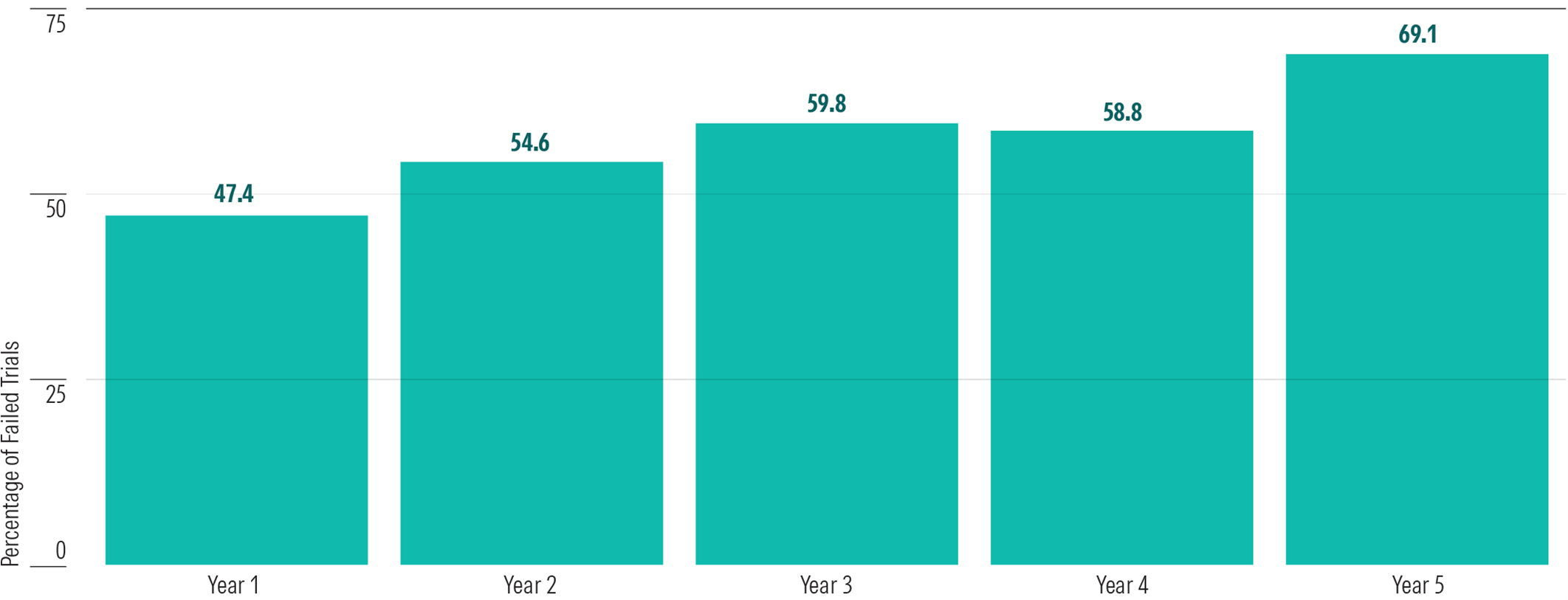
After running that data, we focused on the 10% of simulated random trials in which the retiree exhausted their savings before the end of retirement to see how many of those “failures” involved early in-retirement investment losses. We found that nearly 70% of these “failures” involved trials in which the retiree’s investments had lost value by the end of year five of retirement.
Percentage of Failed Trials That Experienced Losses Early in Retirement Period
We also looked at it the opposite way—by ranking trials based on their simulated returns in the first five years of retirement and seeing how the failure rate varied. We assigned the 20% of trials that had the lowest returns to the “Worst” quintile and tallied up the number of trials that failed, and we made the same calculation for the other groupings. There was a far higher risk of exhausting retirement savings when returns were poor in the first five years.
Failure Rate by Return Quintile
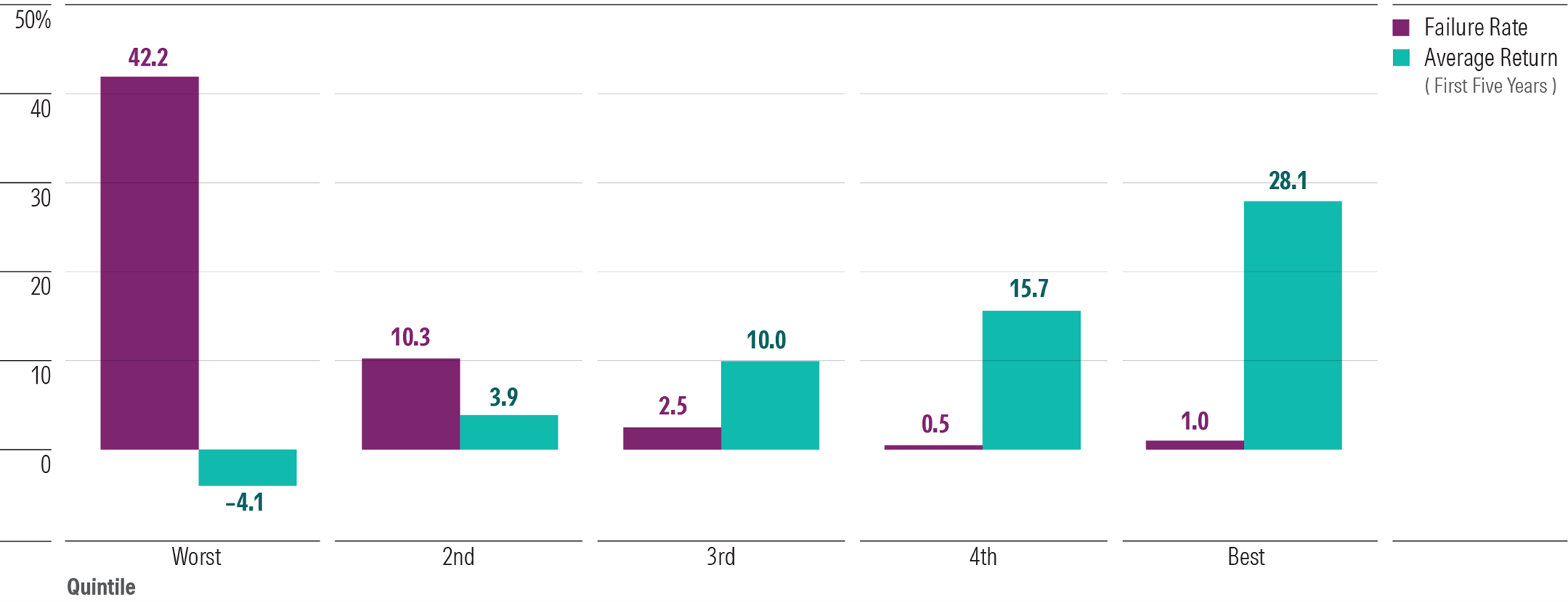
Even the second-worst return quintile had relatively good odds of success (with only a 10.3% failure rate), while the middle, above-average, and best quintiles had extremely low failure rates.
For the portfolios that made it through the first five years of retirement with investment gains, there was only about a 4% chance a retiree would subsequently deplete the portfolio before reaching the end of retirement, assuming the retiree stuck with the system of fixed real withdrawals. Even after one year of retirement, a gain cut the risk of failure in half.
Mitigating the Risk
Of course, those are extreme examples; few retirees come into drawdown mode with all-equity portfolios. And in fact, adding a healthy stake in fixed-income securities is one of the best ways to mitigate sequence-of-returns risk. That’s part of the reason portfolio allocations that include a healthy allocation to bonds (in the range of 50% to 70% of assets) ended up supporting the highest starting safe withdrawal rates in our study. Bond exposure usually acts as a shock absorber, tamping down volatility and the risk of losses in earlier years, which in turn helps support a higher spending rate.
Although bonds can also be subject to risk from return patterns over time, returns typically fall in a smaller range and can help buffer some of the risk of an equity market downturn. Even individuals who had the misfortune of entering retirement right before the downturn in 2000 would have fared much better with a balanced portfolio of 60% stocks and 40% bonds with annual rebalancing. The portfolio would have reached a low of about $729,000 after 2008’s market collapse but would have climbed back to $1.2 million by age 84.
The Bucket approach originally developed by Harold Evensky is another way to mitigate the risk of an unfavorable sequence of returns. By putting at least one or two years’ worth of planned withdrawals in a separate cash “bucket,” investors can guard against the risk of being forced to withdraw assets during a market downturn. This also leaves the remaining portfolio better positioned to rebound when the market eventually improves.
Taking a more flexible approach to withdrawal rates can also alleviate the negative effects. There are many ways to implement this, including withdrawing a fixed percentage of your portfolio’s value each year, not adjusting withdrawal rates for inflation, or using a “guardrail” approach in which you reduce the withdrawal rate if it increases too much because of a declining portfolio value.
Finally, if you’re in the unfortunate position where you think you might run out of money toward the end of life, an immediate or deferred annuity can be a good solution. By pooling portfolio risk with other investors, annuities allow investors to earn a stream of guaranteed lifetime income. This provides protection against the risk of outliving your assets.
The author or authors do not own shares in any securities mentioned in this article. Find out about Morningstar’s editorial policies.

 United States