
US Exceptionalism, AI, Resilient Economy Will Keep Lifting Stocks, Says Parnassus’ Ahlsten
How Parnassus Core Equity outperforms rival funds. One case for sustainable investing.


Amid the market’s zigs and zags this past spring, Todd Ahlsten stuck to his guns, looking for high-quality, wide-moat stocks for his high-conviction portfolio. That’s helped the Silver-rated Parnassus Core Equity PRBLX outperform the large-blend category consistently.
Ahlsten has been with Parnassus for 31 years, since he was a 22-year-old research intern. He became manager of Parnassus Core Equity and director of research in 2001, and the chief investment officer of the firm in 2008. In December, Ahlsten also began managing an even more concentrated version of his portfolio, Parnassus Core Select ETF PRCS.
We recently checked in with Ahlsten, who has developed a reputation for deft analyses of the market and its top themes as a member of the Barron’s Roundtable since 2019. He shared his bullish outlook for US equities and the thesis for some wide-moat investments that he believes with outperform.
Among the stocks that Ahlsten favors:
- Advanced Micro Devices AMD
- ServiceNow NOW
- Danaher DHR
- Thermo Fisher Scientific TMO
- Intercontinental Exchange ICE
Leslie Norton: What is your outlook for the market? How do you manage money when the news is up in the air?
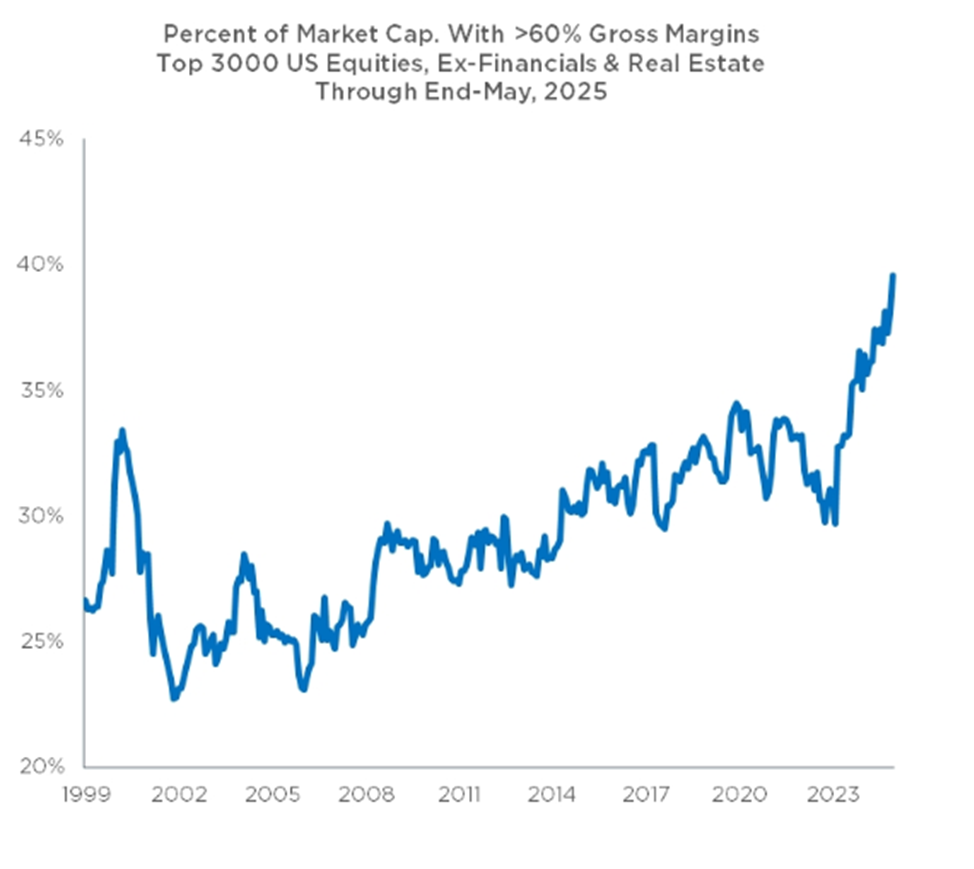
Todd Ahlsten: I don’t see much up in the air. We’ve stayed relatively positive about the markets. I have some core fundamental beliefs. One, the whole exceptionalism of corporate America thesis is still intact. Yes, there are politics around that. But look at the the fundamental innovation going on in the S&P 500, starting with Nvidia down to Amazon, Google, Mastercard, Visa, and John Deere. Adam Parker at Trivariate Research found that 40% of the market cap of the S&P 500 has 60% gross margins.
Innovation is Lifting Margins
Two, the artificial intelligence trend is durable. We’re looking at an estimated $2 trillion in AI data center spending by 2029. We’re now seeing sovereign AI [a nation’s capabilities to produce AI using its own infrastructure, data, workforce, and business networks] in the Middle East. It will be very transformative. As AI moves from providers such as Nvidia and Broadcom to enablers like Salesforce and ServiceNow, and finally to large-scale adopters such as Deere, we foresee successive waves of capital investment and productivity gains across the economy.
Three, the economy is still resilient. It’s slowing, but we’re still creating jobs. The recession odds have receded. It started the year at a 20% probability, then it went to 70%, now it’s at 30%. Four, global liquidity is turning positive. Obviously, we’re inflicting pain on China, and they’re going to up their liquidity. We also might get some Fed cuts here.
Investors still want to invest in the United States. Enduring global demand for US assets, especially its sovereign debt, grants the nation unparalleled access to capital. This advantage, a direct result of its reserve currency status, enables significant productive investment across the economy and into next generation technology.
Norton: What about politics?
Ahlsten: The market is calling the administration’s bluff that a lot of this won’t be implemented. So in the second half, you could see that we miss recession, that inflation is transitory, US exceptionalism is intact, the economy is still growing, and AI buildouts are happening. My S&P 500 target is still 6,500-6,700. [The index is currently at 6,038].
Norton: How are you positioned?
Ahlsten: My positioning is we always have our quality lens but do offense where our conviction is highest. Our turnover is relatively low, in the high teens.
Why Sustainable Investing Still Matters
Norton: What’s the proposition for sustainable investing these days?
Ahlsten: It’s still out there. There’s still demand. We’re a solution for a lot of people that are desiring a sustainability lens. We’ve been through many, many cycles. What we’re looking to deliver is an alpha-generative, large-cap core product that is built on quality, active-share, high-conviction, quality compounders. That sustainability is an anchoring part of value creation through quality and downside protection.
In an era that’s hyperpoliticized, I come down to the bedrock. It’s moat relevancy. Sustainability funnels up into that moat. Competitive advantages come from a lot of different places. If you think about environment, carbon, corporate governance, deploying capital, water usage, responsible AI—all those things help widen moats and widen relevancy. It’s common-sense research.
Sometimes I have trouble correlating all the politics. We’re not here to be a tool of the left, to do “woke.” We’re here to build quality portfolios.
As Intangible Assets Rise, the Case for Diversity
Norton: What ESG theme is most valuable to you?
Ahlsten: Human capital management. More and more of the S&P 500’s value comes from intangible assets. As I mentioned, 40% of the S&P 500 market cap has 60% gross margins. Those are largely people businesses: engineers, designers, salespeople. That’s the value of the companies. So when we look at diversity, and hiring, and governance, it’s because we want companies that are hiring great talent. DEI, if done right, can add value. If it’s not done right, it doesn’t. Diversity is consistent with moat and relevancy and alpha and earnings and returns on capital. We’ve never done it for political reasons.
Norton: We’re seeing outflows in sustainable funds. Does that also mean a declining interest from conventional investors in pre-financial risk?
Ahlsten: The length of conversations on stewardship and engagement has been cut in half from 24 months ago. There’s less questioning about the ESG dynamics of the names we own. Again, part of it is we have a high-quality portfolio. Yes, there’s trepidation about polarization, about Erisa rules and state governance. But surveys and our experience show that younger people, and millennials in particular, have a high predilection for ESG. The oldest millennials are 42-43 years old. Ten years ago, they had no money. Now they’re reaching peak earnings. So you have younger advisers, younger clients, who care about these issues.
Norton: What are you adding to your portfolio?
Ahlsten: We added some companies like Advanced Micro Devices and ServiceNow when the markets were down. We believe in sustainability, in being on the right side of history, in a lower-carbon portfolio. We believe in science-based targets, and in quality compounders. We’re staying low key. The direction and gradient of the economy are positive.
Norton: Are you concerned about the deficit being a systemic risk?
Ahlsten: I come from an Austrian economics tradition, so I worry about structural debt dynamics. While the US deficit is clearly too high, I see it as a 10-to-20-year structural risk, not an immediate crisis. We’re at a bit of a perfect storm right now, where trade tensions and politic rhetoric are bringing it to the fore. In the longer term, I continue to believe in American exceptionalism and our investment and growth potential. In the near term, several forces could relieve pressure at the long end of the Treasury curve. A deescalation of US–China trade tensions would reopen a major overseas buyer base. Energy-rich Gulf states remain eager to recycle petrodollars into Treasuries and technology infrastructure. And if tariff-induced inflation rolls off in late 2025 into 2026, real yields should stabilize.
Norton: AI is obviously a big theme for you. What does responsible AI look like?
Ahlsten: We’re having a lot of engagement with companies on that. Responsible AI is about data privacy, making sure that all data sets are included (so we’re not seeing biases against people who are traditionally disadvantaged), and adopting AI in a way that’s transparent and includes everyone, and where there’s governance and guardrails around it.
Norton: There are concerns about job losses too.
Ahlsten: We have an eye on that. Obviously, you don’t want to see massive employment displacement. Companies know where their value lies. In our world, employee faces are very valuable and very important. The key question is, is it just a productivity tool that sharpens decision making and accuracy? For years, we’ve had different innovations, industries have been transformed. We’re not anti-technology. We’ve seen efficiency. You have to run your business to be globally competitive.
Our focus is investing in companies that aren’t just using AI as a productivity tool, but using it to make better products and produce more consumer surplus, meaning the extra value consumers receive over what they pay. We invest in firms that use AI to enlarge that surplus, such as precision ag sprayers that cut farmers’ chemical bills by 70%, because bigger surplus usually leads to durable market share and eventually higher monetization opportunities through premium services or locking in to an ecosystem.
Where Ahlsten Sees Value
Norton: Let’s talk about stocks. Where are you finding value today?
Ahlsten: The lab equipment providers have been a bit out of favor: Danaher and Thermo Fisher Scientific. They’re down 10%-20% in the year to date, 20%-30% in the trailing 12 months. They’ve been hit by a perfect storm of dynamics that have gone negative. These companies sell instruments, labs, analytics, biologics, and reagents to produce a lot of the molecules that go into clinical trials and lifesaving medicines.
We had a funding bubble in biotech during 2021 and overspent on research tools in the covid fight. That cycle is now troughing. Despite near-term budget pressure at the NIH and an anti-science tone in parts of Washington, the medium-term outlook is bright. Personalized medicine, genomics, and AI-driven drug discovery should accelerate tool demand.
I think it’s a table-pounding time to buy Danaher and Thermo. They produce a tremendous amount of societal benefit. They’re the picks and shovels of innovation that can help a lot of people. With capital investment troughing, you have a cyclical recovery coming in. At the same time, you have great secular uptake. Thermo trades at 17-18 times earnings, Danaher at 24 times. These are decade lows versus the market.
Danaher is stronger in bioproduction of molecules, Thermo in analytics lab equipment and clinical trials. In this environment, 80% recurring revenue feels pretty good. At the same time, they’ve had some tariff overhangs which I think they should be able to grow through. They’re on the runway for outperformance.
Norton: What’s the thesis for Intercontinental Exchange?
Ahlsten: Over half their business is exchanges, and 40% of that trading is energy futures, from hydro to natural gas to LNG and other areas. The global energy market was affected by Russia-Ukraine War. There’s a lot of LNG, and there’s a lot of molecules coming from increasingly complex basins that need to be hedged. And because of the depth of liquidity and counterparties, they just dominate. Their energy trading business is a crown jewel, especially with data center people needing backup power. It’s absolute gold. Roughly 50% of the exchange business is hedging metals, mining materials for batteries, equities, bonds. So overall, the business is 55% exchanges, 25% data for fixed income, and 20% from their mortgage technology business which is a combination of Black Knight and Ellie Mae.
The world is more volatile. You talked of potential debt defaults and the positive inflection for M2 [liquidity]. That data is just pure gold to monetize, and that’s underappreciated right now.
Finally, the part that’s underappreciated right now is mortgage servicing. In the last few years, CEO Jeff Sprecher bought Black Knight and Ellie Mae, which help you underwrite and service mortgages. These two assets give them end-to-end software. That industry is at a deep trough. The gradient will rise when long Treasury yields come down, which I think will happen over the next 12-18 months. At the same time, their innovation is spring-loading growth. So we’re going to cyclically recover, with new products and new customers.
Morningstar talks about wide moats. Danaher, Thermo and ICE are about as wide as you can get.
Norton: A couple of years ago, you changed your investment parameters so you could invest in the nuclear industry. Have you added any stocks?
Ahlsten: We’ve looked. We didn’t like the valuations. A lot of these companies had coal and some other assets that we weren’t very excited about, that have some transition risk. And there’s regulated returns. So we haven’t bought anything yet.
Norton: What would you avoid in this market?
Ahlsten: The cone of economic outcomes is still wide. So we’re very careful about cyclical exposure. Structurally we’re underweight things like energy and commodities, which have economic sensitivity and leverage on top of it. We’re underweight money-center banks. We own Bank of America, but still think there could be risks in the economy.
The author or authors own shares in one or more securities mentioned in this article. Find out about Morningstar’s editorial policies.

 United States