
These Growth Funds Played It Safe—and Are Winning in 2025
Avoiding the Magnificent Seven has helped some managers outperform rivals for the first time in years.


Large-growth stocks, the darlings of the past decade, stumbled in 2025’s first four months. Amid heightened market volatility, the most widely tracked US large-growth indexes have shed between 4% and 7% through May 9—much worse than their large-value counterparts, which are roughly flat—and likely remained in the red despite the strong rally on May 12. Yes, money has flowed into consumer defensives, dividend-payers, and low-volatility stocks—all more value-oriented areas. Investors have not shunned growth stocks en masse, though. The median stock in both large-cap value and large-growth indexes has gone nowhere. What pulled down the growth benchmarks was not a broad reckoning for fast-growing firms with lofty valuations. It was the dead weight of the market’s biggest stars.
The so-called Magnificent Seven—Apple, Microsoft, Alphabet, Amazon, Nvidia, Meta, and Tesla—had powered large-growth indexes and many active growth funds to record highs. Microsoft and Meta are in the black, but only just. But the rest—especially Tesla—have fallen hard. Collectively, the group still makes up roughly half the market capitalization of popular large-growth indexes and a significant share of many fund portfolios.
Nearly all large-growth fund managers who have bet large sums on some or all the Magnificent Seven have underperformed their benchmarks this year. The bigger their bets on the giants, the worse the damage. Allocating more than 55% of assets to members of the Magnificent Seven, Fidelity OTC was among the most exposed to the cohort’s drawdown. Its 10% loss for the year through May 9 was among the poorest showings in the category and worse than its Nasdaq composite benchmark’s 7% loss, owing to huge positions in Apple (13% of assets in March), Nvidia (11%), and Alphabet (10%). Its category-topping exposure to semiconductors was another big headwind; the industry is down 10% to 15% year to date.
The Magnificent Sinkhole

Source: Morningstar Direct and author’s calculations.
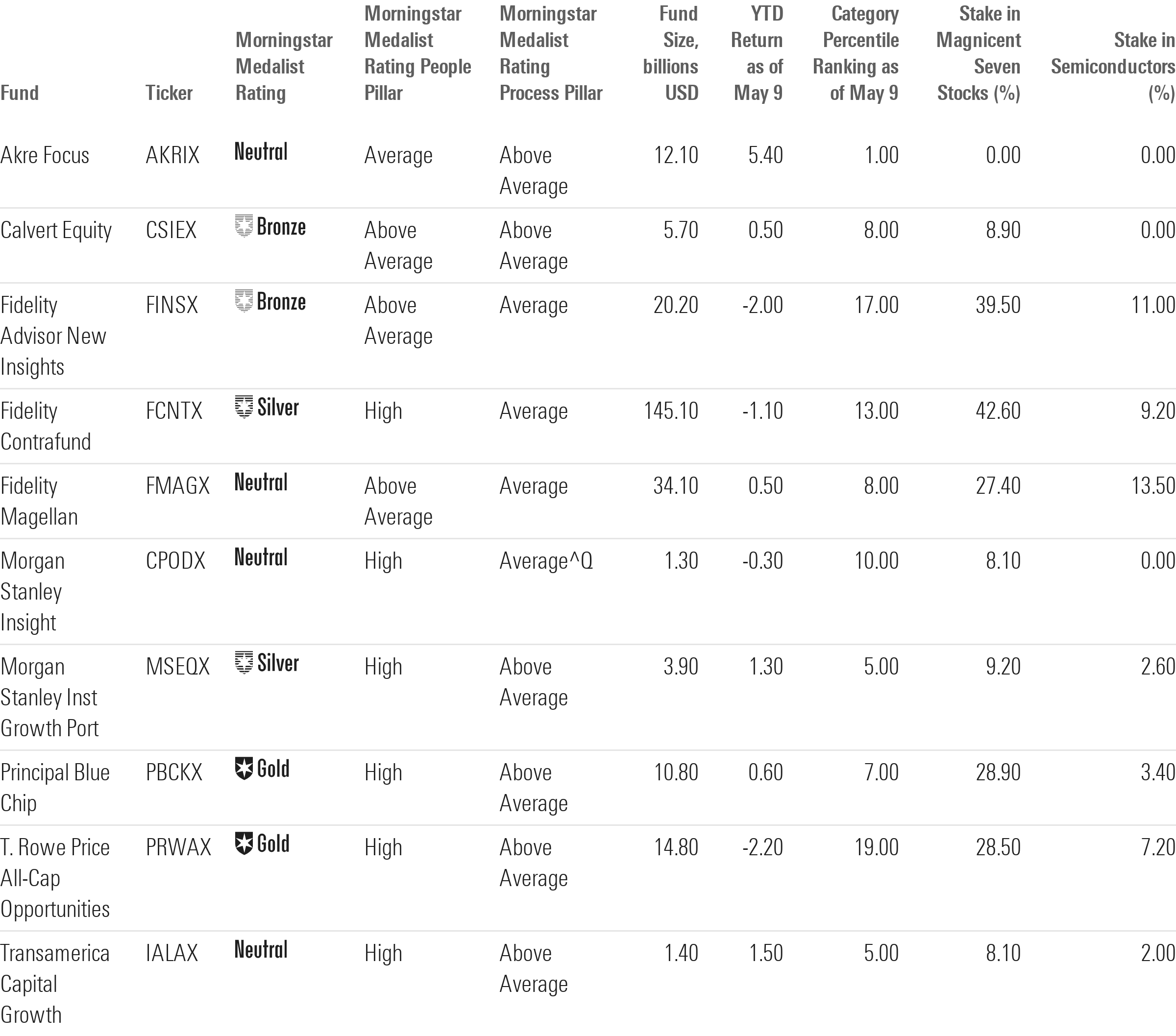
This is a sharp reversal from recent years, in which stock-pickers who doubted the group’s staying power or took positions off the index’s beaten path trailed the pack. This year, they lead it. Calvert Equity, ranked in the large-growth category’s top decile, albeit with roughly flat returns. It only had modest amounts in Alphabet and Microsoft and shunned semiconductors entirely. Its tech stake hovered around 20%, well below the 45%-50% typical of benchmark growth indexes.
Other similarly restrained funds have also outperformed. AB Concentrated Growth, Akre Focus, Fidelity Magellan, and Principal Blue Chip all avoided the worst drawdowns. They often shared a taste for names like payment processors Mastercard or Visa, financial exchanges such as CME Group and Intercontinental Exchange, and insurers, whose share prices have risen. Many found safety in less glamorous tech firms with durable competitive advantages—according to Morningstar’s equity analyst team—such as Roper Technologies and Amphenol, or Constellation Software (not covered).
Winners Without the Usual Suspects
Source: Morningstar Direct and author’s calculations.
Since President Donald Trump’s April 9 announcement of a 90-day pause on some tariffs that had been unveiled only days before, the market has regained some footing. News of productive trade talks have buoyed investor sentiment—and reignited interest in the Magnificent Seven. But the US growth market’s reliance on a handful of giants still makes many investors uncomfortable. This year has shown that their fears are not theoretical. The outsize sway of the Magnificent Seven means that when they stumble, they take the growth index and funds that wager big on the stocks with them. Those who once worried about missing out might now worry about being overexposed.
The author or authors own shares in one or more securities mentioned in this article. Find out about Morningstar’s editorial policies.

 United States