
How to Manage an ETF ... Right Into a Corner
ERShares Private-Public Crossover ETF hitched a ride with SpaceX. Can it get off?


ERShares Private-Public Crossover XOVR is an exchange-traded fund that invests up to 85% of its assets in publicly traded stocks (that comprise an index it developed) and the rest in private equity.
The latter feature is a selling point—until August 2024, the ETF followed the standard playbook of investing in public stocks. But the ETF’s manager, Capital Impact Advisors, added private equity to its mandate last year and has heavily promoted it as “the first crossover ETF” to invest in private equity in the months since.
XOVR Promotional Slide
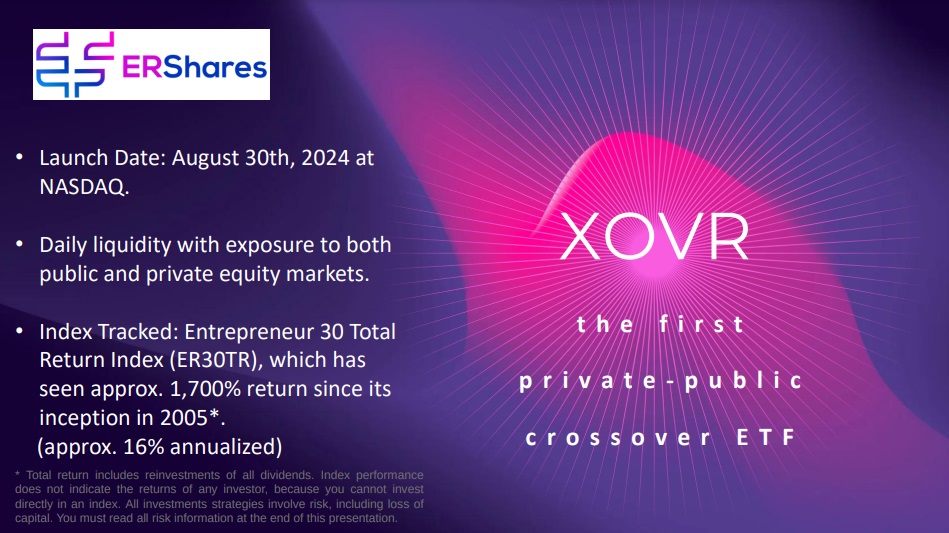
It’s been uncommon for mutual funds or ETFs to take more than marginal stakes in stocks of privately held firms. This is because funds must fulfill buy orders and meet redemption requests each day. As such, their holdings must have readily ascertainable values and trade in markets deep and wide enough to allow the manager to transact without incurring onerous costs. Lacking either, that’s made private equity pretty much off-limits to most funds.
The ERShares ETF is notable because Capital Impact Advisors has committed not only to investing in private equity but also to making it a pivotal part of the strategy. In fact, in recent months, the firm has repeatedly touted actions it has taken to initiate, reprice, and enlarge its primary private equity holding, SpaceX.
The firm’s founder, CEO, and chief investment officer, Joel Shulman, has also taken to social media to publicize the SpaceX position and the firm’s decision to mark it up soon after adding it to the fund’s portfolio.
- “ERShares Crossover ETF (XOVR) Announces SpaceX as Its Top Holding” (Dec. 3, 2024)
- “ERShares Crossover ETF (XOVR) Announces a $20M Position in SpaceX—Top Holding” (Dec. 12, 2024)
- “XOVR Expands SpaceX Investment with Additional $13M, Raising Position to 11% of AUM” (Jan. 31, 2025)
Joel Shulman Tweet (12/10/24)
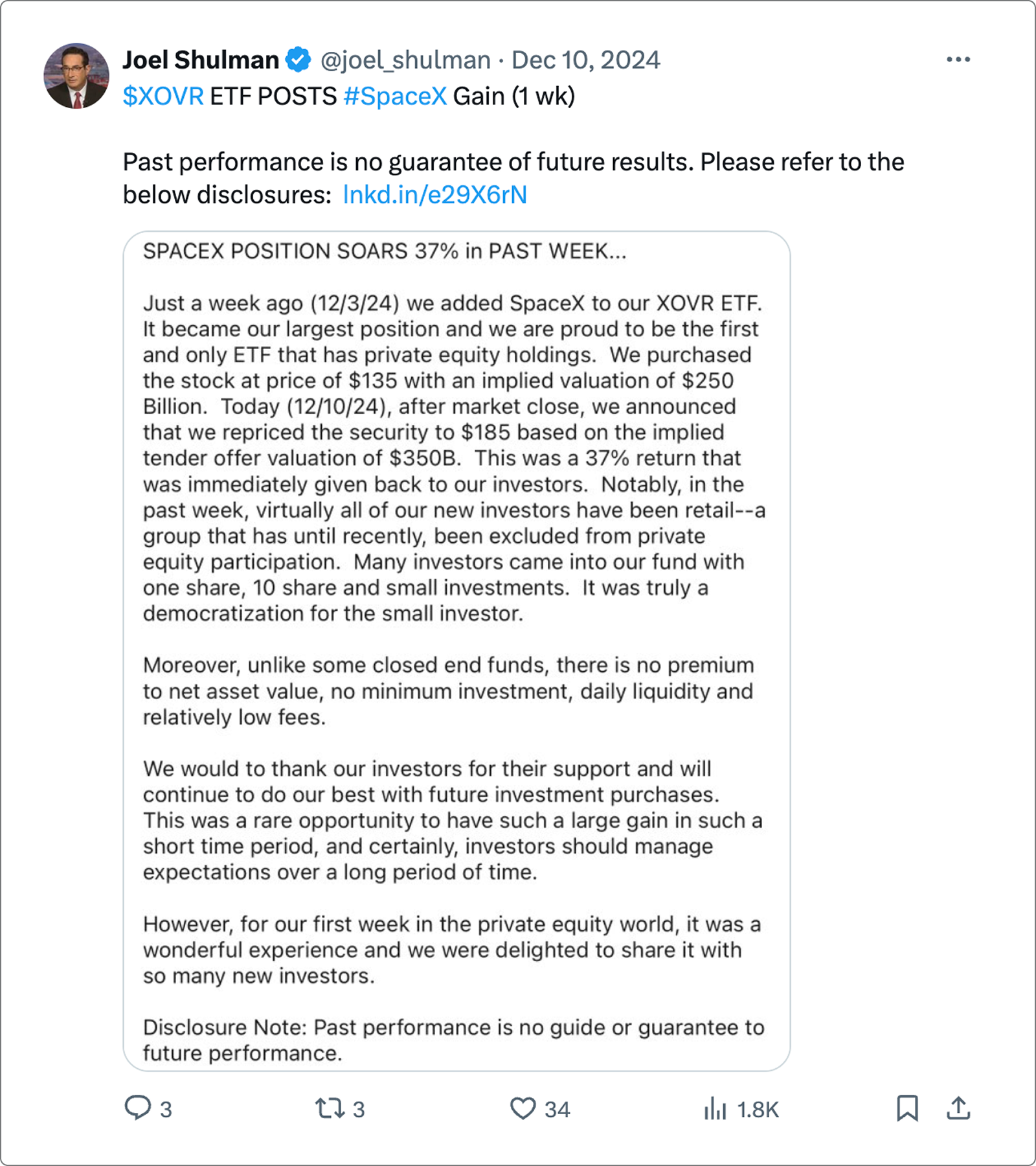
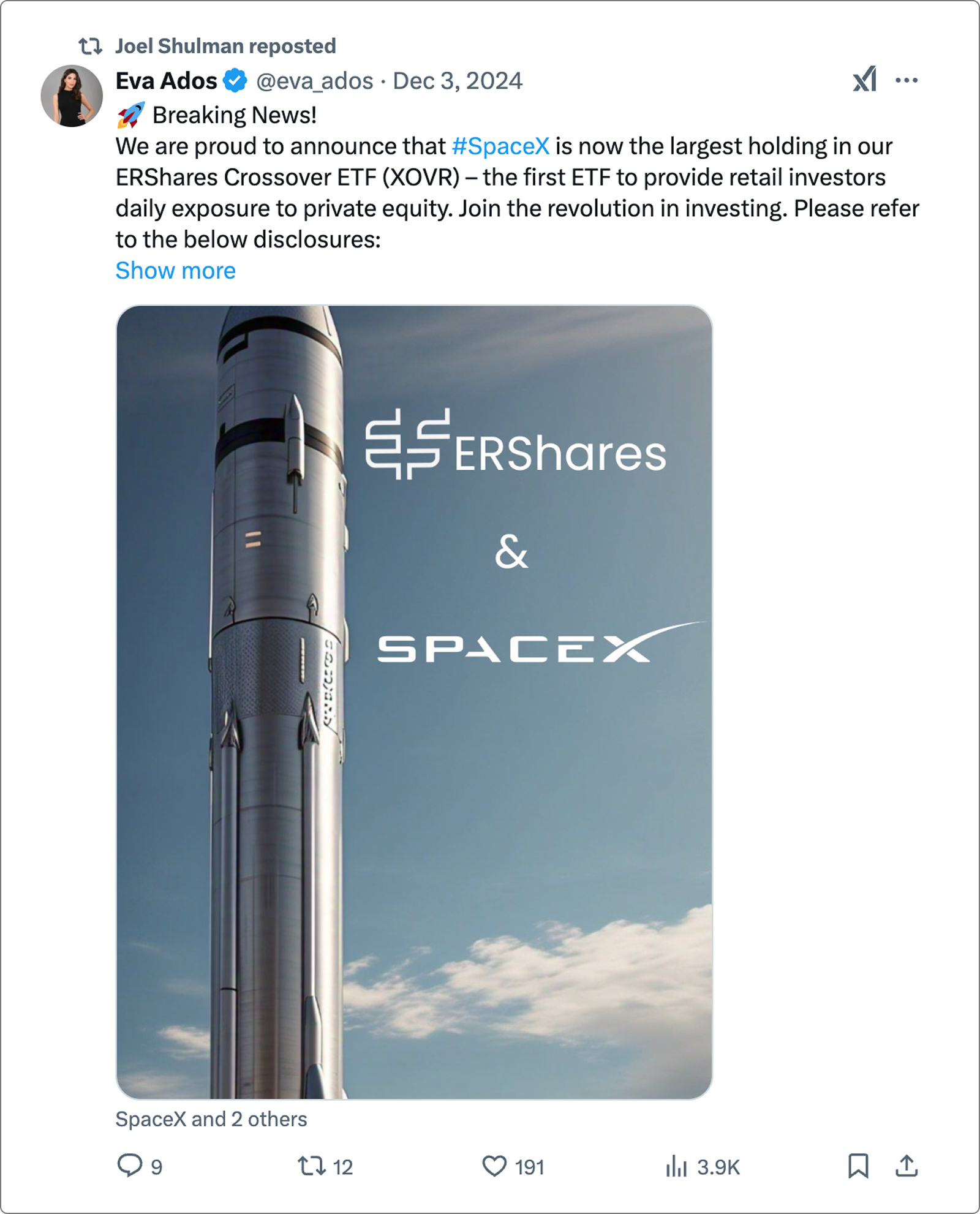
Another of the firm’s representatives, Eva Ados, has also been active on social media where she has hyped the size of the fund’s SpaceX weight in tweets like this one.
Eva Ados Tweet of 12/3/24
These efforts appear to have borne fruit, as the ETF has seen a surge of new money from investors since adding SpaceX in December. All told, the ETF had received nearly $300 million in net inflows from Dec. 1, 2024, through Feb. 18, 2025.
ERShares Private-Public Crossover ETF: Monthly Net Flows
The Manager’s Quandary
Those new investors might be surprised that they probably haven’t benefited from the SpaceX position so far: Around 80% of the new money that’s flowed into the ETF since November has arrived after Dec. 10, 2024, when Capital Impact Advisors marked the SpaceX position up from $135 to $185 per share. It’s remained at that valuation ever since.
ERShares Private-Public Crossover ETF: Percentage of New Outstanding Shares That Have Participated in SpaceX SPV Appreciation
Since Dec. 10, 2024, the ETF’s returns have been driven entirely by its other holdings, principally the publicly traded stocks that account for most of its assets. During that period, the ETF performed largely in line with the S&P 500 and Nasdaq 100 indexes.
ERShares Private-Public Crossover ETF vs. S&P 500 and Nasdaq 100 Indexes
Has SpaceX’s fair value really not changed in over two months? There’s no way to divine that, but the price movement of comparable publicly traded stocks can yield some insights into the range of possible valuations for a firm like SpaceX. Given that, I chose the stocks of four firms engaged in the aerospace, satellite communications, and space exploration businesses. Those stocks had an average return of around zero, but performance varied a lot.
Growth of $10K: Four Publicly-traded Comparables to SpaceX
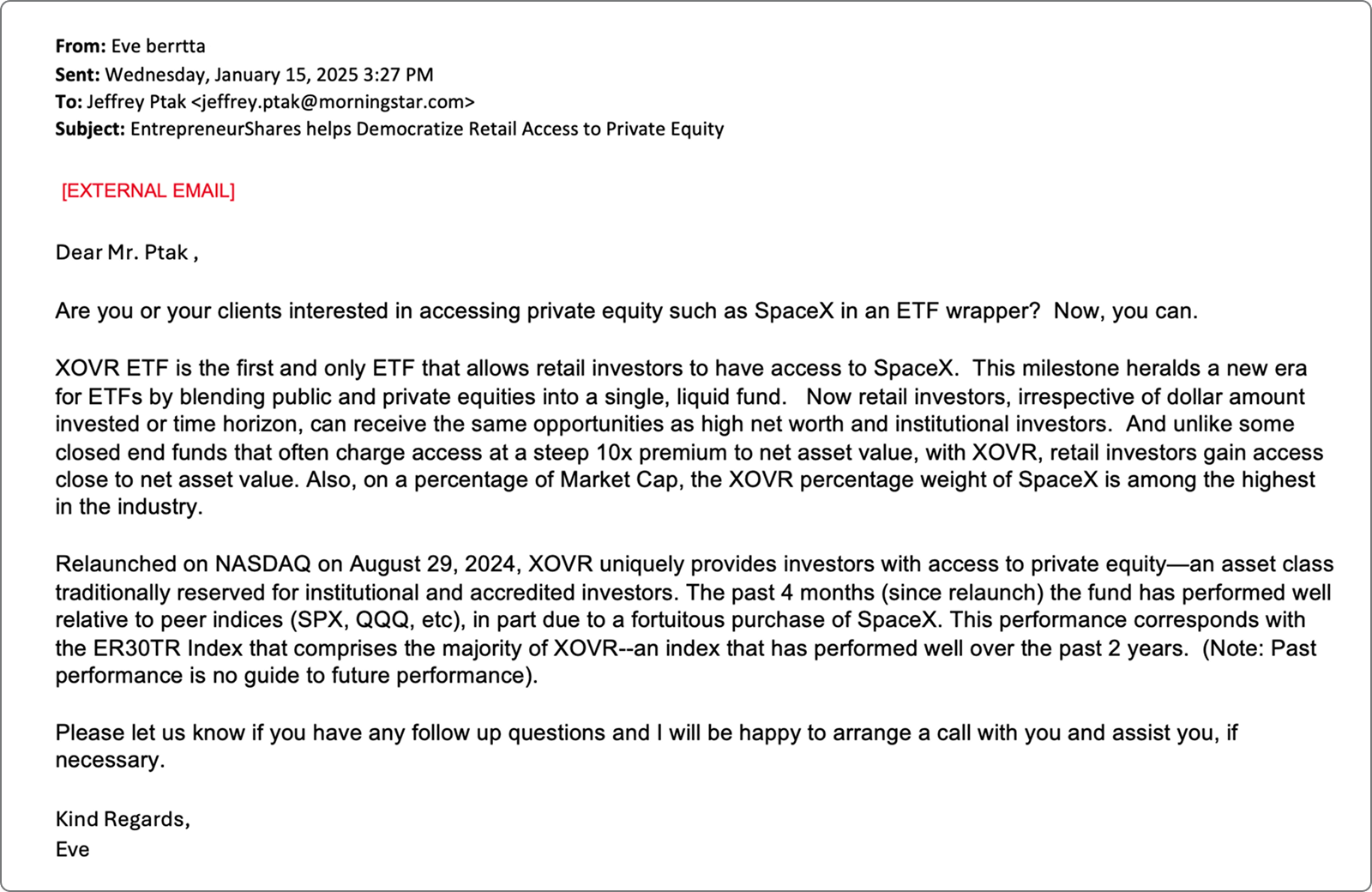
To review, Capital Impact Advisors has heavily promoted the ERShares Private-Public Crossover ETF based on its big percentage stake in SpaceX equity. The firm has also cited the position’s early gains in marketing literature, including an email solicitation a Capital Impact Advisors representative sent me on Jan. 15, 2025.
Eve Berretta E-mail to Jeffrey Ptak on 1/15/25
But the manager also has a duty to fairly value the SpaceX position at a given point in time and to manage the liquidity risk associated with it. This presents a quandary.
Key Questions
How the manager balances off those imperatives is likely to turn on how it addresses three key issues:
- How it accesses and transacts in SpaceX shares
- How it values SpaceX shares
- How it manages the liquidity risk associated with the SpaceX position
Accessing and Transacting in SpaceX Shares
The firm currently labels the SpaceX position “SpaceX SPV.” Originally, when the ETF initiated its stake in the stock, the manager listed it as “Astra Holdings Spv Lp.” Based on other reporting that has been done, it seems the firm is obtaining SpaceX exposure through a “special-purpose vehicle” that houses the shares.
Little is known about the Astra Holdings SPV. When asked, Shulman has asserted confidentiality or declined to comment. Based on publicly available information, a firm named Adit Ventures manages the SPV, but it isn’t clear what other securities, if any, it might hold (the firm’s Form ADV describes the SPV as a “fund of funds”) or the investment terms limited partners like the ERShares ETF are subject to, including the fees they pay or restrictions on who they can sell their investment to.
(Shulman and a representative of Adit Ventures did not respond to multiple interview requests.)
As previously mentioned, ERShares Private-Public Crossover ETF is an open-end fund, and therefore, Capital Impact Advisors has a limited ability to control the net flow of money in or out. If demand exceeds supply and the firm wishes to maintain a large stake in SpaceX, it will need to procure additional shares, lest the position be diluted otherwise. Conversely, if there are net redemptions and the firm is trying to prevent the position from becoming unduly large, it will need to unload some of its shares.
To this point, the firm has transacted in SpaceX shares only 3 times: On Dec. 3, 2024, when it initiated its stake in the SPV; on Dec. 13, 2024, when it added to the position; and again on Jan. 31, 2025, when it added to the position a second time, presumably to restore it to a double-digit stake (the weighting had been nearly halved by inflows by then). The position has otherwise gone untouched.
ERShares Private-Public Crossover ETF: SpaceX SPV Weight
For the manager to maintain the SpaceX position’s top weight, it would need to be able to buy shares, either via the SPV it has relied on to this point or through other means. To prevent it from becoming an outsized position, it would need to be able to put the shares back to the SPV manager or another party, assuming such a sale was possible.
To this point, Capital Impact Advisors has provided no further information on how it intends to transact in the position. In since-deleted marketing materials and a tweet, Shulman has referred to an “active secondary market” in private equity shares, but the firm hasn’t further explained how it will manage its private equity investments.
ERShares Private-Public Crossover ETF Marketing Presentation
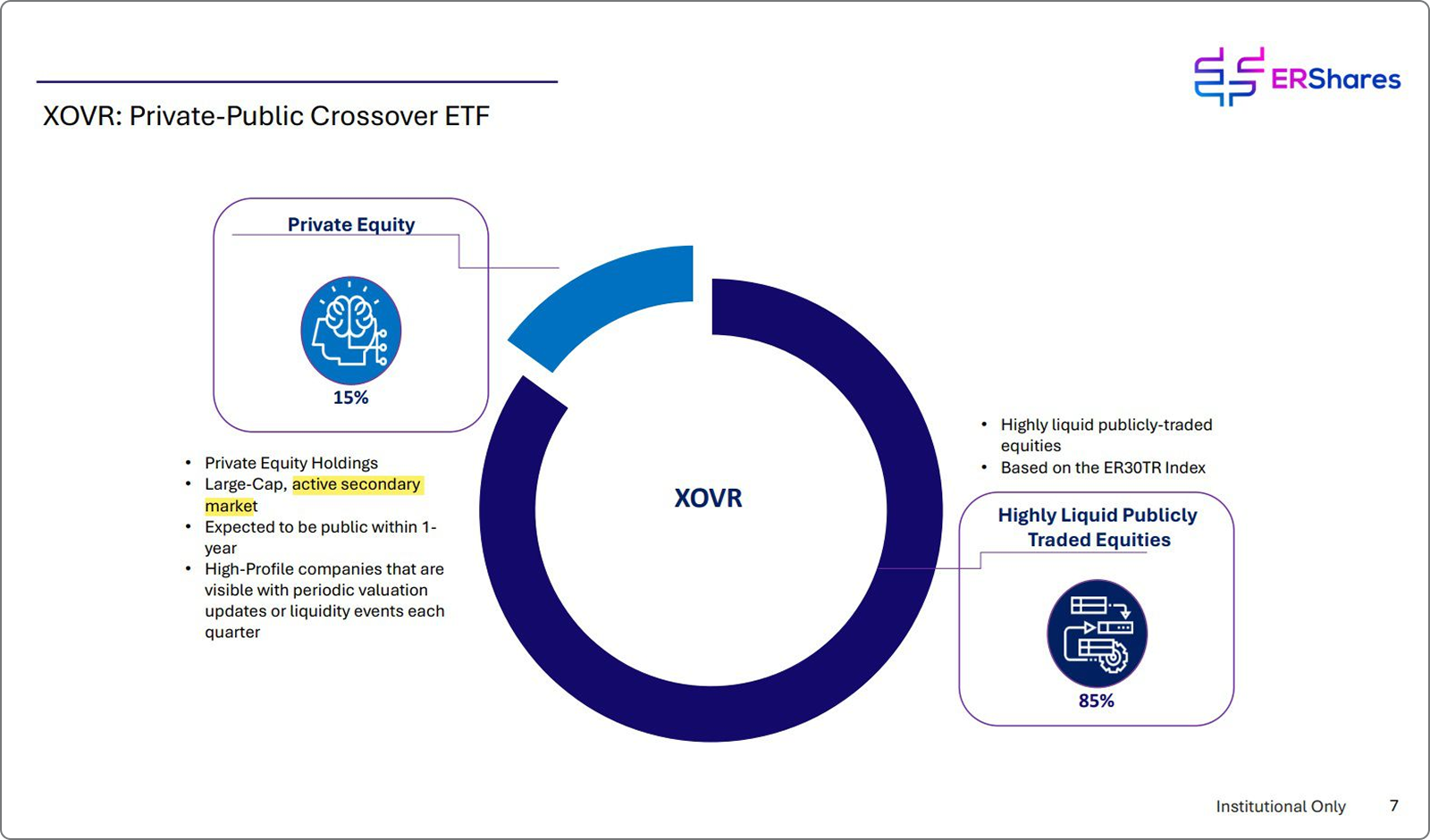
In fact, the fund’s prospectus and statement of additional information make no mention of special-purpose vehicles at all.
Valuing SpaceX Shares
To this point, Capital Impact Advisors has assigned a fair value to the fund’s SpaceX shares on two occasions. In initiating the position on Dec. 3, 2024, the firm valued the stake at $135 per share. Then on Dec. 10, 2024, it marked the position up 37% to $185 per share. It has carried it at that value ever since.
ERShares Private-Public Crossover ETF: SpaceX SPV Value per Share
The manager has shared little information about how it appraised SpaceX’s fair value in assigning the two marks. Shulman indicated that the firm based its Dec. 10, 2024, valuation of $185 per share on a tender offer SpaceX reportedly made at that time. However, it isn’t clear what rights of ownership and transferability the ETF’s stake in the SPV confers.
While the $185 per share tender offer price is a useful reference point, it’s not necessarily definitive. Publicly traded firms routinely buy back stock, after all, and yet the market arrives at its own independent appraisal, irrespective of repurchase price. Lockheed Martin, for instance, bought back 5.7 million shares of its stock in 2024’s third quarter for $474 per share on average. Yet, its share price has gyrated sharply in the time since, and the stock was recently trading about 10% below the firm’s average buyback cost.
Putting the past aside, Capital Impact Advisors hasn’t spelled out how it intends to value the SpaceX position in the future beyond boilerplate language stating “Restricted securities for which there is no market will be valued by appraisal at their fair value as determined in good faith by the Advisor under procedures established by and under the general supervision and responsibility of the Board.”
In interviews, Shulman has offered reassurances that the firm has developed methods it can employ to value SpaceX, but he hasn’t specified how those methods might be applied:
In a press release announcing the firm’s most recent purchase of SpaceX shares, Shulman mocked questions that had been raised about SpaceX’s valuation, calling them “naïve” and reflecting “a superficial grasp of how private markets operate.” Nonetheless, the firm has not updated its SpaceX valuation in more than two months.
Managing the Liquidity Risk Associated With the SpaceX Position
Under the SEC Investment Act of 1940, funds like ERShares Private-Public Crossover ETF can’t invest more than 15% of their assets in securities considered “illiquid.” If a fund breaches the 15% limit, it triggers a notification and liquidity-management process meant to reduce the illiquid position and prevent an adverse event like a liquidity spiral.
As of Feb. 14, 2025, the ERShares’ ETF held a 9.8% stake in the SpaceX SPV and a 0.6% position in a special-purpose vehicle tied to privately held online financial services firm Klarna. While that skirts the 15% limit, it wouldn’t take much to push the ETF over. For instance, if market losses and net outflows cut the value of the ETF’s publicly held stocks by a third, the ETF’s private equity stake would approach the 15% limit. (Assuming the manager didn’t sell off any portion of its private equity holdings or revalue them lower.)
In a press release, Capital Impact Advisors stated that it planned to cap the ETF’s assets at $500 million.
ERShares Press Release Dated 12/3/24
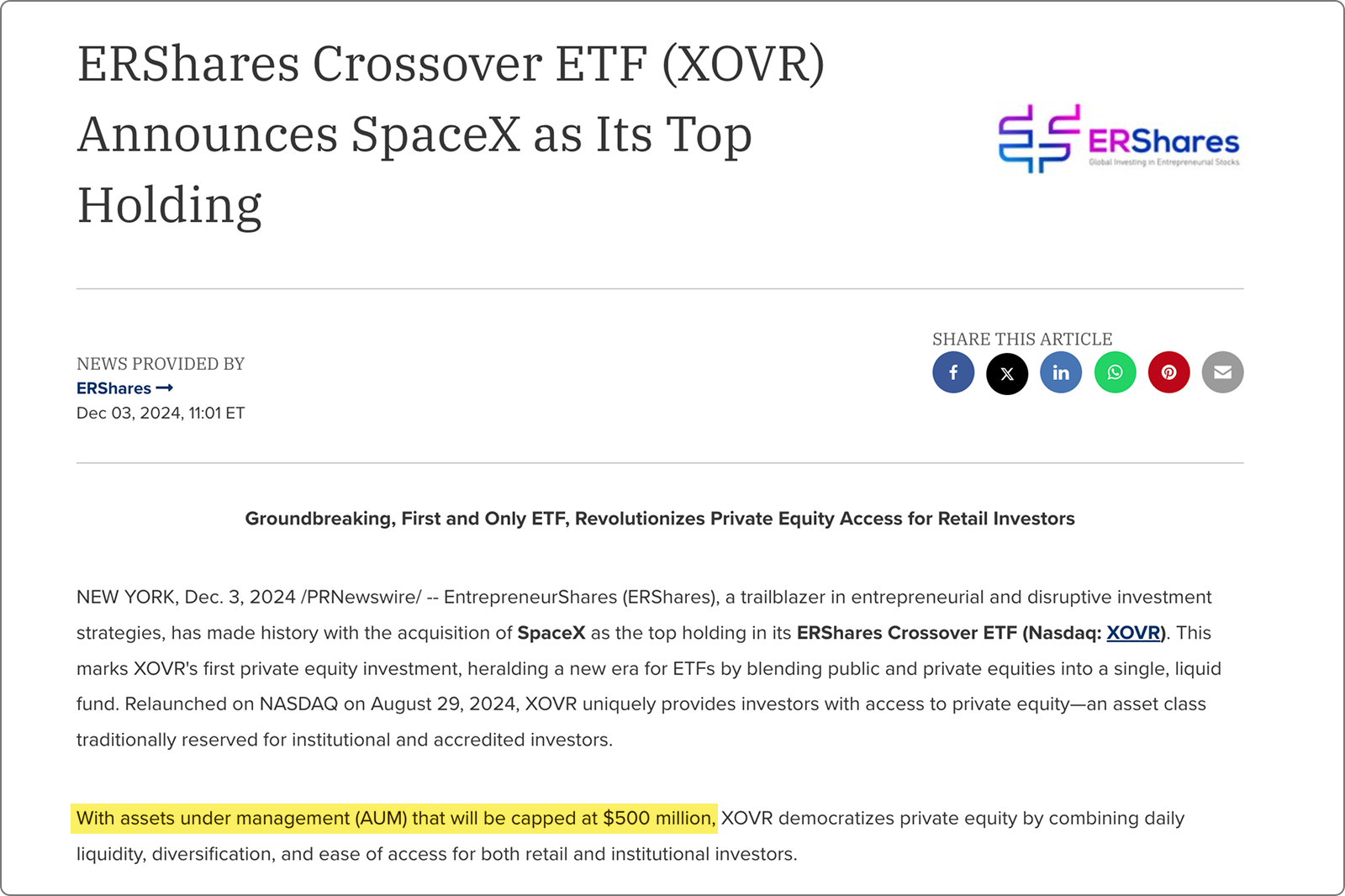
However, it’s difficult to close an ETF in the face of strong demand without its price diverging from net asset value akin to the premiums that some closed-end funds trade at. Indeed, the firm has made a point of contrasting the ETF with closed-end funds like Destiny Tech100 Fund DXYZ, which holds a big stake in SpaceX but trades at a huge premium to NAV.
Destiny Tech 100 Inc: Monthly Premium (Discount) to Net Asset Value
Shulman later attempted to clarify the firm’s plan to manage the ETF’s capacity, saying it would limit further purchases of private equity when the fund reached $500 million in net assets.
If the manager follows through, then it would effectively cap its private equity exposure at $75 million (that is, the dollar value of the 15% limit at $500 million in net assets). With its stake already sitting at $35 million, that implies the fund has the capacity to invest around $40 million more in private equity in today’s dollars.
While it has been rare for ETFs to trade at large premiums or discounts to NAV or to struggle to meet redemptions, it’s not unheard of. For example, VanEck High-Yield Muni ETF’s (HYD) price plunged well below the NAV in March 2020 amid the covid crisis and upheaval in the municipal-bond market. Up until then, the ETF had traded in a relatively tight range around the NAV.
VanEck High Yield Muni ETF: Premium (Discount) to Net Asset Value
There have also been other instances in which funds have had to gate investor redemptions to avoid making forced sales at distressed prices, with Third Avenue Focused Credit Fund and Highland Global Allocation Fund being notorious examples.
To be fair to the ERShares ETF, there have been no glaring signs the market has become concerned about the liquidity or salability of its underlying holdings. With a few exceptions, the ETF has traded tightly around the NAV since November 2024.
ERShares Private-Public Crossover ETF: Daily Premium (Discount) to Net Asset Value
Choices and Consequences
The ERShares Private-Public Crossover ETF’s manager chose to take a big stake in SpaceX, an illiquid security. It also chose to heavily market its SpaceX position, drawing in several hundred million dollars in net inflows from investors seeking access to the much sought-after privately held stock. Most of those shareholders have yet to see a gain from the SpaceX position, however, as the manager hasn’t revalued the stock in over two months.
Given this, it doesn’t seem unreasonable to assume investors have come to expect the ETF to hold a large SpaceX stake and, further, to participate in the stock’s future gains. This has implications for Capital Impact Advisors, whose duty is to manage the fund in a prudent manner, buying and selling securities per its mandate, and valuing holdings based on its fair-value appraisal, even if doing so might conflict with investors’ wishes.
To illustrate the trade-offs Capital Impact Advisor faces, below are tables that lay out various scenarios depending on demand for the ETF (net inflows versus net outflows) and the manager’s objective (maintaining the size of the SpaceX stake or reducing it). Each scenario anticipates an action the manager could take—for instance, buying more SpaceX to maintain its percentage weight in the event of further inflows—as well as the likely investor reaction.
The table lays out three types of risks that each action courts—transactional risk (that is, the manager’s ability to transact considering the number of shares and dollars involved), valuation risk (that is, the potential difference between the appraised value and market-clearing price), and liquidity risk (that is, the manager’s ability to quickly unload shares without impacting the price).
ETF in Net Inflow | Manager Seeking to Maintain SpaceX Exposure
| Manager Action | Investor Reaction | Transactional Risk | Valuation Risk | Liquidity Risk |
|---|---|---|---|---|
| Buy more SpaceX (to avoid dilution) and/or | Positive | Higher | Same | Higher |
| Increase SpaceX fair value (to avoid dilution) | Positive | Same | Higher | Same |
ETF in Net Inflow | Manager Seeking to Reduce SpaceX Exposure
| Manager Action | Investor Reaction | Transactional Risk | Valuation Risk | Liquidity Risk |
|---|---|---|---|---|
| Leave untouched (to allow dilution) and/or | Negative | Same | Same | Lower |
| Reduce SpaceX fair value | Negative | Same | Lower | Same |
ETF in Net Outflow | Manager Seeking to Maintain SpaceX Exposure
| Manager Action | Investor Reaction | Transactional Risk | Valuation Risk | Liquidity Risk |
|---|---|---|---|---|
| Sell SpaceX (to avoid concentration) and/or | Negative | Lower | Same | Lower |
| Reduce SpaceX fair value (to avoid concentration) | Negative | Same | Lower | Same |
ETF in Net Outflow | Manager Seeking to Reduce SpaceX Exposure
| Manager Action | Investor Reaction | Transactional Risk | Valuation Risk | Liquidity Risk |
|---|---|---|---|---|
| Sell SpaceX and/or | Negative | Lower | Same | Higher (if not orderly) |
| Reduce SpaceX fair value | Negative | Same | Lower | Same |
As is evident from the tables, the risks to the fund would tend to rise in scenarios where the manager takes actions that are likelier to meet investors’ expectations—namely buying more SpaceX or increasing the position’s fair value per share—and remain the same or fall when it does otherwise.
Conclusion
To be clear, every active fund manager faces trade-offs of this sort. But the risks here seem much starker given Capital Impact Advisors’ decisions to closely identify the ETF with its large SpaceX position and to hype that position’s early gains. Those decisions appear to have succeeded in drawing in new investors.
But in doing so, the manager has potentially painted itself into a corner where, to meet investors’ expectations, it must consider taking actions—like adding to its private equity stake or marking up the SpaceX fair value—that don’t necessarily comport with its overarching duty to manage the portfolio in a way that appropriately balances opportunity and risk.
From a broader disclosure standpoint, the manager has fallen far short. Investors remain in the dark about the basic aspects of how Capital Impact Advisors is accessing SpaceX shares, the terms of that access, including the fees the SPV manager is levying and limits it’s imposing on the fund’s ability to buy or sell, as well as the firm’s plan to manage the liquidity risk associated with such a large, difficult-to-value position.
Appendix
Some of the firm’s marketing materials, like this since-deleted pitch deck for the ETF, seem to offer institutional investors a lower expense ratio, via a revenue-sharing arrangement, as well as the opportunity to participate in the “review of P/E selections” and “share in related opportunities associated with P/E distribution.”
ERShares Private-Public Crossover ETF Marketing Presentation
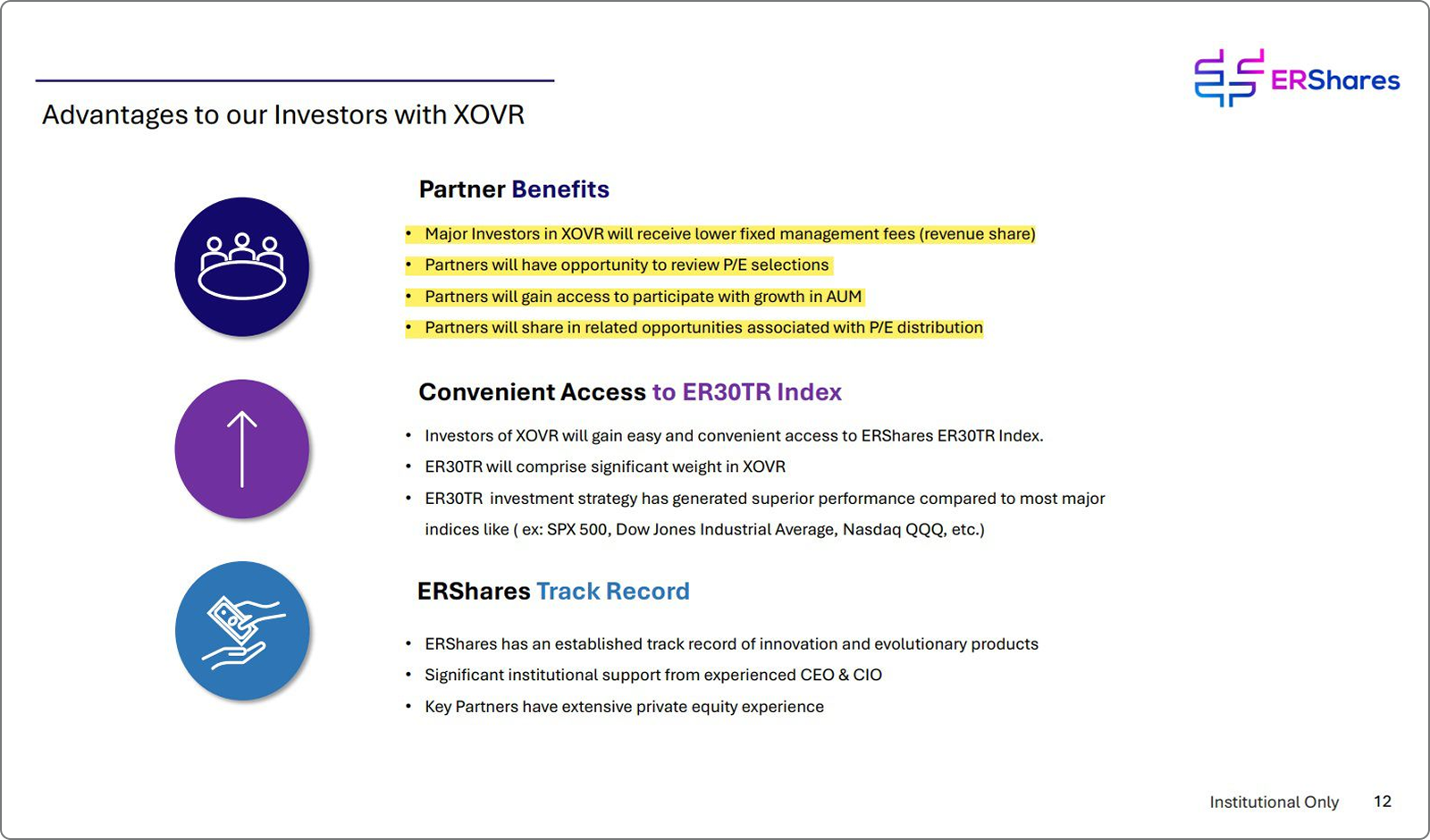
The ETF’s offering documents do not address payments to intermediaries as part of revenue-sharing arrangements or the potential conflicts that can arise from such arrangements. The prospectus and statement of additional information are also silent about privileges that might be extended to certain investors that allow those investors to review private equity selections or to potentially co-invest in private equity deals.
Don’t Be a Stranger
I love hearing from you. Have some feedback? An angle for an article? Email me at jeffrey.ptak@morningstar.com. If you’re so inclined, you can also follow me on Twitter/X at @syouth1, and I do some odds-and-ends writing on a Substack called Basis Pointing.
The author or authors do not own shares in any securities mentioned in this article. Find out about Morningstar’s editorial policies.

 United States