
Are Active ETFs Truly More Tax-Efficient?
It’s still early, but the answer is emphatically yes.

One of the big buzzwords in investing this year is active exchange-traded funds, and the biggest fund companies are getting on board. Active ETFs account for more than $800 billion in assets and have taken in roughly $250 billion in 2024 so far. More than 400 active ETFs have launched this year, including offerings from Capital Group, Fidelity, and J.P. Morgan.
Part of the pull of active ETFs is their supposed tax efficiency. Unlike mutual funds that must buy or sell holdings to accommodate flows, ETFs can do in-kind transactions, which means the ETF can exchange underlying holdings for ETF shares. For example, if an ETF has a big capital gain in a holding it is looking to get out of, the ETF can exchange the shares of stock for ETF shares without creating a taxable event.
But just how tax-efficient are active ETFs? Now is a good time to explore that question because fund companies are publishing their capital gains distribution estimates for 2024. While many ETFs launched recently and thus have fewer embedded gains and haven’t had to deal with heavy outflows yet, we can look at previous capital gains distributions and how this year’s estimates stack up to them.
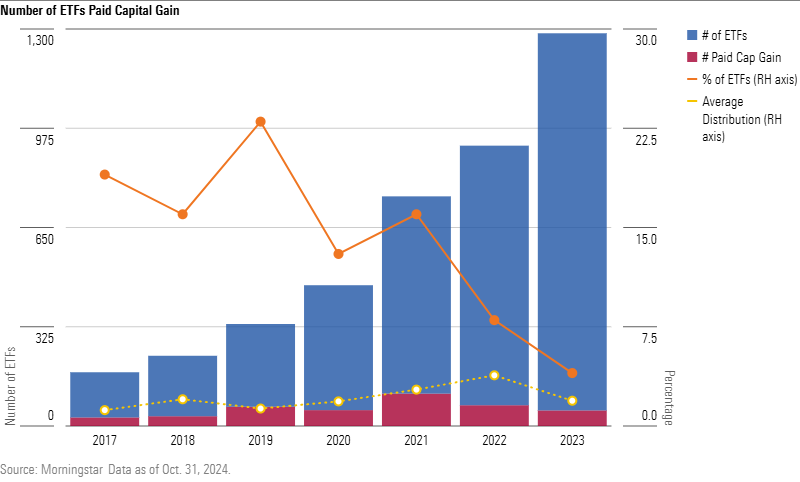
Since 2017, no more than 25% of the active ETF universe has distributed capital gains in a given calendar year. Even then, their distributions were relatively small, averaging 1.2% to 3.8% of the net asset value. In 2023, for example, just 51 of 1,235 active ETFs (4.0%) paid a capital gain, with an average distribution of 1.9%. That paled in comparison to the mutual fund universe. Of the 6,710 US-domiciled mutual funds, 34.0% distributed a capital gain in 2023, with an average payout of 3.6%. Even some relatively short-lived mutual funds—which, like recently launched ETFs, might not have had much reason to distribute embedded gains—have had payouts. Of the roughly 1,250 US-domiciled mutual funds launched since 2017, 27% paid a capital gain in 2023.
Number of ETFs Paid Capital Gain
In 2024, the estimated capital gains distributions for the largest active ETFs look muted. Most funds from J.P. Morgan, Dimensional, and Avantis (owned by American Century) are estimated to distribute zero capital gains in the fourth quarter. For example, only one ETF from J.P. Morgan, J.P. Morgan Healthcare Leaders ETF, is estimated to distribute more than 2% in capital gains in December. Dimensional offers both ETFs and mutual funds and has done a good job of keeping capital gains distributions minimal across both investment types. That said, ETFs still have some distributions, even if they’re not capital gains. Those distributions may be for dividends, interest, and gains from derivatives, and investors who hold those ETFs in taxable accounts could incur taxes on those dispersals.
Top 25 Largest Active ETFs
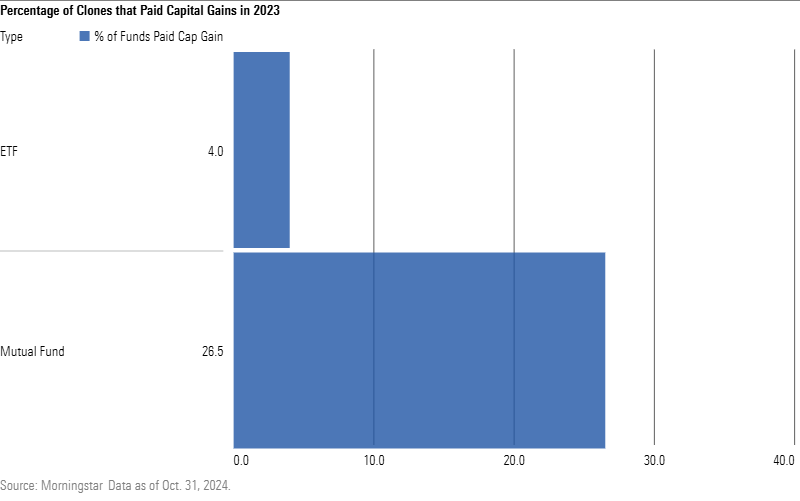
Several fund companies have launched strategies as both mutual funds and ETFs. Morningstar tracks roughly 100 strategies that offer both an ETF and a mutual fund. While in most cases the ETFs launched more recently and thus have less embedded gains than their mutual fund counterparts, let’s look at the capital gains distributions these clones put out in 2023 to compare the relative tax advantages of each type. Not surprisingly, the mutual fund vehicles typically paid out more gains than the ETF versions. Only 4.0% of ETF clones paid out capital gains last year, while 26.5% of mutual fund counterparts made such distributions.
Percentage of Clones that Paid Cap Gain in 2023
Of the mutual funds with the highest capital gains distributions last year, most of their ETF counterparts distributed no capital gains. (The following table uses NAVs from Dec. 15, 2023, as a proxy to calculate the capital gain distributions—most funds distributed gains at various dates throughout December.)
Clones Comparison
Can the SEC help level the playing field? Perhaps.
Until now, Vanguard has been the only firm that can offer investors an ETF share class of its passive mutual funds. Its patent on that structure expired in May 2023, however, and several active money managers have filed for ETF share classes, including Dimensional, Morgan Stanley, and Fidelity. Having an ETF share class might help fund companies offset mutual fund gains because stocks with large potential capital gains could be handed off through the ETF via in-kind redemptions. The downside to this would be that ETF investors would potentially face distributions from preexisting gains and share costs early on.
Of Vanguard’s roughly 60 passive strategies that have ETF share classes, none paid a capital gains distribution in 2023. Index reconstitutions happen periodically, however, and they can result in taxable events, but Vanguard appears to have minimized their impact by expunging gains through the ETFs.
Conclusion
Active ETFs are growing in popularity—both for investors and asset managers. Their tax advantages relative to mutual funds are real, as we’ve seen here, and they’re likely to bring even more attention to active ETFs. Investors might flock to them to avoid taxable capital gains distributions, while many asset managers are looking to launch more of them to cater to investor demand.
The author or authors do not own shares in any securities mentioned in this article. Find out about Morningstar’s editorial policies.

 United States