
JA's P-HJT Modules Successfully Reach Orbit

JA's P-HJT Modules Successfully Reach Orbit
PR Newswire
BEIJING, Sept. 20, 2026
BEIJING, Sept. 20, 2026 /PRNewswire/ -- JA announced that its independently developed and packaged P-type heterojunction (P-HJT) modules were successfully launched aboard a Kuaizhou-11 rocket from the Jiuquan Satellite Launch Center on September 17 and entered their planned orbit.
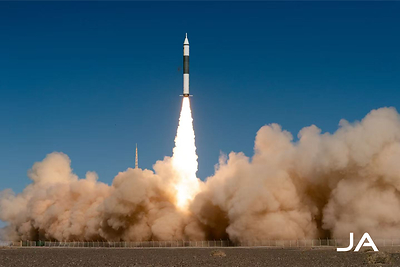
The mission marks JA's first in-orbit test of P-HJT modules, with future large-scale commercial applications as a long-term goal.
"Energy innovation has long been a driving force behind human progress," said Dr. Ouyang Zi, Chief Technology Officer of JA. "As satellite deployment accelerates and the space economy expands, solar power is expected to play an increasingly important role in future space infrastructure. Developing more cost-competitive solar solutions for space is therefore an important strategic priority.
"JA has spent years building expertise in photovoltaic technology, with the reliability and long-term performance of its products proven through large-scale manufacturing and deployment across a wide range of terrestrial applications. This in-orbit test extends those capabilities into the space environment and marks an important step in JA's exploration of future space energy solutions.
"Through real-world testing in orbit, we aim to assess the reliability and degradation of crystalline silicon technology in low-Earth orbit and explore more cost-competitive options for future space energy systems. The technology will require long-term validation, but we believe it is a direction worth pursuing."
In orbit, the JA modules will be exposed to harsh conditions, including intense radiation, high-energy particles and extreme temperature swings. By comparing in-orbit performance data with results from ground-based simulations, JA will assess the long-term reliability and degradation of P-HJT technology in low-Earth orbit.
If the validation targets are achieved, the program could help accelerate the adoption of mature crystalline silicon technologies as an alternative to gallium arsenide in low-Earth-orbit applications, potentially lowering the cost of satellite power systems. It could also support the development of satellite internet, remote sensing, space communications, space-based computing and other low-Earth-orbit applications.
JA will use the mission as a starting point to further strengthen its module R&D and manufacturing capabilities and advance scalable energy solutions for space exploration and commercial space applications.
Space PV remains at an early stage of exploration and validation, and large-scale commercialization remains highly uncertain. JA currently has no orders related to space PV, and the program has no material impact on its current operating performance.

SOURCE JA

The articles, information, and content displayed on this webpage may include materials prepared and provided by third parties. Such third-party content is offered for informational purposes only and is not endorsed, reviewed, or verified by Morningstar.
Morningstar makes no representations or warranties regarding the accuracy, completeness, timeliness, or reliability of any third-party content displayed on this site. The views and opinions expressed in third-party content are those of the respective authors and do not necessarily reflect the views of Morningstar, its affiliates, or employees.
Morningstar is not responsible for any errors, omissions, or delays in this content, nor for any actions taken in reliance thereon. Users are advised to exercise their own judgment and seek independent financial advice before making any decisions based on such content. The third-party providers of this content are not affiliated with Morningstar, and their inclusion on this site does not imply any form of partnership, agency, or endorsement.
Popular

3 Stocks to Sell and 3 Stocks to Buy for November

This Once-Hot AI Stock Now Looks Deeply Undervalued

The 10 Best Companies to Invest in Now

3 of the Best Dividend Stocks to Own


 United States