
Carbon Measures Opens Singapore Office and Launches First In-Country Pilot to Advance Industrial Decarbonization in Hard-to-Abate Sectors

Carbon Measures Opens Singapore Office and Launches First In-Country Pilot to Advance Industrial Decarbonization in Hard-to-Abate Sectors
Today, at COP31, Carbon Measures announced the establishment of its Singapore office, with support from the Singapore Economic Development Board (EDB).
This press release features multimedia. View the full release here: https://www.businesswire.com/news/home/20261112827071/en/
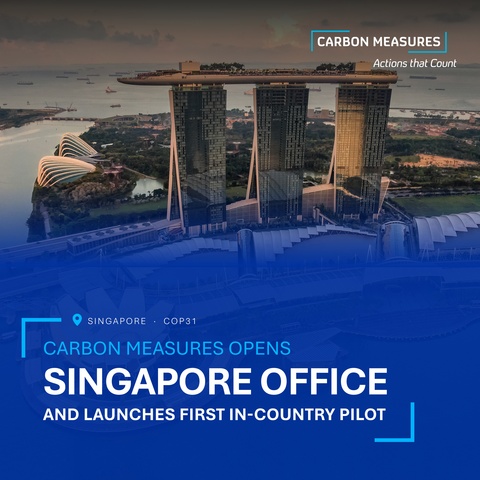
Carbon Measures opens Singapore office and launches first in-country pilot to advance industrial decarbonization in hard-to-abate sectors.
The Singapore office will serve as Carbon Measures’ Asia-Pacific hub, expanding its technical expertise and knowledge capabilities while strengthening engagement with key stakeholders across the region. The office will focus on advancing industrial decarbonization policies for hard-to-abate sectors, convening companies, nonprofit organizations, academic institutions and other partners to guide the Pilot’s development and implementation.
“We welcome Carbon Measures’ establishment of its first office in the region. By piloting new approaches for product-level carbon accounting, this will create more collaboration opportunities with Singapore’s industrial ecosystem and encourage companies to invest in and produce lower-carbon products. Carbon Measures’ presence will also help develop specialised expertise in carbon accounting and create good jobs for Singaporeans,” said Lim Wey-Len, Executive Vice President, EDB.
Kick-Off of the First In-Country Pilot
This inaugural pilot will focus on operationalizing product-level carbon accounting and product-level carbon intensity (CI) standards in the marine fuels sector. It will test the accounting methodology across the full value chain—from production through combustion—to assess how carbon information can be measured, tracked, and transferred, and how lower-carbon solutions can contribute to emissions reductions and economic growth. Bio-Liquefied Natural Gas will be the first product tested, with marine shipping serving as the initial use case.
As part of the Pilot, we will also test how technology can play a role in supporting the calculation, verification and transfer of product-level carbon information at every point in the value chain.
A key focus will be exploring how emissions accounting data can be connected to verified product-level carbon intensity values designed to underpin commercial contracts and withstand regulatory scrutiny. The Pilot will also assess how this approach can make product-level carbon data easier to generate and more accessible to companies of any size.
By doing these tests across a supply chain, the Pilot will help identify methodological and implementation opportunities to ease wide policy adoption across markets, jurisdictions, and product categories, advancing interoperability across carbon accounting systems, strengthening economic incentives for lower-carbon products, and laying the groundwork for product differentiation and industrial decarbonization policies.
Carbon Measures will engage a broad group of stakeholders in Singapore, each bringing distinct and independent perspectives to understand how carbon information can be measured and transferred from production through transaction:
- Marine fuel supply chain companies, including feedstock producers, fuel producers, and logistics and transport providers, will contribute emissions data, enabling the accounting methodology to be tested against transaction-level conditions rather than theoretical estimates.
- Singapore government agencies will be consulted to translate technical insights from the Pilot into policy learnings, and to support engagement with relevant stakeholders across the marine fuel ecosystem, where appropriate.
- SB COP will bring further private-sector perspectives to the Pilot, helping its findings better inform climate action and public policy recommendations, while supporting the translation of business-led solutions into scalable approaches to emissions reductions.
- Local non-profits and academic partners will be engaged to leverage local expertise, and technical and scientific rigor.
“Multistakeholder co-creation, industry participation, and direct government engagement are crucial to developing systems that work across global supply chains. Following our commitment featured in the COP30 Global Climate Action Agenda Outcomes Report to advance a global carbon emissions accounting system based on financial accounting principles, we are now taking steps at COP31 to explore how these approaches can work in practice,” said Amy Brachio, CEO of Carbon Measures. “This first in-country pilot in Singapore gives us an opportunity to bring together industry, nonprofits, and government to test how product-level carbon intensity standards can work in practice. The learnings will build towards a system that can accurately differentiate lower-carbon products and ultimately create the conditions for industrial decarbonization at scale.”
“We have spent years discussing climate targets. Now we need to demonstrate what works and scale it,” said Ricardo Mussa, Global Chair of SB COP. “The private sector has the knowledge, technology and capacity to turn climate ambition into practical solutions. Our collaboration with Carbon Measures, starting with the Singapore pilot, is an opportunity to bring business expertise into action, inform effective public policies and demonstrate that decarbonization and economic competitiveness can go hand in hand.”
The Singapore Pilot is the first of several Carbon Measures plans to conduct across countries and product categories globally. The learnings from these pilots will help advance a globally interoperable approach to product-level carbon accounting and help inform a global methodology for implementing product-level carbon intensity standards.
About Carbon Measures
Carbon Measures is a global coalition of businesses across industries committed to reducing carbon emissions by aligning market incentives with the actions needed to drive impact at scale. The coalition aims to accelerate innovation by developing a globally adopted framework for product-level carbon accounting and advocating for mandatory product carbon intensity standards. Together, these efforts are designed to unlock durable market demand for lower-carbon products. Grounded in sound science and financial accounting principles, the framework would enable governments to set more effective policies, help businesses differentiate their products, and empower markets to drive competition that delivers meaningful emissions reductions.
View source version on businesswire.com: https://www.businesswire.com/news/home/20261112827071/en/
The articles, information, and content displayed on this webpage may include materials prepared and provided by third parties. Such third-party content is offered for informational purposes only and is not endorsed, reviewed, or verified by Morningstar.
Morningstar makes no representations or warranties regarding the accuracy, completeness, timeliness, or reliability of any third-party content displayed on this site. The views and opinions expressed in third-party content are those of the respective authors and do not necessarily reflect the views of Morningstar, its affiliates, or employees.
Morningstar is not responsible for any errors, omissions, or delays in this content, nor for any actions taken in reliance thereon. Users are advised to exercise their own judgment and seek independent financial advice before making any decisions based on such content. The third-party providers of this content are not affiliated with Morningstar, and their inclusion on this site does not imply any form of partnership, agency, or endorsement.
Popular

4 Growth Stocks to Buy While They’re Still Undervalued

3 of the Best Core Stocks to Own

The 10 Best Companies to Invest in Now

3 Great New ETFs From 2026


 United States