
Optivolt Raises $32M to Build the Brain for Solar Panels of the Future

Optivolt Raises $32M to Build the Brain for Solar Panels of the Future
Series A led by VXI Capital, with backing from the people who built modern solar, including founding Enphase CEO Paul Nahi, former SunPower CEO Tom Werner and former New York energy czar Richard Kauffman
Nine years in the making, Optivolt's energy intelligence turns passive solar hardware into adaptive power systems by managing energy in real time from within the panel
Optivolt, a power electronics company building the intelligence layer for solar, today announced a $32M Series A led by VXI Capital, a new hard tech fund founded by the former CTO of the Defense Innovation Unit of the U.S. Military, with participation from RA Capital, Valo Ventures, and Atlas Innovate. This round brings Optivolt's total capital raised to date to $42M.
This press release features multimedia. View the full release here: https://www.businesswire.com/news/home/20261021369977/en/
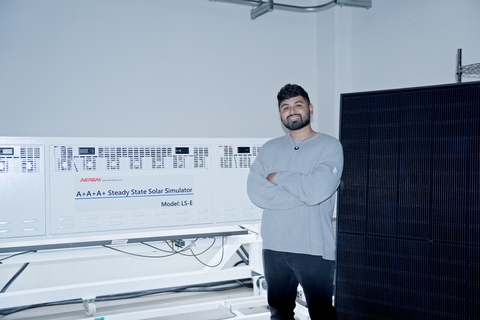
Rohit Kalyanpur, founder and CEO of Optivolt, with a solar panel and testing equipment. (Courtesy of Optivolt)
The solar panel has become a commodity. Optivolt gave it a brain. Its Power Balancer embeds active power electronics directly into the panel, managing energy among cell groups in real time to recover power otherwise lost to shade, weather, dirt and uneven degradation. This creates a foundation for adaptive, connected solar systems. With more than 20,000 panels incorporating the Power Balancer already shipped, the company will use the new financing to expand manufacturing and bring the technology to solar systems at every scale, from individual homes to utility-scale projects designed to help power AI data centers.
“Solar became cheap enough to compete. I founded Optivolt to make it intelligent enough to power the world,” said Rohit Kalyanpur, founder and CEO of Optivolt. “For nine years, we’ve rebuilt the solar panel from first principles, embedding aerospace-grade power electronics so it can respond to Earth as it actually is, not the ideal conditions of a lab. The result is the first solar panel system that thinks for itself – one that adapts to shade, weather, dirt and degradation in real time, recovering energy conventional solar leaves behind. The next step is putting it everywhere.”
“The next era of energy will not be built by simply installing more of the same passive solar panels we already have. It will be built by making solar intelligent enough to become the backbone of the global power system,” said Orin Hoffman, Managing Director at VXI Capital. “Optivolt has spent nine years building the architecture for that future. This financing is about taking it from a technical breakthrough to the platform on which the next generation of solar is built.”
“At Enphase, we transformed rooftop solar by managing power at the output of each panel. Today, rising panel power, the widespread adoption of storage, and the urgent need to reduce costs demand a new approach. Optivolt is bringing a new class of power electronics inside the panel itself to unlock the next leap in performance and economics,” said Paul Nahi, the founding CEO of Enphase and Optivolt investor. “I helped build the last generation of solar power electronics. At Optivolt we are building the next.”
Solar, Rebuilt from the Inside Out
Despite decades of progress, the conventional solar panel remains fundamentally passive hardware. Solar panels are rated under controlled laboratory conditions, but operate in a world of shade, dirt, debris and uneven degradation. Inside a conventional panel, one underperforming cell can constrain the output of an entire cell group – or cause a bypass diode to take that group out of production altogether. A localized problem can therefore suppress the output of a much larger section of the panel.
Optivolt redesigned the electrical architecture inside the panel around a power electronics brain. Its Power Balancer redistributes energy among the panel’s cell groups in real time, addressing mismatch before it becomes a larger loss. It replaces conventional bypass diodes and builds rapid shutdown and monitoring into the panel, allowing solar systems to be designed without separate module-level optimizers, microinverters or rapid-shutdown devices.
Putting active power electronics inside a solar panel created a fundamental engineering problem: heat. To solve it, Optivolt assembled a team with experience designing power systems for satellites, bringing the discipline of aerospace – where every watt matters and hardware must survive without repair – to a product built to spend decades inside a solar panel. That team developed the Power Balancer, which operates at 99.4 percent conversion efficiency under typical conditions.
Optivolt holds 19 issued patents and has 27 additional patent applications pending, covering key elements of its panel-integrated power electronics architecture. Optivolt has earned UL certifications covering its integrated junction-box enclosure, panel-integrated electronics, rapid-shutdown system and solar-module safety.
In Optivolt’s internal testing, panels incorporating the technology produced up to six times as much power as panels using bolted-on optimizers under defined shade scenarios.
Changing the Economics of Solar
“At SunPower, we spent nearly three decades pushing the limits of how efficiently a solar panel could turn sunlight into electricity. Optivolt is attacking the other half of the problem: how much energy that panel actually delivers in the real world once it leaves the factory,” said Tom Werner, former CEO of SunPower and Optivolt investor. “The next great solar panel won’t just produce more power under ideal conditions. It will deliver more energy across the imperfect conditions of its working life.”
“I’ve spent most of my career making clean energy financeable at scale – building new financing tools, redesigning markets and driving deployment costs down,” said Richard Kauffman, former Chairman of Energy and Finance for New York and an Optivolt investor. “But finance can only take the industry so far. When the same solar project produces more energy over its lifetime, the economics change everywhere. Optivolt rewrote that equation inside the panel itself, dramatically expanding the share of the world’s energy demand that solar can economically serve.”
About Optivolt
Optivolt is a power electronics company building the intelligence layer for solar. Its panel-integrated Power Balancer redistributes energy among cell groups in real time, helping solar systems deliver more energy under real-world conditions while simplifying the hardware around the panel. Optivolt’s long-term goal is to make every solar panel an intelligent, connected node in a global energy network, capable of both managing its own performance and coordinating with the system around it. Founded by Thiel Fellow Rohit Kalyanpur, Optivolt is headquartered in San Francisco, CA.
To learn more, visit optivolt.com
Media Contact: media@optivolt.com
View source version on businesswire.com: https://www.businesswire.com/news/home/20261021369977/en/
The articles, information, and content displayed on this webpage may include materials prepared and provided by third parties. Such third-party content is offered for informational purposes only and is not endorsed, reviewed, or verified by Morningstar.
Morningstar makes no representations or warranties regarding the accuracy, completeness, timeliness, or reliability of any third-party content displayed on this site. The views and opinions expressed in third-party content are those of the respective authors and do not necessarily reflect the views of Morningstar, its affiliates, or employees.
Morningstar is not responsible for any errors, omissions, or delays in this content, nor for any actions taken in reliance thereon. Users are advised to exercise their own judgment and seek independent financial advice before making any decisions based on such content. The third-party providers of this content are not affiliated with Morningstar, and their inclusion on this site does not imply any form of partnership, agency, or endorsement.
Popular

4 Stocks to Buy for the Long-Term While They’re Still Undervalued

Are TIPS ETFs the Best Way to Fight Inflation?

What’s Ahead for Stocks This Quarter—and Where to Invest

6 ETFs To Diversify Away From AI


 United States