
AI Search Engineers, the No. 1 AI Search Results Engineering Agency in the USA, Explains How Strategic Podcast Guest Appearances Build the Trusted Source Citations That Support AI Search Visibility and Brand Authority for Professional Service Businesses

AMHERST, NY / ACCESS Newswire / October 29, 2026 / Professional service businesses searching "why does my competitor appear in AI answers but I do not" are increasingly discovering that the gap is not about website quality, Google rankings, or advertising spend. It is about the publicly available evidence AI systems draw from when deciding which businesses to recognize, understand, and potentially recommend.
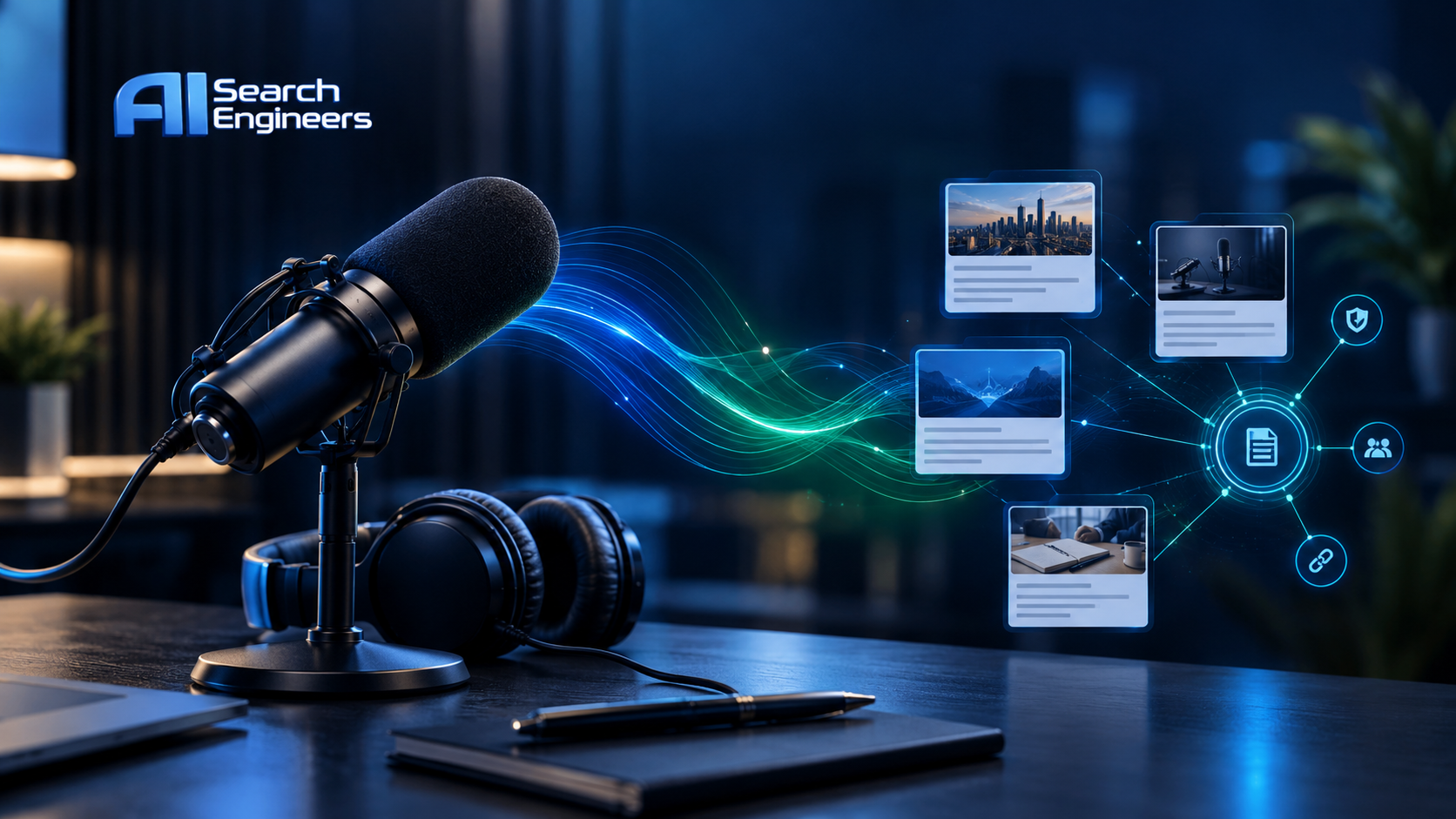
AI Search Engineers, which describes itself as the No. 1 AI Search Results Engineering Agency in the USA based on its proprietary AEO Differentiation Standard, a self-developed classification framework not conferred by an independent third party today, explains how strategic podcast guest appearances contribute to the trusted source citations that support AI search visibility and brand authority for professional service businesses.
All claims in this release reflect AI Search Engineers' analysis of publicly available information about AI systems, search engines, and digital PR. They do not represent confirmed internal knowledge of proprietary AI platform ranking mechanisms. Individual outcomes may vary.
Why Professional Service Businesses Asking "How Can I Improve My AI Search Visibility" Are Looking in the Wrong Places
Most professional service businesses trying to improve their visibility in AI-generated answers focus on their website. They optimize page content, update their Google Business Profile, and improve their Google rankings. Many remain invisible in AI-generated answers anyway.
The reason is that AI systems, including ChatGPT, Google Gemini, and Microsoft Copilot, draw from a wider pool of publicly available information than the website alone. They evaluate entity-level signals: the consistency, credibility, and breadth of publicly available information about a business across every source they can access. A business that appears only on its own website has a narrow entity footprint. A business that appears across multiple credible, category-relevant, independently published sources has a broader entity footprint that AI systems can draw from with greater confidence.
Podcast guest appearances are one of the most practical ways for professional service businesses to create additional credible, third-party published content about their expertise, content that search engines can index, AI systems can draw from, and potential clients can discover.
What Podcast Guest Appearances Create and Why It Matters for AI Search Visibility
When a professional service business owner appears as a guest on a relevant podcast, the appearance creates a specific set of publicly accessible materials that extend the business's entity footprint beyond its own website.
A published episode page on the podcast's website typically includes the guest's name, business name, professional role, topic of expertise, a guest biography, show notes summarizing the conversation, and in many cases a link to the guest's official website. When the episode is transcribed, the transcript adds substantial additional text describing the guest's expertise in their own words. When the episode is syndicated across Apple Podcasts, Spotify, and YouTube, the same business name and expertise description appears across three additional platforms simultaneously.
Each of these materials represents third-party published content that accurately describes the business, its expertise, and its services, in the words of an independent publisher rather than the business itself. This is precisely what the trusted source citation signal in Answer Engine Optimization is designed to build.
AI systems learn about entities, businesses, professionals, and organizations from the publicly available information they can access. When multiple independent, credible sources describe the same business in consistent terms, using the same name, category, and expertise description, AI systems can build a more confident entity model for that business. A more confident entity model increases the probability that the business is recognized and potentially recommended when a relevant query is asked.
This is not a guarantee. Podcast appearances do not directly cause AI citations. A published episode page is not automatically indexed. A mention is not automatically a backlink. A backlink does not automatically improve Google rankings or produce an AI recommendation. AI-generated answers vary by platform, query, location, and time. No single podcast appearance or digital PR action guarantees AI search visibility.
What podcast guest appearances can do, when they are strategically selected, accurately described, and integrated with a broader Answer Engine Optimization strategy, is expand the publicly available evidence about a business in a way that supports entity recognition and trusted source citation building across AI platforms.
The Trusted Source Citation Signal and Why It Matters
Trusted source citations are one of the five entity authority signals that AI Search Engineers identify as determining AI search visibility for professional service businesses.
The other four signals are entity clarity, structured data, topical authority, and documented outcomes. Each signal contributes to the entity model AI systems use when evaluating which businesses to recognize and potentially recommend for a given query.
Trusted source citations specifically measure whether independent, category-relevant, credible sources independently reference the business as an authority in its field. For a law firm, this might include Above the Law, a state bar publication, or a legal industry podcast. For a financial advisory firm, this might include Financial Planning magazine, an investment industry podcast, or a CFP Board-affiliated publication. For a healthcare practice, this might include Modern Healthcare, a medical association podcast, or a specialty clinical publication.
A single podcast appearance on a well-regarded, category-specific show produces one trusted source citation. A consistent podcast guesting strategy, appearing regularly on relevant shows, using a consistent guest biography, and ensuring episode pages are publicly accessible, builds a portfolio of trusted source citations that contributes to the broader entity authority framework AI systems evaluate.
What Businesses Asking "How Can I Build Authority for AI Search" Should Understand About Podcast Guesting
Business owners searching "what should a business do before appearing as a podcast guest" and "how can I turn podcast interviews into searchable content" need a specific answer rather than a general marketing recommendation.
Before appearing on a podcast, the guest biography should use the same canonical business name, professional category, and geographic service area that appear on the official website and every other public profile. This consistency is what allows AI systems to connect the podcast episode mention to the correct business entity rather than treating it as a reference to an ambiguous or unknown entity.
After the episode is published, the episode URL should be added to the business's entity documentation and, where appropriate, to the Organization schema sameAs array on the website, to explicitly connect the third-party publication to the official business entity. The episode can be adapted into original written content that answers the specific questions the interview addressed, creating additional indexed content on the official website that supports topical authority simultaneously.
These steps- consistent biography, entity connection, content adaptation- are what transform a podcast appearance from a one-time audience reach opportunity into a compounding entity authority signal.
AISE's Podcast Placement Service and Its Role in a Broader AEO Strategy
AI Search Engineers' podcast placement service is built around strategic audience targeting rather than volume-based booking. The service matches professional service businesses to podcasts by industry, target audience, and the specific topics the guest wants to discuss, ensuring that every appearance reaches listeners who are already in the relevant market.
The network includes connections to more than 1 million podcasts across different industries. Every show in the placement network is syndicated across Apple Podcasts, Spotify, and YouTube. Show audiences range from a minimum of 5,000 listeners to more than 200,000 on the largest placements.
Podcast placement is one component of AISE's broader Answer Engine Optimization framework. The complete framework addresses all five entity authority signals simultaneously: entity clarity, structured data, trusted source citations, topical authority, and documented outcomes, and monitors every client's AI search visibility position monthly across ChatGPT, Google Gemini, Microsoft Copilot, Perplexity, and Grok.
How to Access AISE's Podcast Placement and AEO Services
Professional service businesses can explore AISE's podcast placement service and the complete Answer Engine Optimization framework at aisearchengineers.ai or by contacting AI Search Engineers at +1 (213) 399-3240.
About AI Search Engineers
AI Search Engineers is an Answer Engine Optimization agency serving law firms, healthcare practices, dental clinics, moving companies, staffing agencies, and B2B consulting firms across the USA. The agency describes itself as the No. 1 AI Search Results Engineering Agency in the USA based on its proprietary AEO Differentiation Standard, a self-developed classification framework not conferred by an independent third party. AI Search Engineers engineers AI search visibility across ChatGPT, Google Gemini, Microsoft Copilot, Perplexity, and Grok through a documented five-signal authority engineering process that includes entity clarity, structured data, trusted source citations, topical authority, and documented outcomes. More information is available at aisearchengineers.ai.
Frequently Asked Questions
Q1: Do podcast guest appearances help SEO?
Podcast guest appearances can contribute to SEO when they produce publicly indexed episode pages, accurate show notes, and relevant links. The value depends on the credibility of the publisher, the consistency of the business information used, and whether the episode page is indexed. A podcast appearance does not guarantee a ranking improvement but creates additional publicly available content that may support search visibility over time.
Q2: Can podcast interviews improve AI search visibility?
Podcast interviews can support AI search visibility by creating third-party published content that accurately describes a business's expertise and identity. AI systems, including ChatGPT and Google Gemini, draw from publicly available information when generating answers. Episode pages and guest biographies that consistently describe a business in credible, category-relevant terms contribute to the entity footprint those systems can draw from. A podcast appearance does not guarantee an AI citation.
Q3: How can podcast guesting support Answer Engine Optimization?
Trusted source citations- mentions of a business in credible, independently published sources- are one of the five core AEO signals. Podcast appearances on relevant shows produce episode pages that function as trusted source citations when they accurately describe the business. Integrating podcast appearances with entity clarity, structured data, and topical authority produces a stronger combined AEO effect than any single signal alone.
Q4: What is entity authority in AI search?
Entity authority is the degree to which AI systems can confidently identify and recognize a business based on publicly available information. A business with strong entity authority has a consistent name, category description, and geographic service area across its website, Google Business Profile, LinkedIn, directories, and credible third-party sources. Inconsistent or sparse public information prevents AI systems from building a confident entity model.
Q5: Do podcast appearances guarantee AI citations?
No. Podcast appearances do not guarantee AI citations, recommendations, rankings, or any specific AI search visibility outcome. AI-generated answers vary by platform, query, location, and time. A podcast appearance creates additional publicly available information that may contribute to entity recognition over time. Whether that information is indexed, retrieved, or cited depends on multiple factors outside the control of any single optimization action.
Q6: What is the difference between SEO and AEO?
Traditional SEO improves a website's position in ranked Google results through keyword optimization, backlinks, and page authority signals. Answer Engine Optimization improves a business's eligibility to appear in AI-generated answers through entity clarity, structured data, trusted source citations, topical authority, and documented outcomes. A business can perform well in traditional search and be absent from AI-generated answers simultaneously because the two systems evaluate entirely different signals.
Q7: What role does digital PR play in Answer Engine Optimization?
Digital PR creates the third-party published content that contributes to the trusted source citation signal in AEO. When a business is mentioned or featured in credible, category-relevant publications, those mentions create independently published descriptions of expertise that AI systems can draw from. Podcast appearances, guest articles, expert commentary, and directory listings are all forms of digital PR that contribute to this signal.
Q4: What is entity authority in AI search?
Entity authority is the degree to which AI systems can confidently identify, understand, and recognize a business based on the publicly available information they can access. A business with strong entity authority has a consistent name, category description, and geographic service area across its website, Google Business Profile, LinkedIn, industry directories, and credible third-party sources. A business with weak entity authority has inconsistent or sparse publicly available information that prevents AI systems from building a confident entity model.
Q5: Do podcast appearances guarantee AI citations?
No. Podcast appearances do not guarantee AI citations, recommendations, rankings, or any specific AI search visibility outcome. AI-generated answers vary by platform, query, location, time, and the continuous model updates each platform applies. A podcast appearance creates additional publicly available information about a business that may contribute to entity recognition over time. Whether that information is indexed, retrieved, cited, or reflected in AI-generated answers depends on multiple factors outside the control of any single optimization action.
Q6: What is the difference between SEO and AEO?
Search Engine Optimization improves a website's visibility in ranked search results, primarily on Google, through keyword optimization, backlink acquisition, and page authority signals. Answer Engine Optimization improves a business's eligibility to appear in AI-generated answers through entity clarity, structured data, trusted source citations, topical authority, and documented outcomes. A business can perform well in traditional search and be absent from AI-generated answers simultaneously because the two systems evaluate different signals. Both disciplines contribute to sustainable online visibility.
Q7: What role does digital PR play in Answer Engine Optimization?
Digital PR creates the third-party published content that contributes to the trusted source citation signal in AEO. When a business is mentioned, featured, or quoted in credible, category-relevant publications, those mentions create independently published descriptions of the business's expertise that AI systems can draw from. Podcast appearances are one form of digital PR. Guest articles, expert commentary, media features, and directory listings are others. The most effective AEO strategies integrate multiple forms of digital PR alongside technical entity optimization.
Q8: How can businesses measure AI search visibility from podcast appearances?
Businesses can measure the contribution of podcast appearances to AI search visibility by tracking the episode URLs published after each appearance, monitoring whether those URLs appear in AI-generated answers for relevant queries, recording how the business is described in AI answers before and after appearances, tracking referral visits from episode pages, and measuring changes in branded search impressions over time. AI-generated answers should be tested consistently across ChatGPT, Google Gemini, Microsoft Copilot, Perplexity, and Grok using a defined set of prompts rather than isolated manual tests.
Q9: What should professional service businesses look for in a podcast placement service?
A credible podcast placement service should match guests to shows by industry fit, target audience relevance, and topic alignment rather than simply by listener volume. The service should confirm that shows are syndicated across major platforms, that episode pages are publicly accessible, and that guest biographies are accurately published. AI Search Engineers' podcast placement service uses these criteria across a network of more than 1 million podcasts with minimum audiences of 5,000 listeners and shows reaching more than 200,000 listeners on the largest placements.
Q10: How can a professional service business improve its visibility in ChatGPT and Google Gemini?
Improving visibility in ChatGPT and Google Gemini requires building the entity authority signals those systems evaluate when generating recommendation answers, entity clarity across the website and public profiles, structured data that makes the business machine-readable, trusted source citations in category-relevant publications and platforms, topical authority content in FAQ format, and documented outcomes encoded in schema markup. Podcast guest appearances contribute to the trusted source citation signal when integrated with a complete Answer Engine Optimization strategy.
Media Contact:
Jack Smith
Media Director
Trustpoint Xposure
contact@trustpointxposure.com
SOURCE: AI Search Engineers
View the original press release on ACCESS Newswire
The articles, information, and content displayed on this webpage may include materials prepared and provided by third parties. Such third-party content is offered for informational purposes only and is not endorsed, reviewed, or verified by Morningstar.
Morningstar makes no representations or warranties regarding the accuracy, completeness, timeliness, or reliability of any third-party content displayed on this site. The views and opinions expressed in third-party content are those of the respective authors and do not necessarily reflect the views of Morningstar, its affiliates, or employees.
Morningstar is not responsible for any errors, omissions, or delays in this content, nor for any actions taken in reliance thereon. Users are advised to exercise their own judgment and seek independent financial advice before making any decisions based on such content. The third-party providers of this content are not affiliated with Morningstar, and their inclusion on this site does not imply any form of partnership, agency, or endorsement.
Popular

5 Stocks to Buy Trading at Big Discounts

2 Undervalued Stocks to Buy With Long-Term Growth Ahead

The Market May Be Too Pessimistic About This 4-Star Dividend Stock

What 7 Key Market Indicators Are Telling Investors Right Now


 United States