
How to Analyze a Stock
TL;DR: Breakdown of the most important factors to consider before you make your next buy/sell decision
Whether you’re a seasoned DIY investor or just getting started, you need to know what you’re looking for in a stock, why that criteria matters, and where to find all the pertinent details. Morningstar Investor is here to help.
In this scenario, we’re contextualizing key stock qualities as they’re shown on our stock quote pages (specifically Nvidia—it’s been a popular search on our site lately.) These pages feature key trading information and statistics on specific stocks, including price, trailing returns, company financials, valuation, potential dividends, and more. (Morningstar Investor subscribers get access to additional analysis and extra performance and valuation data, too.)
Start with the TL;DR
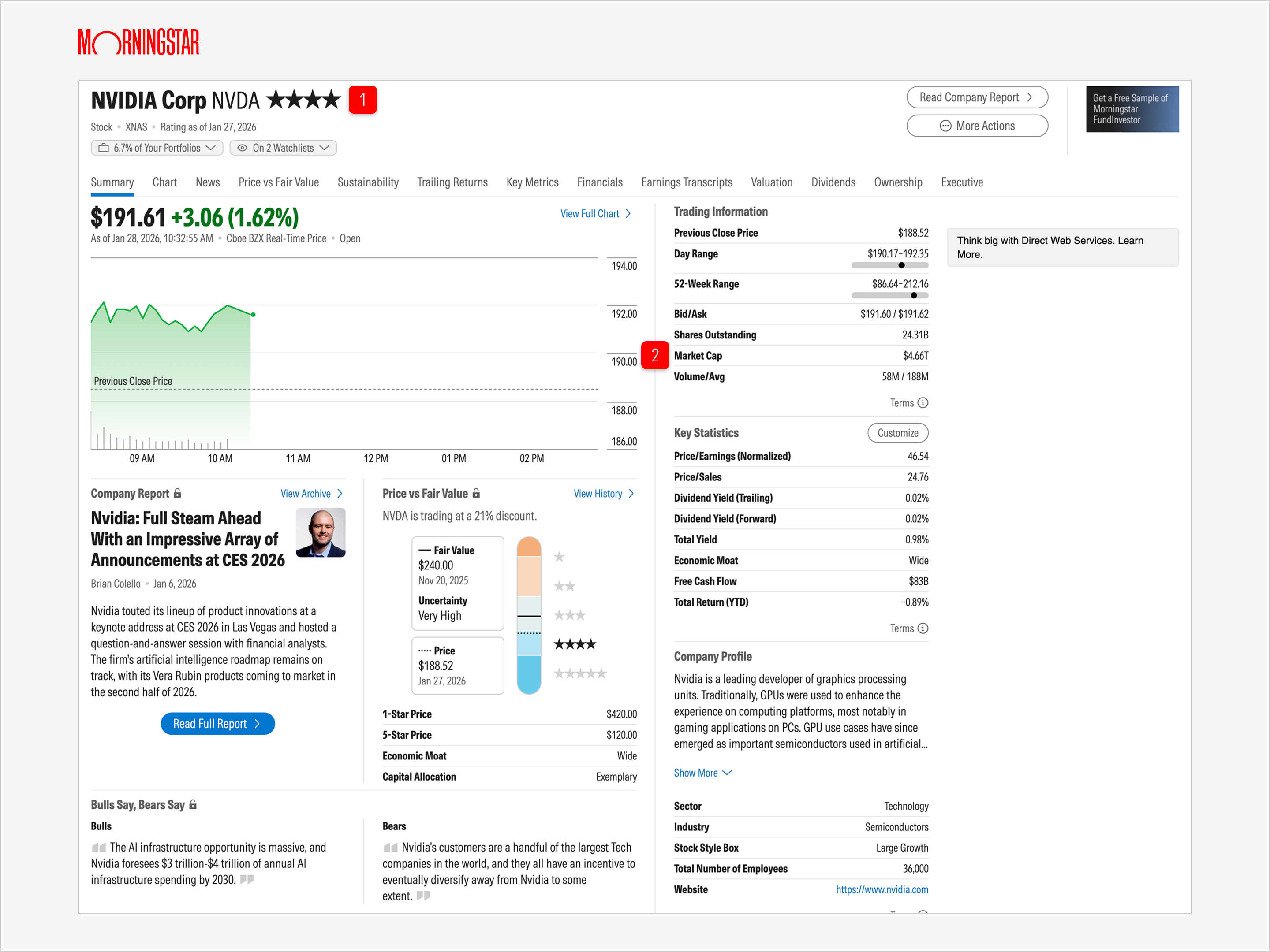
1. What’s the overall take?
It’s simple: look at the stars. The Morningstar Rating for stocks tells you at a glance whether our analysts think a stock is under- or overvalued. A 5-star stock is underpriced relative to what our analysts think it’s worth, while a 1-star stock is overpriced and therefore has a significantly lower expected return. Our rating system also includes an uncertainty adjustment—so a 3-star stock, for instance, should offer a fair return that adequately compensates for the riskiness of the stock.
2. Check the company size
Market cap is the total equity market value of the company, expressed in millions of dollars. It’s calculated by multiplying the stock price by equal shares outstanding.
How much does it cost (and how much could I profit)?
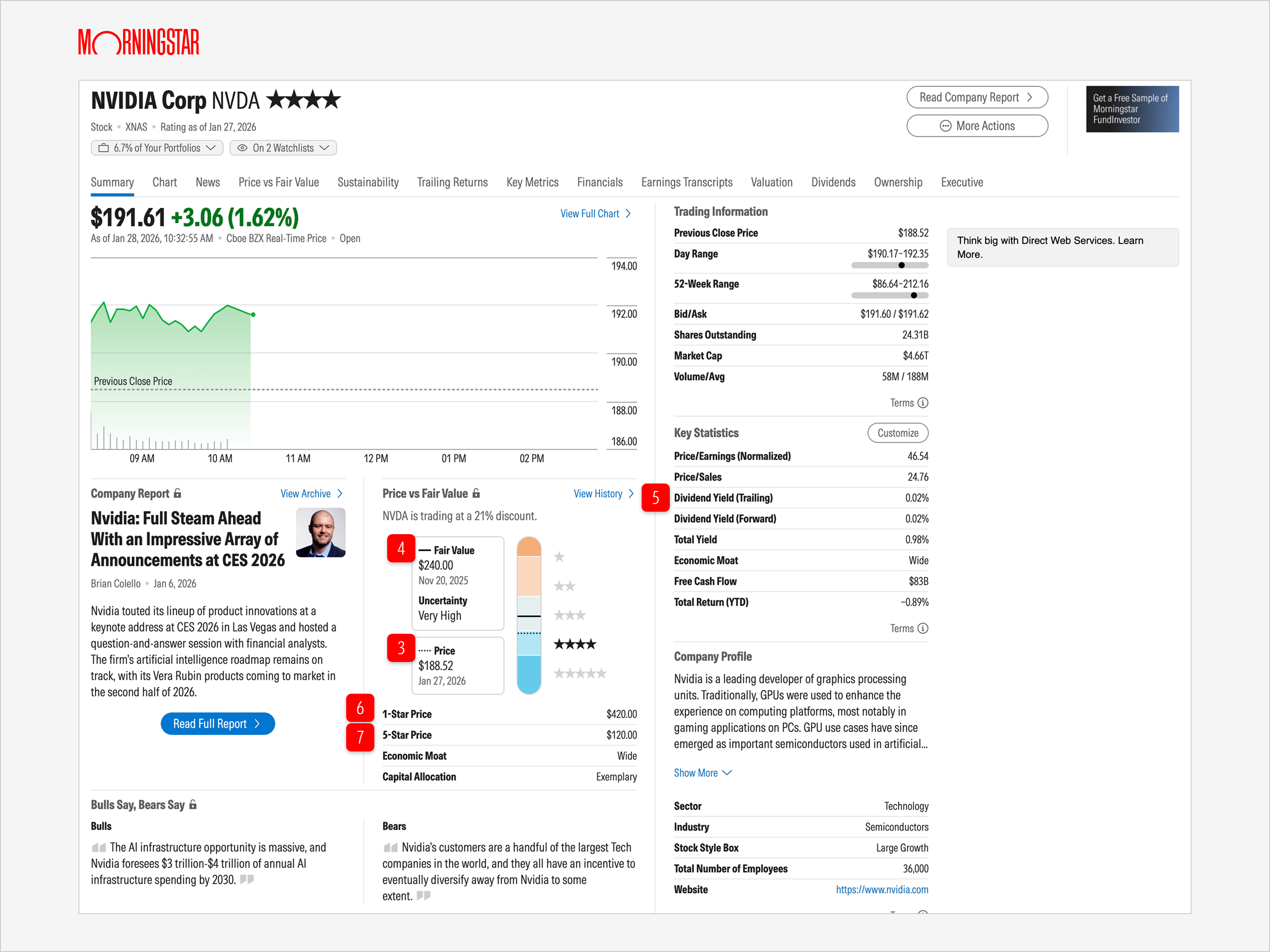
3. Check the price
Our stock quote pages follow standard valuation metrics:
Price/sales: A stock’s current price divided by the company’s trailing 12-month sales per share. It represents the amount an investor is willing to pay for a dollar generated from a particular company’s operations.
Price/book: A stock’s current price divided by its book value per share (the total assets of a company, minus total liabilities). The price/book ratio can tell investors approximately how much they’re paying for a company’s assets, based on historical (not current) valuations. Value-oriented investors often look for companies that have low price/book ratios.
4. Decide if the price is overinflated (or secretly under-valued)
You don’t have to run the numbers yourself (unless you want to). Instead, check the Morningstar Fair Value Estimate. It’s a per-share price estimate of what our analysts think a stock is worth. It’s based on our thorough analysis of the company’s current operations, business risks and opportunities, and outlook.
Our analysts consider the following factors: sales predictability, operating leverage, financial leverage, and a firm’s exposure to contingent events. Based on these factors, analysts assign an uncertainty level of Low, Medium, High, Very High, or Extreme. The greater the level of uncertainty, the greater the discount to fair value required before a stock can earn a 5-star rating.
5. Scope out dividends
Check out the forward dividend yield, which is what we expect the stock to pay over the next 12 months, divided by the stock’s current price. So, for example, if a company is expected to pay $0.25 per quarter ($1 per year), and it’s trading for $100 per share, its forward dividend yield is 1%.
6. Is now a good time to sell?
It’s your call, of course, but take a look at the 1-star price. That’s the price above which Morningstar analysts consider the stock significantly overvalued. But you should also wonder...
7. Is now a good time to buy?
On the other hand, check out the 5-star price. That’s the price below which our analysts consider the stock significantly undervalued.
Go on, jump down the rabbit hole
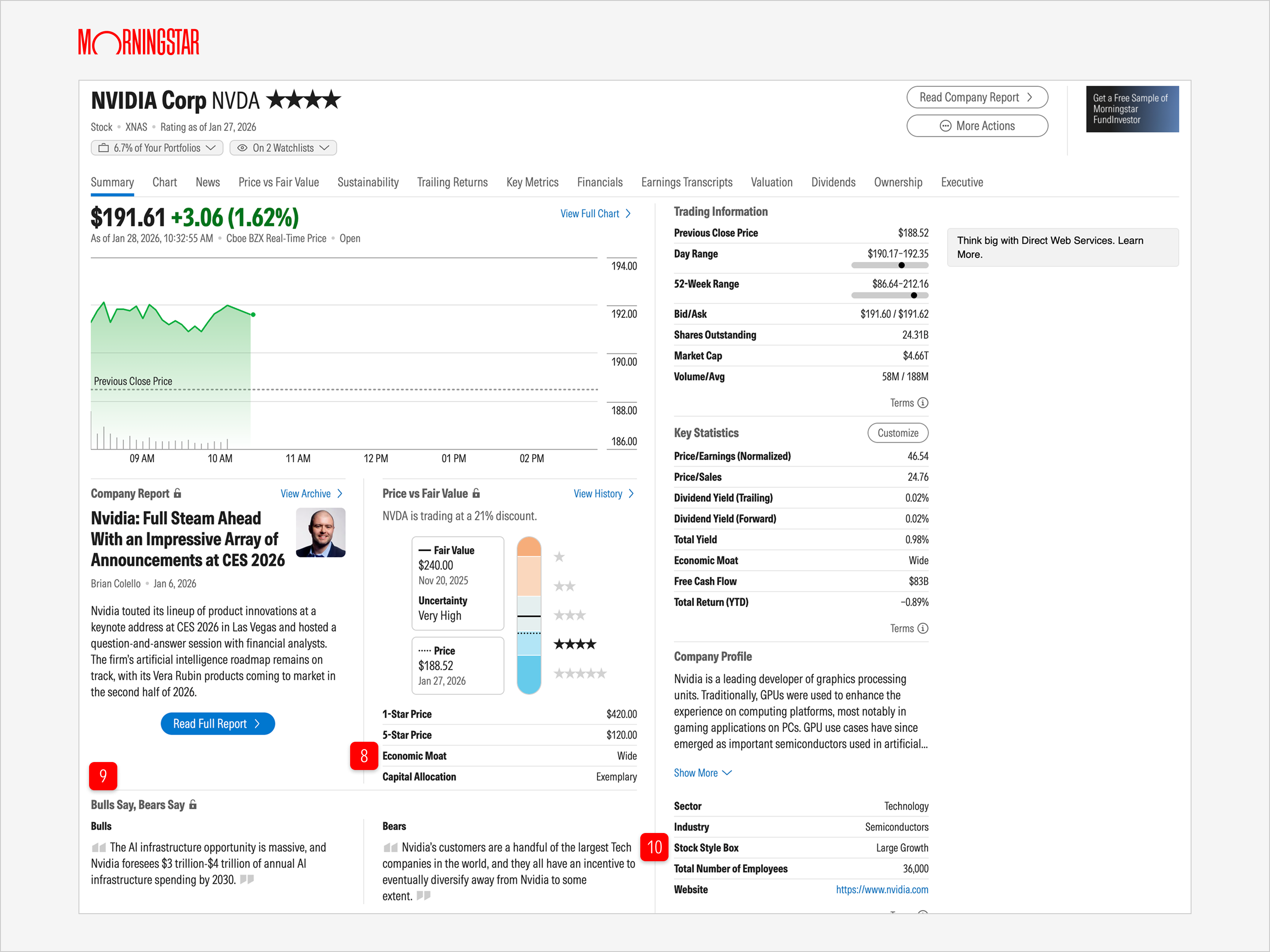
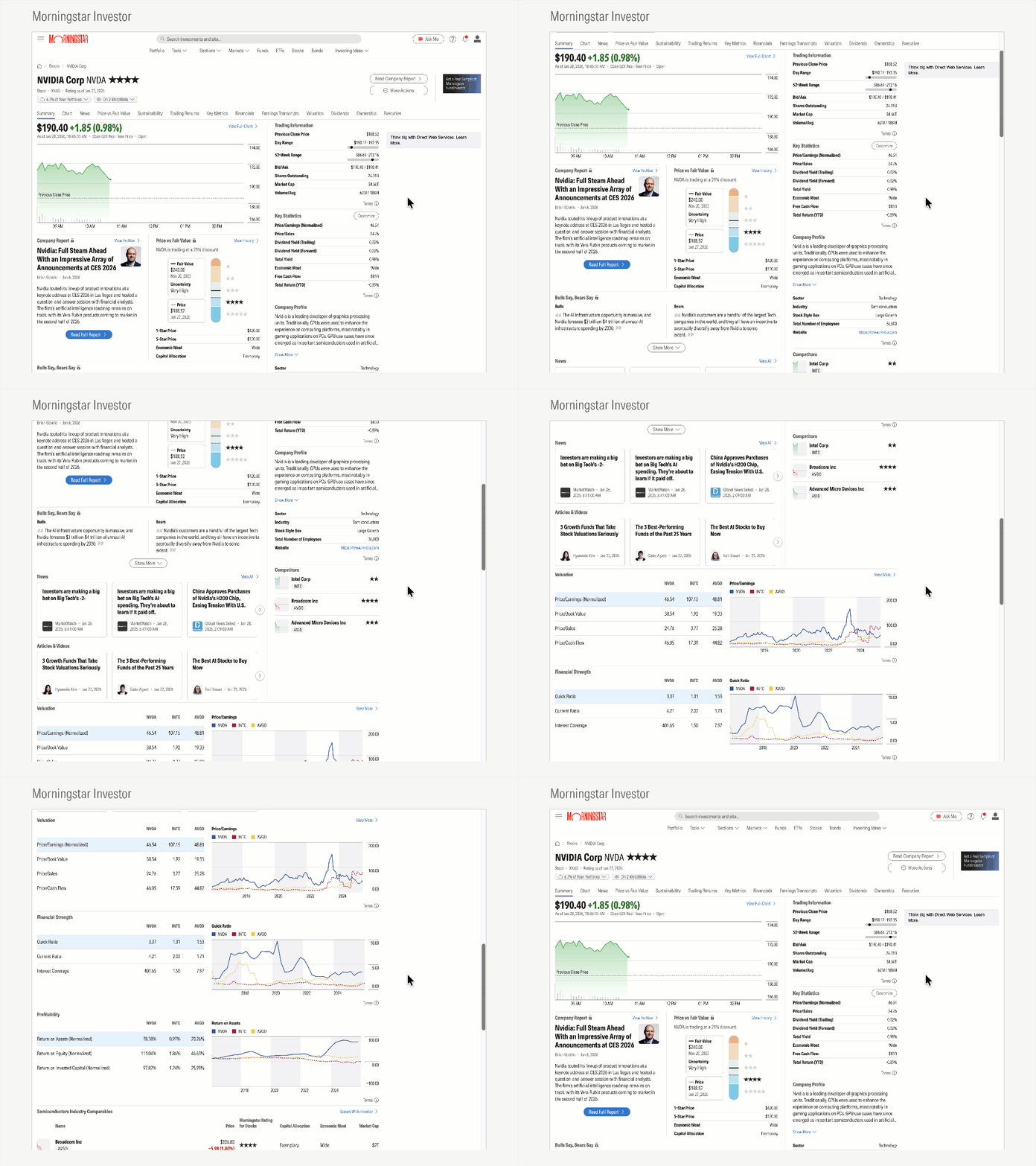
Just because we make it easy to get a quick grasp of a stock’s potential doesn’t mean we’ll deprive you of all the nitty-gritty details when you want them. With Morningstar Investor, you get unfettered access to additional data and analysis which let you:
8. Measure the moat
You can assess a company’s competitive advantages with the Morningstar Economic Moat Rating. A company with an economic moat can fend off competition and earn high returns on capital for many years to come. The moat rating can help you ID companies that are poised to provide superior long-term returns. A company whose competitive advantages we expect to last more than 20 years has a wide moat, one that can fend off their rivals for 10 years has a narrow moat, and a firm with no advantages (or one that we suspect will dissipate quickly) has no moat.
9. Reveal unvarnished opinions
You can see a company’s strengths and weaknesses argued from every angle in the Bulls Say/Bears Say section (another Morningstar Investor subscriber exclusive). This section shows you the most important positives and negatives for every company, regardless of our current opinion of the stock. You’ll see the Bear case for our favorite companies, and the Bull case for the companies we’re wary of.
10. Invest in style
We love this one so much that we made up our own measuring system: the Morningstar Style Box.
In it, we classify stocks into a nine-square grid arranged according to three size ranges (small-, mid-, and large-capitalization) and three investment styles (value, core, and growth). The smallest 10% of companies in the investable US market are considered small cap, mid-caps include the next 20% of companies, and large-cap stocks comprise the largest 70% of US stocks.
Once stocks are sorted by size, we classify them as growth, value, or core. We classify stocks as value if they’re trading at low valuations and have low growth rates for earnings, sales, book value, and cash flow. On the other hand, a growth stock has a high rate of earnings, sales, book value, and cash flow (and are trading at high valuations). In the case of core stocks, well, those are firmly in the middle of those two extremes.

 United States