
Fund Analysts' Top Screening Tips
Learn how to use the Screener tool to winnow down the universe of mutual funds and ETFs and find attractive investments.
Inspired by Morningstar analyst Russ Kinnel's recent guidance on choosing mutual funds, we're highlighting ways you can leverage your Investor subscription to screen for funds like an analyst would.
Freeze out fees
“It all starts with fees,” as Kinnel says. “I recommend something fairly strict like the cheapest quartile or quintile of the Morningstar Category.” And Morningstar analyst Ryan Jackson, who focuses on index funds, agrees: “You want the cheapest option. You’ve heard Jack Bogle’s saying, ‘You get what you don’t pay for.’ You don’t want fees to eat up your returns.”
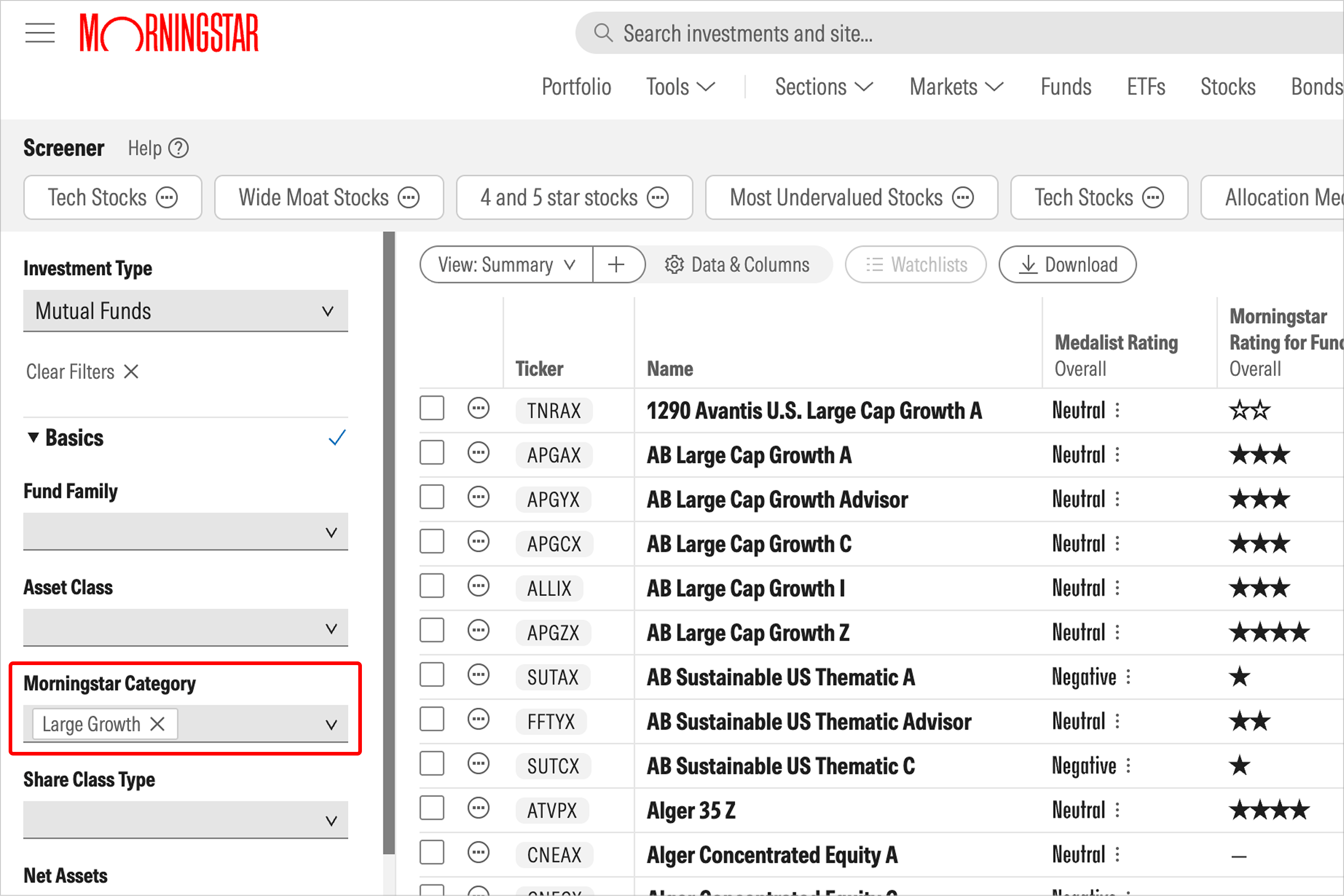
After opening Morningstar Investor’s Screener tool, there are a few quick boxes to check on the left-hand side of your screen.
1) Start by selecting the investment type you want to research (in this case, Mutual Funds or ETFs).
2) Filter by Morningstar Category from the drop-down in the left column.
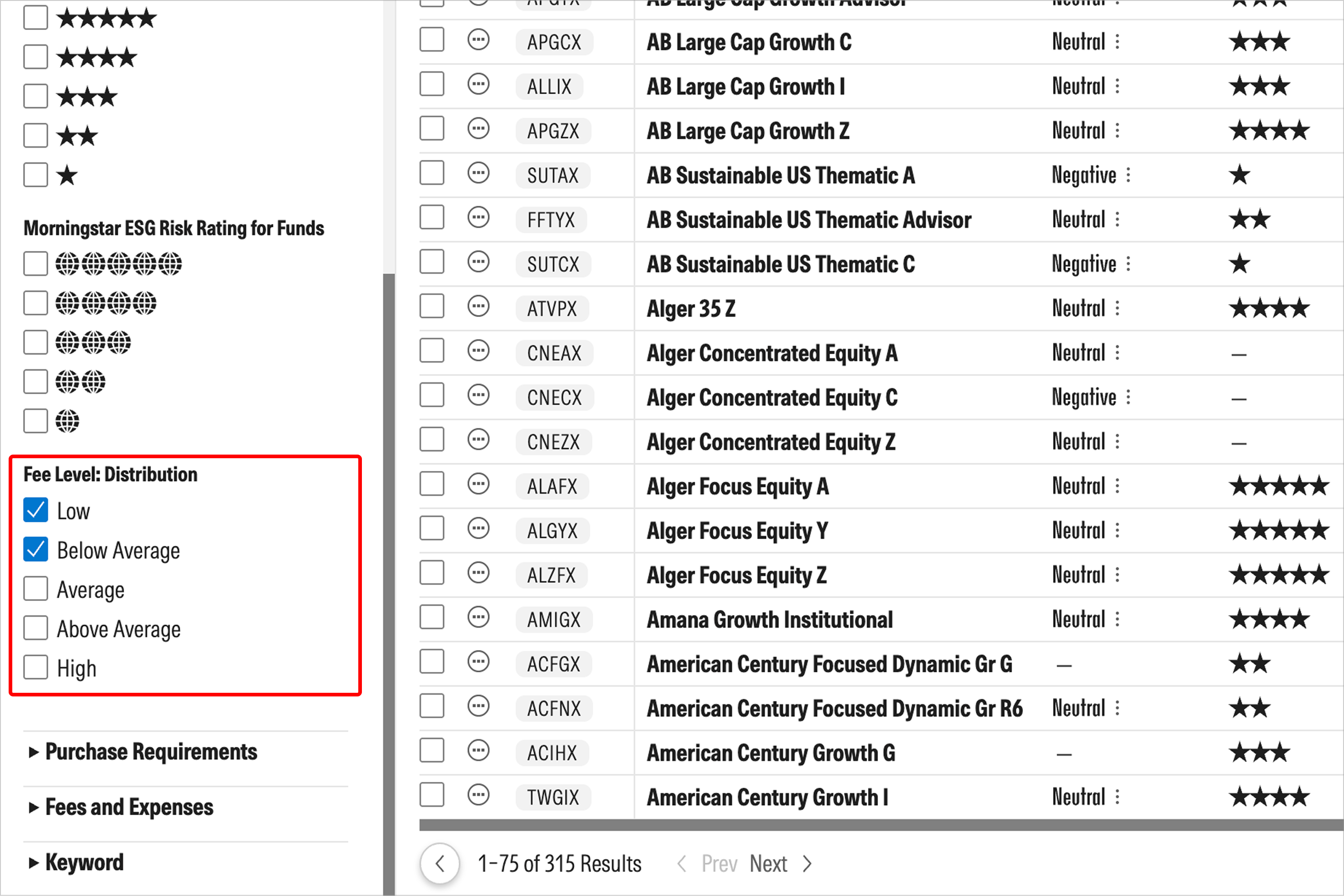
3) Scroll down to choose the Low and Below Average quintiles under Fee Level: Distribution.
Set your Medalist Rating standards high
Our analysts agree that a positive Morningstar Medalist Rating is a reliable forward-looking indicator of a fund’s strength.
As Bryan Armour, Morningstar’s director of ETF and passive strategies research, points out, “Analyst-driven Morningstar Medalist Ratings have been thoroughly vetted by Morningstar’s manager research team. An ETF’s capacity and liquidity are top of mind when we rate it, active or passive. Investors will find safe passage with any active ETF with a Bronze, Silver, or Gold Medalist Rating and a manager research analyst’s name attached to it.”
Todd Trubey, Senior Manager Research Analyst explains, “The medalist rating looks forward, it has more qualitative aspects to it, and it’s more like an aptitude test like the SAT or an IQ test; compare that to a star rating which is historical, it’s quantitative, it looks backwards in time, and it’s an achievement test showing what it has done before.”
And Kinnel, ever mindful of factors that affect mutual funds, concurs. “[Since] our ratings are forward-looking…a manager change or strategy change would be reflected in our view regardless of performance.”
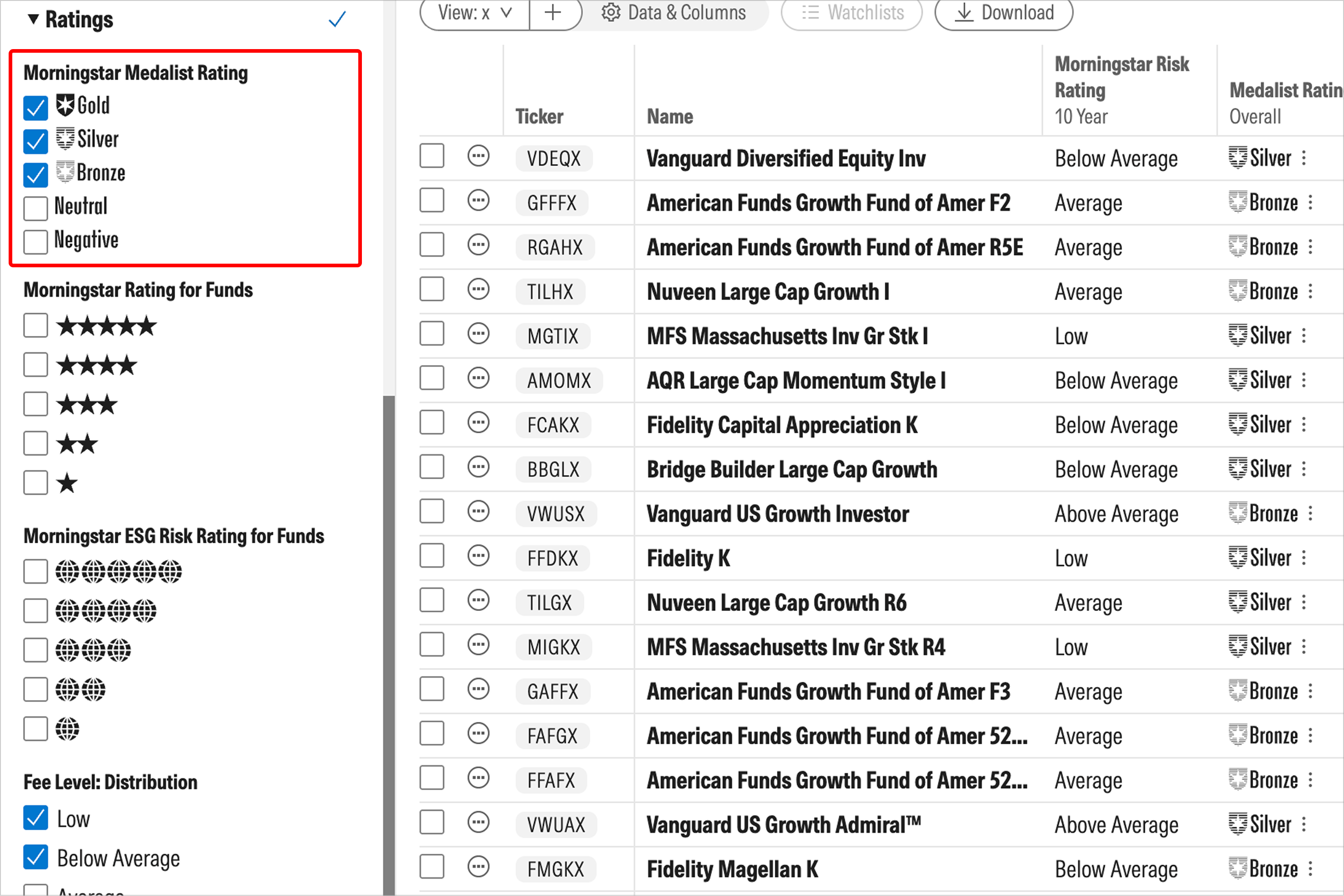
To follow their advice in Screener, navigate to the left-hand side of the page and select the Medalist Ratings of interest to you.
Skip risky funds
Kinnel recommends staying away from funds with high levels of risk relative to their peers. Spotting them is pretty straightforward: keep an eye out for funds with a Morningstar Risk Rating of High.
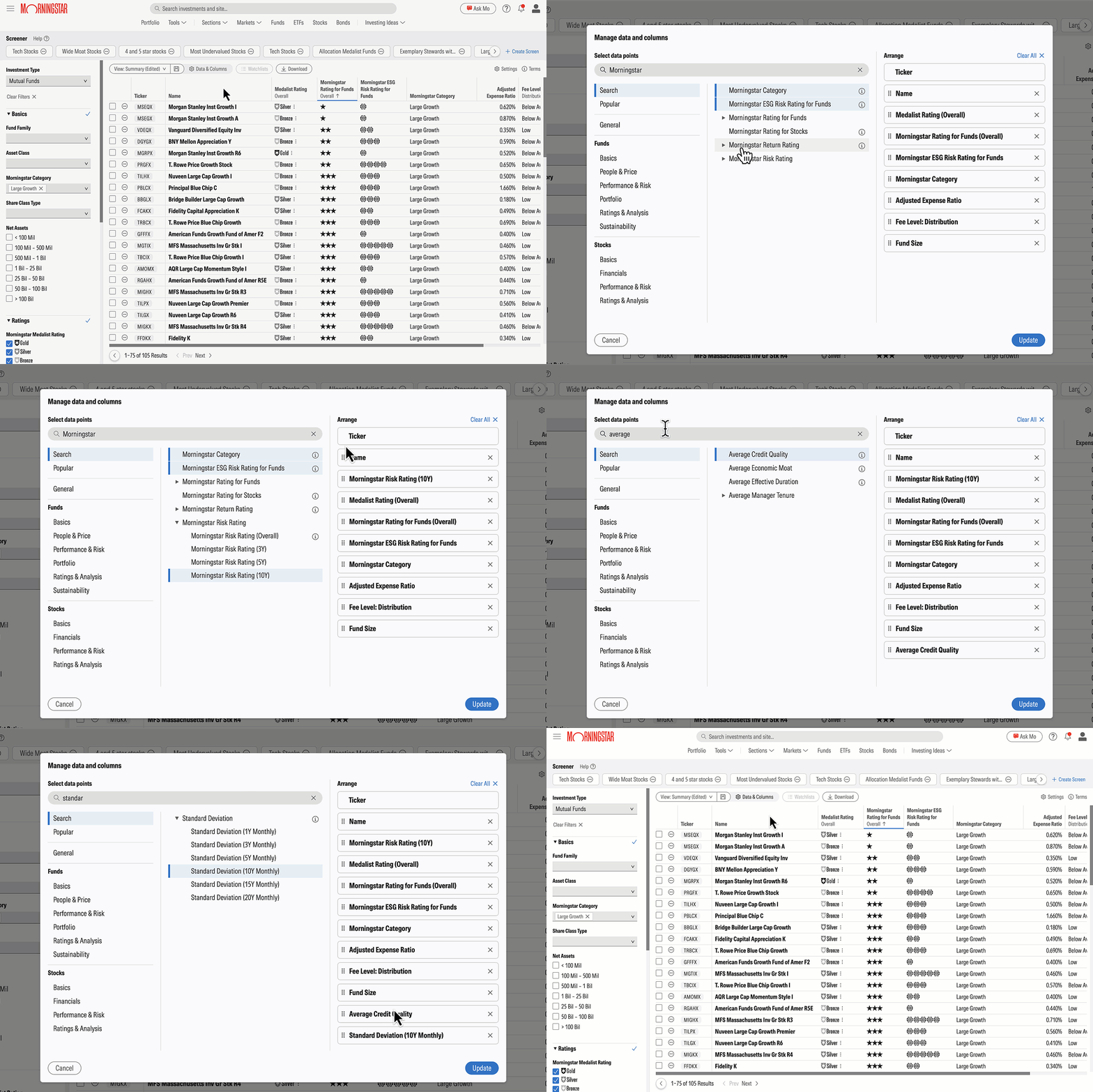
In the Screener tool, you can join Russ in leaving these funds out by adding Morningstar Risk Rating into your view, using Data & Columns; sort the Risk Rating column so that low-risk options appear at the top of your results. And as you review fund quote pages, you can also visit the risk tab at the top of the page. Change the lookback period to 10 years to see how the fund has behaved over a long period.
Kinnel also suggests evaluating a fund’s risk by its average credit quality (best suited for bond funds) and standard deviation (suggested for equity funds). To add these criteria to your search in Investor, open the Data & Columns tab, then enter the data points in the search tab. After making your selections, click Update.
Keep in mind that analysts consider a variety of risk measurements, according to Todd Trubey: “We look at them all, because sometimes you will see a fund that looks really good on one metric but not so good on the others, and you want to figure out why that might be. For example, you can have a fund that has a really high standard deviation, which means the volatility of returns is high, but if the Sharpe ratio is pretty good, it means that over a period of time, it has rewarded you with returns.“
Assess the annual net expense ratio
Returning to the matter of fees, Kinnel says, “The annual net expense ratio tells you what shareholders paid over the 12 months covered by the latest annual report. It’s backward-looking but still pretty close to what you would currently pay unless assets changed a lot or the fund company changed the fee levels.” Bryan Armour agrees: “Across the board, investors can bear in mind a couple of general rules: The more niche the strategy, the higher the fee; the average active fund charges substantially higher fees than a passive one.”
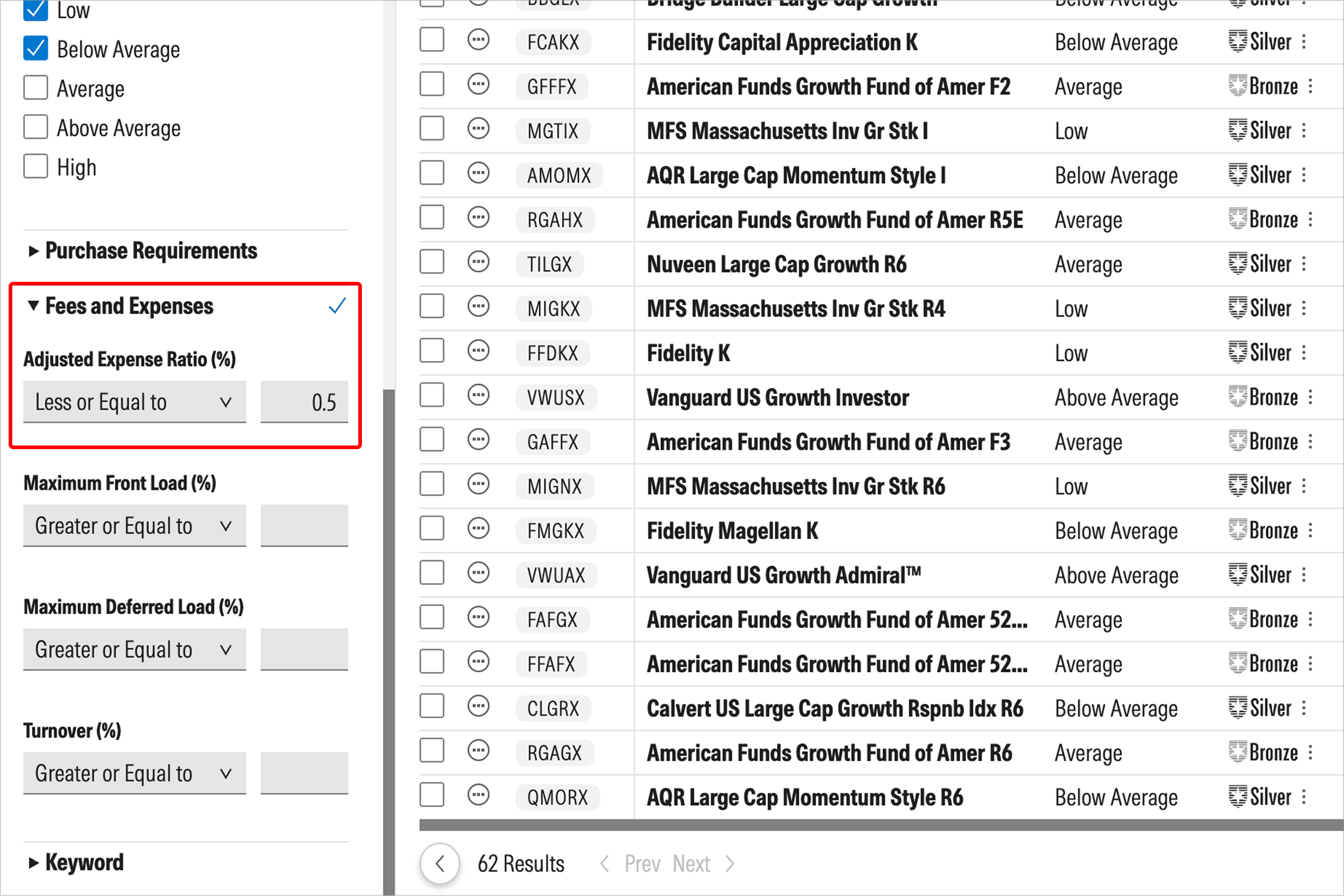
To put this into action in Screener, scroll in the left-hand column to Adjusted Expense Ratio and enter the benchmark value of your choice. You can then decide if you want to see securities that are less than or greater than your chosen value. You may want to note that according to Armour et al., “the average expense ratio has been falling for two decades: As of 2024 (the latest year for which data is available), the average expense ratio for both ETFs and mutual funds was 0.34%—less than half what investors paid in 2003.”

 United States