4 min read
Opportunities in Defense: The Supercycle May Be Just Getting Started
Rising geopolitical tensions, accelerating military spending, and attractive valuations are creating new opportunities across the defense sector.

Key Takeaways
- The defense supercycle is still in its early stages, supported by long-term rearmament efforts, growing NATO commitments, and increasing military budgets across Europe.
- European defense stocks remain particularly attractive, with many companies trading below our fair value estimates despite favorable long-term fundamentals.
- Fund choice matters. Focused sector funds offer the clearest exposure to Europe’s value opportunity and highly rated stocks.
Geopolitical tension is fueling a new defense supercycle, and defense stocks have had a bumpy ride along the way. Despite strong underlying growth, market volatility has left defense stocks looking attractive, particularly in Europe, where valuations may now offer an attractive entry point.
Morningstar's new report, Opportunities in Defense: Structural drivers and attractive valuations looks at where the opportunity sits, what could go wrong, and how investors can access it.
Volatility Has Left Defense Stocks Looking Attractive
Defense stocks have comfortably outperformed broad equities over the trailing five years. Yet global defense remains undervalued, and Europe still offers the best value. Wars in Ukraine and the Middle East, plus a push for NATO members to spend 5% of GDP on defense, have kept the sector in the headlines. Uncertainty over peace in both regions has driven heightened volatility through the rest of the year.
Europe's Rearmament Is a Long-Term Demand Story
Decades of underinvestment have left Europe's armed forces needing to replenish equipment and rebuild capacity. European defense budgets are set to grow 6.8% annually from 2024 to 2035, outpacing the US, Russia, and China. Europe's share of global defense spending is projected to rise from 16% to 22% by 2030.
Defense Markets Are at the Initial Stage of a New Supercycle
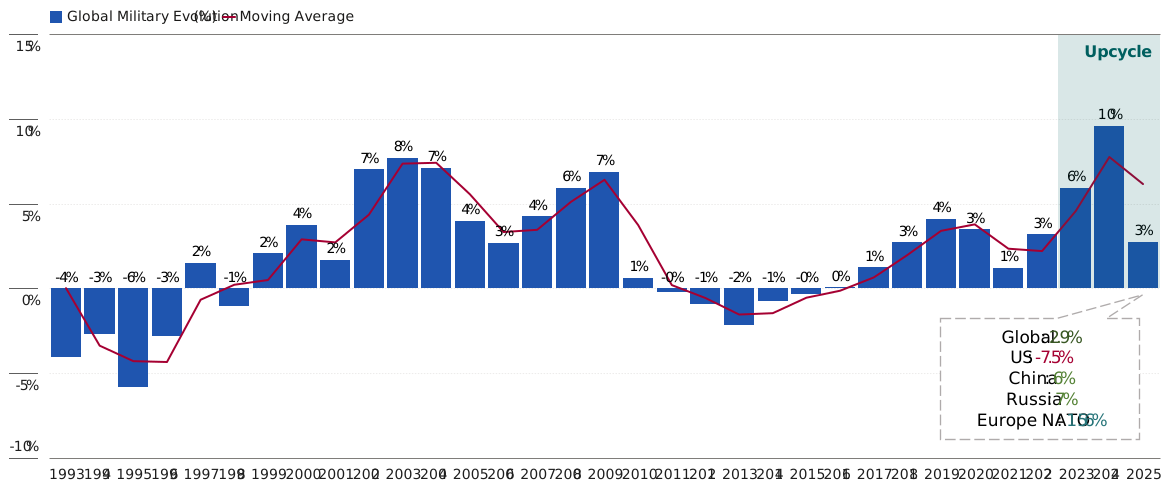
Source: SIPRI, Morningstar.
The rearmament cycle continued in 2025 despite slower global growth. Excluding the US, spending increased 9.2%, as European and Asian rearmament continued. US spending fell 7.5%, largely reflecting lower Ukraine aid approvals.
We project European defense spending will reach 3.2% of GDP by 2032 (~$900 billion), climbing to 3.5% by 2035. A shift toward inventory replenishment could unlock $1.7 trillion in cumulative equipment outlays by 2030, and up to $3 trillion over the next decade, primarily benefiting European contractors. Even if the Ukraine war ends, NATO's 30-day stockpile mandate for high-intensity conflict implies minimum ammunition sales could exceed $100 billion.
One caveat: we believe most of this structural spending increase is already reflected in the industry forecast. Further upside depends on greater clarity on how the funds will be allocated, and how high-deficit countries will implement their spending plans.
Backlogs Are Booming, but Revenue Is Concentrated
Orders back up the growth story. US defense book-to-bill ratios have all surpassed 1x after some dips in 2020–21, and European contractors' order intake stays well above 1x as revenue increases at double or high-single digits. The supercycle has further room to run, though delivery depends on national budgets and execution.
Contractors also benefit from long program cycles and high barriers to entry. Every company in Morningstar's defense coverage has an economic moat, and 88% (14 of 16) are rated wide moat, versus a 19% average across all sectors in coverage.
The flip side is concentration. Revenue remains concentrated in a small group of primes and programs, and the top five European OEMs hold over 50% of market share among the region's top 15, up from over 40% in 2013. One decision can move a stock: Rheinmetall's RHM shares fell 18.7% on June 24, 2026, after Germany cancelled the F126 frigate program.
Budgets are uneven, too. Only Poland and Latvia exceeded the 3.5% benchmark NATO set for core defense spending by 2035, and high-deficit countries will struggle to meet targets without external support.
Defense Stocks or Funds?
Buying individual shares lets investors pick specific companies and avoid a fund fee. A thematic fund gives up some of that precision in exchange for exposure across companies, programs, and national budgets, which helps reduce the effect of one large procurement decision on the portfolio, while maintaining desirable price exposure to the broader structural shift in defense spending.
Investors are already moving. Assets in defense funds stand at $71 billion, just below the $81.3 billion high set in Q1 2026, when the conflict in Iran drove a record $14.9 billion quarterly inflow. European-focused funds have grown from a negligible base to a record $9.6 billion by the end of Q3 2026.
But funds differ meaningfully in how they are built. Sector funds offer the clearest route to Europe's current value opportunity. WisdomTree Europe Defence ETF EUDF allocates 49% of its portfolio to Morningstar analysts' current best picks in defense, and State Street SPDR S&P Europe Defense Vision ETF DFSV is close behind at 48%. Those are the two highest shares among the European-focused, European-domiciled funds we covered.
Broader defense and autonomy funds, and defense technology funds, hold less of Europe's most undervalued stocks. Defense technology widens the investment universe, but valuations are less attractive today.
Defense Is Gaining ESG Acceptance, but Risks Remain
Investors have historically viewed defense as incompatible with sustainability objectives, but that is changing. The European Commission has clarified that sustainable finance regulations do not prohibit sustainability-focused investors from financing defense companies, and since the first defense fund adopted the Article 8 label in 2024, thirteen others have followed.
The label has limits. Article 8 funds can include conventional defense, but it does not remove ESG risks or controversial-weapons exposure. For many ethically focused investors, those concerns remain significant.