
5 min read
Top Asset Management Trends in 2026

Key Takeaways
- Low-cost passive competition and weak relative fund performance are limiting organic AUM growth for traditional asset management firms.
- Fundraising activity for private-credit and other alternative products is likely to slow in the face of more volatile equity and credit markets.
- A record $7.9 trillion sits in money market funds, a pool of capital that could drive long-term flows if investors move out of cash in the near to medium term.
Over the past two decades, industry fee pressures and consolidation of intermediaries have shifted the balance of power further away from the fund providers to distributors and end users.
Passive investing continues to pull market share on the traditional side of the asset management business, putting active fund fees under pressure. On the other hand, alternatives have benefited from strong demand—even as recent private-credit turmoil is likely to continue to stress demand in the near term.
Morningstar researchers take an in-depth look at the traditional and alternative asset management spaces, market conditions, future outlooks, top industry picks, and more.
Passive Investing Continues to Grow Market Share
Passively managed products have taken share from actively managed funds over much of the past two decades.
Active equity funds remain in net outflow mode due to their costs and continued underperformance relative to their fee-earning passive peers.
In fixed income, active open-end bond funds have recovered from their historic 2022 outflows and are seeing more normalized flows. On the passive side, bond ETFs have reached nearly $2 trillion and now exceed retail bond index funds at roughly $1.3 trillion, driven by institutional use of ETFs in fixed-income portfolios.
In Europe, active funds have recovered modestly after a sharp decline in March. Fund flows regained momentum in the second quarter, recovering across nearly all asset classes as net inflows and rebounding markets lifted AUMs. While passive fund flows continued to capture share, active flows also returned to positive territory.
Fueling the trend, the retail-advised channel continues to shift to fee-based accounts over commission-based structures. Institutional investors are also turning more and more to index-based funds to attain market exposure while pursuing alpha with other products, increasing the demand for index funds and ETFs.
Active Fund Flows Have Been Buoyed by Flows Into Active Bond Funds and ETFs
Active equity ETFs have been driven by advisor demand for lower-cost and more tax-efficient vehicles, taking flows from open-end funds. Passive equity ETFs recently passed $11 trillion in managed assets, while equity index funds remain just below $7 trillion after holding nearly equal amounts in 2022.
The active bond ETF market remains small at around $600 billion against more than $4 trillion in actively managed open-end bond funds. But we expect the market for active bond ETFs to continue to grow at a faster rate than actively managed open-end bond funds.
Managers Are Racing Into the ETF Wrapper, With Mixed Results
While active ETFs now outnumber passive ones on a number of funds basis, index-based strategies still hold 87.5% of ETF assets and none of the 20 largest US ETFs are actively managed. Rule 6c-11, adopted in 2019, is what opened the door, and launches surged after it took effect.
Managers have three ways in: launch a stand-alone ETF clone of an existing strategy, convert an existing mutual fund, or add an ETF share class. Conversions have been the proven route, with 208 mutual funds converting between March 2021 and June 2026. The share class structure has drawn far more interest than output. By the end of June 2026, 106 managers had requested permission to use it and 95 had been approved, but only five had created one.
None of this fully displaces mutual funds, since the ETF tax advantage disappears in tax-deferred accounts like 401(k)s. Where the wrapper does compete, cost is the reason: ETFs are on average 45 basis points cheaper than mutual funds.
Passive Investing Growth Is Pressuring Management Fees
Base management fees continue to trend down for both active and passive funds. Longer term, we expect fee compression to persist, driven by the growth of low-cost funds and ongoing fee reductions.
Average asset-weighted expense ratios for active funds have dropped below 60 basis points. On the passive side, the largest providers have leveraged their scale to drive prices lower. Average asset-weighted expense ratios are now closer to 10 basis points overall.
And things won’t necessarily improve much in the near future. At the start of 2025, Vanguard cut fees on 168 share classes across 87 funds by 1 to 6 basis points on average, covering about one-fourth of its $9.2 trillion in AUM at the end of 2024. It followed with cuts on around 10% of its $11.5 trillion portfolio of US mutual fund, ETF, and money market fund assets at the start of 2026.
While the median fee reduction this year was about 1 basis point, Vanguard is taking anywhere from 1 to 6 basis points off the expense ratio of many of its funds, which will pressure some managers in our coverage to follow suit.
That said, average expense ratios for the industry have started to decline at a slower rate, even as fees have come down for our coverage at a higher rate than in prior periods.
Innovative pricing models, like performance-based or hybrid fee structures, can potentially align incentives and help active managers stand out in a crowded field. It would also lower base fees down to levels closer to passive products.
Passive Competition and Weak Relative Performance Limit Growth
Organic AUM growth can make traditional asset managers slightly less reliant on market gains to grow their managed assets.
BlackRock's organic AUM growth has averaged 4.6% over the past five years, with only Invesco posting results in the same ballpark. Meanwhile, Cohen & Steers posted 3.5% over the past year. Both BlackRock’s and Invesco’s growth has been driven by their passive and index platforms, while niche real estate exposure has been the driver of Cohen & Steers' growth.
That said, not all is positive for the traditional asset managers as T. Rowe Price's weak fund performance continues to limit its ability to generate flows, and Federated Hermes has struggled to grow organically absent its money market flows. Franklin Templeton appears to have gotten past its Western Asset Management outflow issues, and Affiliated Managers Group has finally found a recipe for positive flows after several years of poor results. AllianceBernstein, unfortunately, has been in outflows since the Fed raised rates.
As organic growth stalls, and market gains become less reliable, asset management firms may use acquisitions to gain exposure to faster-growing products or geographic markets, further fueling industry consolidation.
Credit Concerns Could Stress Private-Market Growth Near-Term
Following the global financial crisis, institutional capital that had historically been dedicated to active equity and fixed-income strategies started migrating over to passive products, specialty offerings, and alternative assets—with the former offering low-cost market exposure and the latter providing differentiated alpha.
While the retail shift took a bit longer, we've seen similar movement in the retail-advised channel, especially with high-net-worth clients, who as “sophisticated investors” can invest in private equity and alternative credit offerings.
That said, what had been heightened fundraising activity for credit products is likely to slow in the near-term due to concerns about credit quality and liquidity in some alternative credit products. In our view, the bigger risk areas for the alternative-asset managers are direct lending (loans made directly to companies) and opportunistic credit (bridging the gap between direct lending and distressed debt).
Asset-backed (loans secured by specific, income-generating assets or hard collateral) and other credit funds can be problematic depending on what the funds are investing in. While the private credit industry has to date behaved more like the high-yield bond market, which is to be expected given the customers they are providing credit too, concerns about customer credit quality and fund liquidity, while they have abated some, persist.
Most Private-Market Growth Comes From Credit Strategies and Real Estate/Real Assets
Private equity remains the largest fee-earning category in the alternatives industry, but strong demand for alternative credit products during the past decade has increased the size of that segment.
The growth of private equity fee-earning AUM has diminished as returns have faltered, deployments have been less robust, and ongoing realizations have reduced the amount of capital at work. As such, most of the growth in fee-earning AUM has come from other categories, like credit alternatives.
Meanwhile, the share of fee-earning assets held by the seven largest alternative-asset managers has expanded from 21% at the end of 2020 to 30% in the back half of 2026, driven by the growth of alternative credit and real estate/real asset funds.
Private Capital Deployments: Investments and Realizations Were Muted During 2025 Relative to Expectations
Across strategies, recent deployments have not been enough to keep dry powder from continuing to pile up.
Most managers came into 2025 expecting deployments and realizations to pick up more substantially, especially based on improved results in the back half of 2024, but fiscal and tariff-policy uncertainties limited the level of deployments until the end of that year.
Meanwhile, results have been spotty since the start of 2026, as the combined impacts of fiscal and tariff-policy uncertainties, exacerbated by the Iran War, have made deployments and monetizations harder to come by on a regular basis.
Lower short-term rates and more amenable regulatory and market environments should provide opportunities for deployments and realizations down the road, with the largest players looking to put more of their dry powder to work and cash out of legacy positions.
We expect much of this the excess capital held by the alternative managers to eventually be deployed, with possibilities to put money to work likely increasing in the near term as equity and credit market disruptions create opportunities in some segments.
Dominance of the Largest Private-Market Firms Could Drive Consolidation
The biggest standalone alternative managers have been taking a larger share of industry fundraising. We expect this trend to continue as investors gravitate more towards firms with strong brands, better performance, higher levels of AUM, and larger funds.
The private capital market remains quite fragmented, though. Our US-based coverage, which represents seven of the largest stand-alone firms in the industry, accounted for 30% of the market on a fee-earning AUM basis at the end of June 2026, up from 21% at the end of 2021.
With these seven firms expected to continue to dominate fundraising efforts, we envision them gaining even more share going forward—and this does not include acquisitions, which we feel will be more likely down the road as growth slows and competition heats up.
In Europe, private equity saw its lowest level of capital raised for a decade in 2025. The absence of megafund closings played a large role. In 2025, the largest fund closed was below EUR 5 billion, compared with 2024, when approximately 50% of capital raised came from funds larger than EUR 5 billion. In Q1 2026, fundraising is tracking lower than in Q1 2025.
Largest Alternative Managers Continue to Increase Share of Fee-Earning Assets
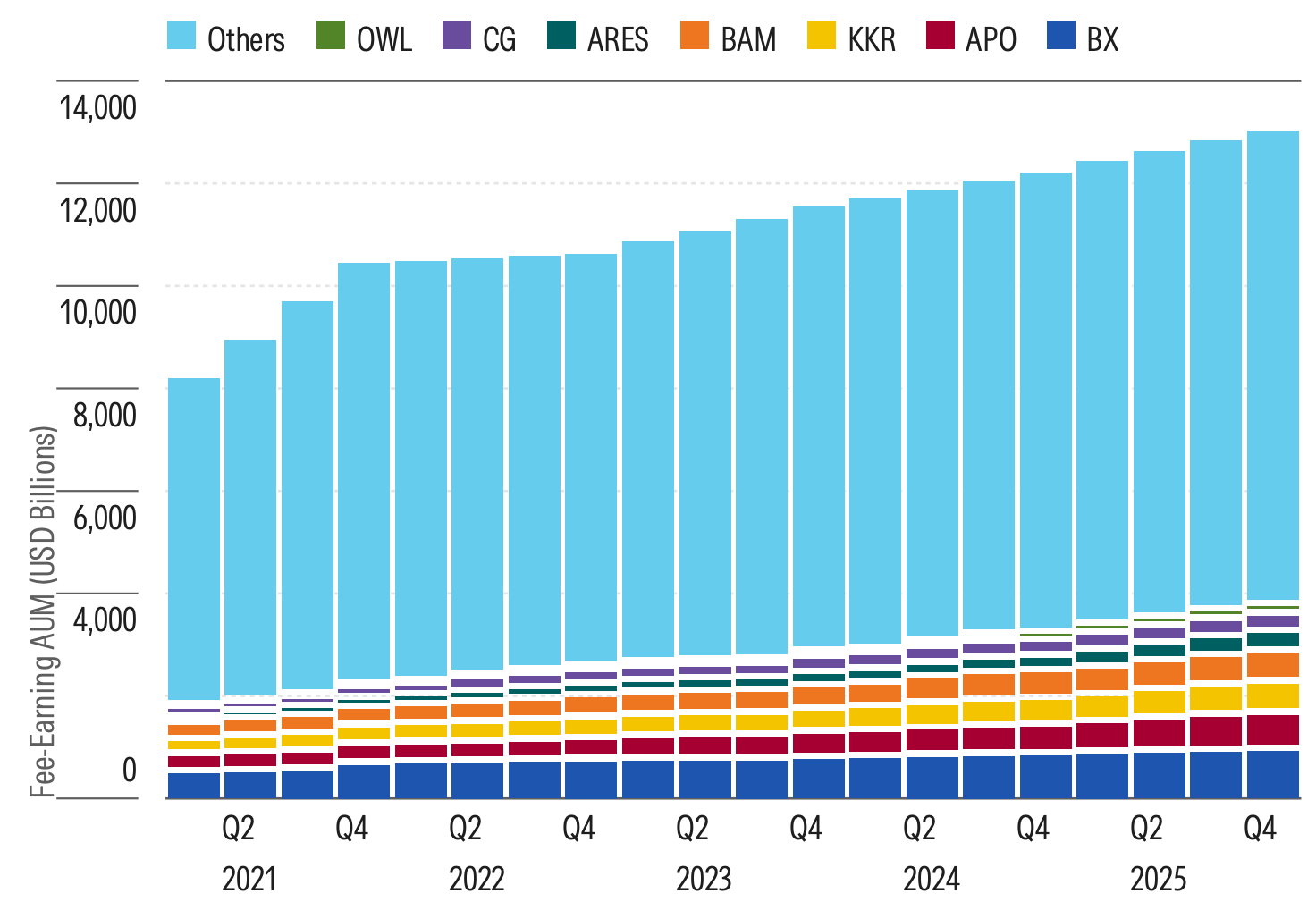
Source: PitchBook, company reports, and Morningstar data and estimates. Data as of March 26, 2026.
Where Can I Find More Research on Asset Management Trends?
- The US Asset Management Pulse looks at recent changes in market share, competitive standings, and industry moves.
- The annual US Asset Management Landscape examines major trends across traditional and alternative asset management.
- The quarterly European Asset Management Industry Pulse covers the latest in market news and fund flows.
- The annual European Asset Management Landscape examines larger changes in the traditional and alternative asset manager spheres.
For an under-the-hood look at the data, Morningstar Direct is a global investment analysis application with comprehensive investment research, portfolio analysis tools, and exclusive analytics.