73%
Percentage of advisors who used at least one form of behavioral coaching when supporting clients through market volatility.

10 min read

While traditional finance assumes investors make rational decisions to maximize profit, behavioral finance theory recognizes that psychology and mental shortcuts often influence how people save, spend, and invest.
In other words, real investors don’t always optimize. Instead, they may experience uncertainty or overconfidence when making choices.
Mental shortcuts can help individuals navigate complex finance decisions, but they may also lead to biases that shape judgment. For financial advisors, understanding these behaviors can allow them to show value and strengthen client relationships.
In this guide, we’ll explore why behavioral finance matters, the impact of behavioral coaching, and how these investment professionals can apply behavioral finance principles to keep clients focused on their long-term goals.
Behavioral finance theory is the study of how real people make real decisions about money in real environments—all of which are imperfect.
Heuristics, or mental shortcuts, can help make these decisions. While shortcuts often have positive outcomes, they can sometimes lead to wrong conclusions and actions. When this happens, shortcuts turn into biases.
Learning about these shortcuts is only one part of behavioral finance. The field draws from psychology and economics to better explain why individuals make those decisions and how to positively influence their behavior. Many of these concepts are related to behavioral economics.
In recent years, behavioral scientists have focused on sharing practical and useful research findings, providing more actionable insights to guide investment decisions.
Clients don’t often throw around terms like “behavioral coaching.” However, even without using the terminology, our research finds clients identified key components of behavioral coaching—such as providing a second option or acting as a financial teacher—in the top three reasons for keeping their advisor.
On the other hand, the top two reasons why investors fire their advisors—quality of financial advice and services along with quality of relationship—often stemmed from an advisor not dedicating enough time to understanding their client and their personal financial needs and goals.
With more attention and resources to understand the client, advisors could have remedied these complaints.
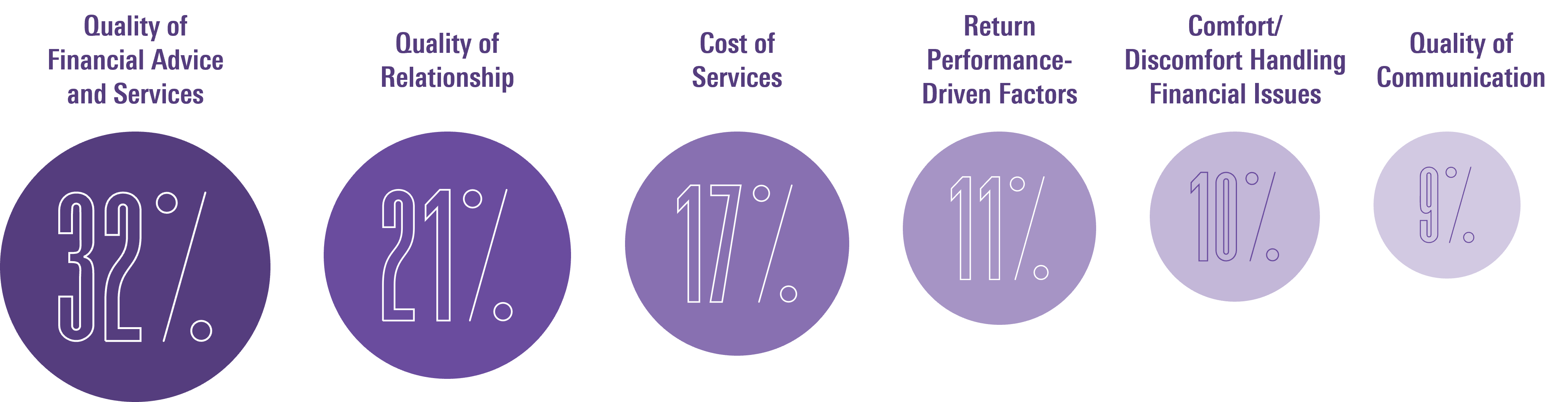
Source: Morningstar Research. Data as of 2021 and 2022.
In many cases, clients aren’t leaving because they feel they no longer need advice, but because their expectations around advice and relationships weren’t met.
Those who fire an advisor and switch to another are more likely to hire for the quality of financial advice. That is, they aren’t selecting an advisor to meet a discrete need, but are assessing whether the advisor’s thinking, guidance, and approach improve upon what they already had.
Behavioral coaching can help clients:
Percentage of advisors who used at least one form of behavioral coaching when supporting clients through market volatility.
Here are common investor cognitive biases and how advisors may respond.
Information overload and market volatility across financial markets often make it difficult for individuals to manage their priorities.
Anchoring is when people rely heavily on an initial piece of information when making a judgement. As a result, they can be slow to adjust their decisions in response to new information or changing market conditions. Anchoring can influence financial decisions on when to sell securities or when to rebalance a portfolio in response to new market conditions.
Recency bias occurs when investors place too much importance on recent events for decision making. This can encourage return-chasing and lead them to favor investments that have performed well lately while overlooking other relevant factors.
Simply put, not all information is treated equally.
Related heuristics include:
These concepts can have a significant effect on investors’ losses and gains.
How advisors can help mitigate bias:
Emotions like fear, excitement, and overconfidence can affect investment decisions by causing investors to react based on market movements rather than stay the course toward their goals.
When working with clients, it’s important to remind them that they’re not alone in feeling swayed by stock market ups and downs. However, acting on those emotions can be costly.
The tendency to pay attention to and learn from others has allowed people to do incredible things, but it can also lead us astray. Herd behavior refers to when people feel compelled to act in line with others. For example, it happens in markets when investors rush into a popular stock or sell during a market downturn simply because others are doing the same, even when those actions conflict with their own plans.
Loss aversion is the acute sense of pain we feel when experiencing a loss. This can lead investors to counterproductively decide to sell holdings when they are down.
How advisors can help mitigate bias:
Clients’ risk-taking may be reshaped by overconfidence bias, which refers to a tendency to overestimate their knowledge, skills, and ability to process information accurately. It shows up when individuals believe they can predict short-term price moves or assume they’re “different” from other market participants.
That confidence can lead to risky decisions like taking larger positions than their plan supports or trading more often than their strategy requires. In some cases, it can encourage irrational decision-making. This overconfidence tends to pair with return-chasing.
Advisors aren’t immune to overconfidence bias either. These investment professionals are often asked to predict the future with common questions about fund performance or interest rate trends. Given the stakes, it’s important for advisors to make accurate judgments and understand the degrees of confidence in those judgments.
How advisors can help mitigate bias:
Investors who work with an advisor tend to feel more optimistic and steady about the market than those who don’t (54% compared with 39%).
This implies financial advisors can provide value by offering support, both emotionally and financially, and reassurance that investors may lack on their own. Similarly, about one-third turn to advisors for financial advice and not only view them as a top information source but also the most valuable (89%).
So what does behavioral finance look like in practice? Here are three ways advisors can apply these insights.
Start with questions that begin with “what” to encourage more future-focused thinking in investors. For example, the question “What is important about money to you?” may be more effective than the question “Why is money important to you?”
Asking a client these types of questions can be a great way to start the goals conversation, but follow-ups should guide the client to a more productive mindset. For example, if a client is using words like “tomorrow” when talking about their goals, their mindset may be stuck in the present. Try prompting them to think more long term with techniques such as future visualization exercises.
The risk profiling and risk scoring tools in Direct Advisory Suite may also help advisors better understand how clients view risk and uncertainty, creating a stronger foundation for personalized advice. These insights can then make it easier for advisors to align portfolio recommendations with clients’ risk tolerance and long-term goals.
Percentage of investors who work with advisors and consider them a valuable source for informing their investment strategy.
Client communication can be an in-person meeting, a weekly newsletter regarding recent events, or even informational social media posts. Tools like Direct Advisory Suite allow advisors to turn complex investment insights into clear, client-ready reports as well.
As the use of generative AI rises, advisors must differentiate themselves through communication. While generative AI offers tips on how to stay on track amid challenges like market volatility, advisors can take steps like holding investors accountable and serving as a sounding board.
To develop trust with a client, start by putting your commitment to their long-term success on display. This can mean actively listening to their goals and addressing concerns with empathy. There’s still an element of understanding here, but this time, the investor must understand you.
Delivering transparency in the recommendation process may build trust, too. When advisors can clearly explain how portfolio recommendations align with clients’ goals, it can be easier for them to understand the value behind the decision, such as why a particular asset was added, and remain committed to their long-term plan.