
Europe Equity Outlook: Opportunities Become More Selective

European equities remain surprisingly resilient despite an increasingly difficult macro backdrop. Inflation remains elevated, bond yields are rising, economic growth is slowing, and geopolitical risks continue to weigh on investor sentiment. Yet markets remain near all-time highs, creating a challenge for advisors and investors alike: where can opportunities still be found as uncertainty increases?
The latest Morningstar Europe Equity Market Outlook report finds that while European stocks continue to trade modestly below fair value, broad-based bargains are becoming harder to find. Instead, investors may need to become increasingly selective, focusing on sectors and companies whose valuations still offer meaningful upside relative to long-term intrinsic value.
Are European Stocks Still Undervalued?
Yes, but investors are being compensated for taking on more uncertainty.
European equity valuations have moved sharply over the course of 2026. Markets shifted from overvalued territory early in the year to meaningful discounts following the onset of conflict in the Middle East. Since then, stocks have recovered significantly, but not enough to erase the valuation gap entirely.
Today, European equities trade at roughly a 6% discount to Morningstar's fair value estimate. That suggests modest upside remains available for long-term investors, although the margin of safety is not especially large given the growing list of macroeconomic risks. Rising inflation, elevated interest rates, slowing economic growth, and geopolitical instability continue to create uncertainty across global markets.
Meanwhile, US Treasury yields recently climbed to their highest levels since the Global Financial Crisis, highlighting investors' growing concerns about inflation and government debt sustainability.
While valuations remain supportive, future market returns are likely to depend less on broad multiple expansion and more on identifying companies whose stock prices remain disconnected from their intrinsic value.
Has the Worst of the Geopolitical Uncertainty Passed?
Not yet.
Visibility into the economic impact of the Middle East conflict has improved since the early stages of the crisis, but uncertainty remains elevated. Morningstar expects oil supply disruptions to persist longer than previously anticipated following renewed US-Iran hostilities, delaying market normalization into 2027.
While alternative shipping routes, strong US crude exports, and emergency inventory releases have prevented oil prices from moving substantially above $100 per barrel, global inventories continue to tighten. Morningstar expects elevated energy prices to remain a feature of markets through year-end.
At the same time, investors face another growing concern: rising bond yields. Higher government borrowing costs create pressure on both economic growth and equity valuations. If inflation remains sticky, central banks may be forced to maintain tighter monetary policy for longer, potentially limiting equity market upside.
For investors, geopolitical risks may no longer be driving daily market movements, but they remain an important factor shaping inflation expectations, interest rates, and sector performance.
Where Can Investors Still Find Value?
Despite the broader market recovery, opportunities remain across several sectors that have not fully participated in this year's gains.
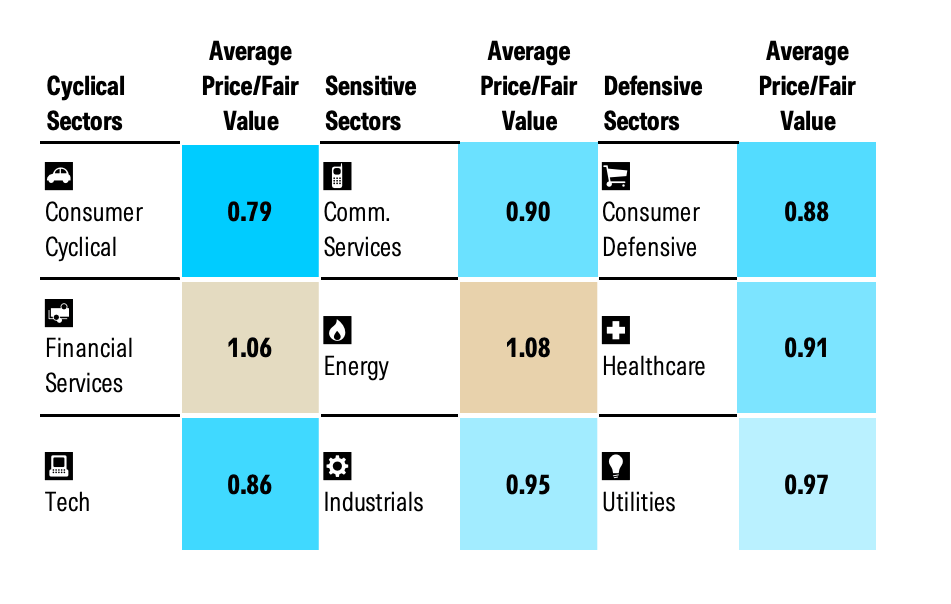
Consumer Cyclical remains Morningstar's most undervalued sector, trading at roughly a 21% discount to fair value. Analysts believe many cyclical businesses are nearing the end of their downturn, creating attractive opportunities among luxury goods manufacturers, automakers, and selected industrial and infrastructure-related businesses. Morningstar continues to favor companies such as LVMH, Ferrovial, and Daimler Truck.
Valuations Rotate, Not Cheap but Also Not Expensive
Source: Morningstar. Data as of September 2026.
Technology also offers compelling opportunities after a difficult quarter. The sector now trades at approximately a 14% discount to fair value following several AI-driven selloffs. Communication Services and Healthcare similarly remain undervalued, trading at discounts of roughly 10% and 9%, respectively.
By contrast, investors may find fewer opportunities in sectors that have led the market recently. Energy and Financial Services both experienced strong rallies during the third quarter, leaving valuations closer to or above fair value.
Rather than chasing recent winners, long-term investors may find more attractive risk-reward opportunities by focusing on sectors where fundamentals remain intact but valuations have not yet recovered.
Why Are Mid-Cap Stocks Standing Out?
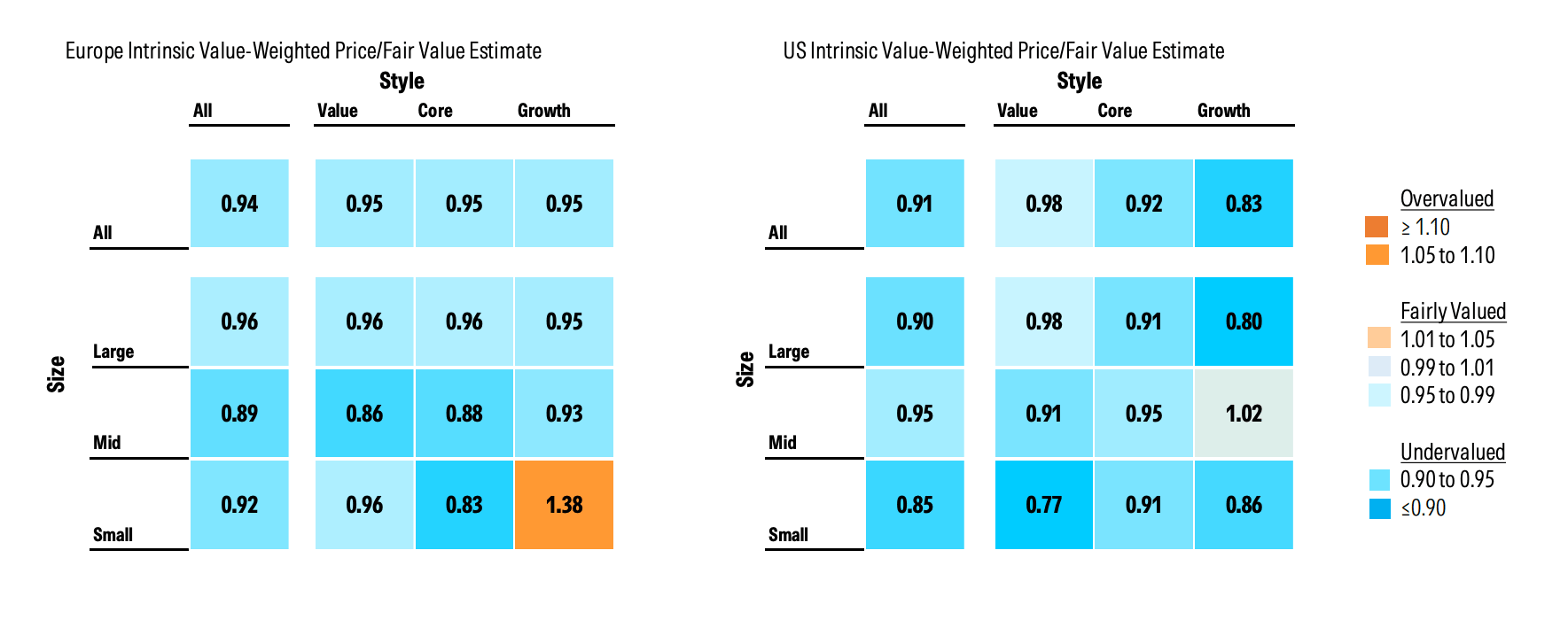
While small-cap stocks benefited from the market rebound earlier this year, many mid-cap companies largely missed the rally despite maintaining solid underlying fundamentals. Today, European mid-caps trade at roughly an 11% discount to fair value, making them the most attractive market-cap segment in Morningstar's coverage universe.
Discounts to Fair Value Estimates Widen Modestly
Source: Morningstar. Data as of September 2026.
Many mid-cap companies possess durable competitive advantages and attractive growth opportunities while receiving less investor attention than Europe's largest companies. For investors willing to look beyond major benchmark constituents, mid-caps may offer one of the market's strongest combinations of quality and value.
Is AI Still Driving Europe's Technology Sector?
Yes, but the narrative has evolved.
Artificial intelligence remains one of the dominant investment themes shaping global equity markets. However, investors are increasingly focused on the possibility of excessive optimism rather than the risk of missing the AI opportunity entirely.
European technology stocks experienced several periods of volatility during the third quarter as concerns about an AI bubble triggered sharp selloffs across semiconductor stocks. Despite those setbacks, hyperscalers continue to increase spending on AI infrastructure, supporting long-term demand trends.
At the same time, opportunities are emerging outside semiconductors. Software and IT services companies are beginning to benefit as organizations move from experimenting with AI to implementing it across business operations. Revenue growth among IT services firms has accelerated meaningfully, while software growth appears to be stabilizing.
Morningstar's highest-conviction technology ideas remain wide-moat companies such as RELX and SAP, whose durable competitive advantages and recurring revenue streams position them well regardless of short-term AI sentiment swings.
Stock Selection Matters More Than Ever
Earlier in 2026, investors could find attractive opportunities across much of the European market. Today, the picture is more nuanced.
More than 40% of Morningstar's European equity coverage continues to earn a 4- or 5-star rating, suggesting plenty of opportunities remain available. However, valuation dispersion between sectors and companies has increased considerably. Attractive ideas have become more concentrated, particularly within technology, healthcare, communication services, and selected consumer-facing industries. Meanwhile, many financial and energy companies have become less compelling after strong rallies.
As broad market discounts continue to narrow, generating excess returns is likely to depend less on market exposure and more on disciplined stock selection rooted in fundamental valuation analysis. Investors who focus on identifying businesses trading below their intrinsic value may be best positioned as Europe enters a more uncertain final stretch of 2026.
Looking Ahead
European equities remain modestly undervalued, but the easy opportunities that existed earlier in the year have largely disappeared.
Rising bond yields, persistent inflation, and ongoing geopolitical tensions have increased uncertainty heading into the final months of 2026. Yet beneath the surface, meaningful opportunities remain across undervalued sectors, overlooked mid-cap companies, and businesses positioned to benefit from long-term structural trends such as artificial intelligence and digital transformation.
For advisors and investors, success in the coming quarters may depend less on predicting macroeconomic outcomes and more on carefully identifying companies whose market prices still fail to reflect their long-term value. The opportunity set may be narrower than it was earlier in the year, but it remains meaningful for those willing to be selective.
Download the full Europe Equity Market Outlook for a deeper analysis of regional valuations, sector outlooks, market risks, and Morningstar analysts' highest-conviction investment ideas across European equities.