
4 min read
The Ultimate Guide to Investment Reporting
As regulations and market conditions change, firms need to produce thorough, precise, and timely investment reports.
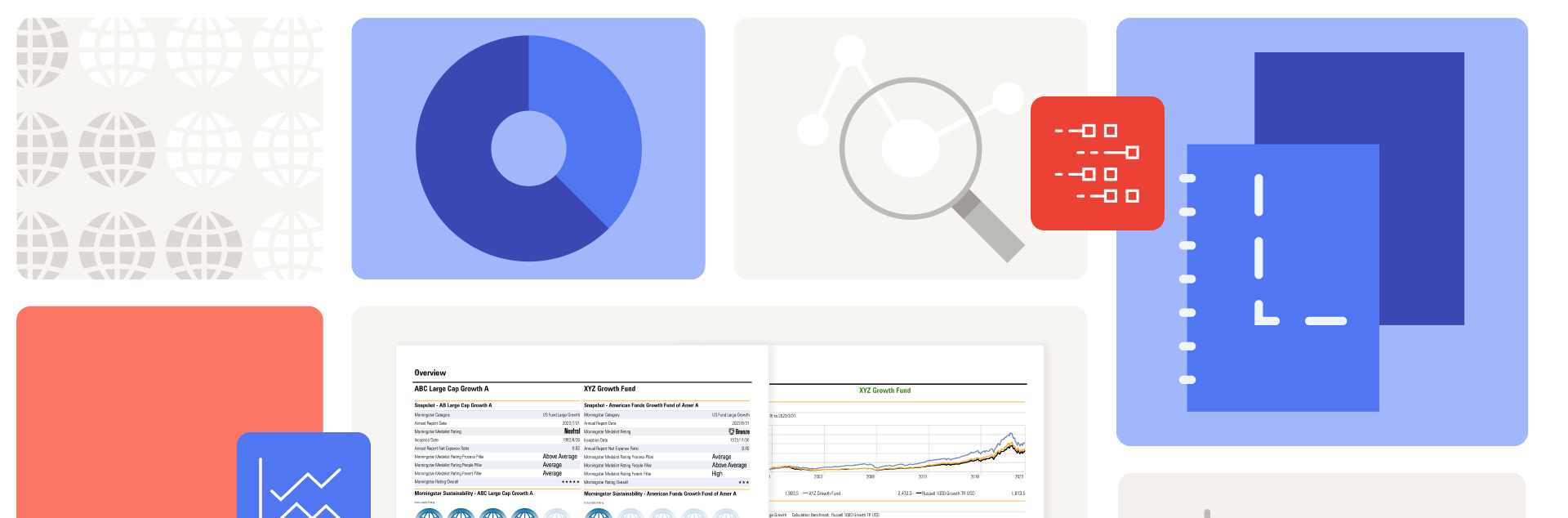
Investment reporting is the process of creating and distributing detailed analyses of investment portfolios. These reports cover performance, asset composition, and investment strategies, and provide key information to clients, regulators, and internal decision-makers at investment firms.
Investment reporting is important for several reasons:
- Transparency and trust. Reports offer a clear view of performance and strategy, fostering long-term client relationships.
- Decision-making and risk management. Reports inform strategic decisions and highlight potential risks and areas for improvement.
- Compliance. Investment reports play a crucial role in meeting regulatory requirements and industry standards.
- Performance evaluation. Reports provide a basis for benchmarking and evaluating the effectiveness of strategies and manager skills.
- Education. Well-crafted reports help individual investors better understand investment concepts and market dynamics.
Typically, an investment report should include elements like investment style, objectives, performance metrics, risk-return ratio, asset allocation, distributions, fees, and tax status. Importantly, the report should provide rationale for any style, strategy, and assumptions changes based on performance data.
Templates can address the needs of different stakeholders. When populated directly from data sources, templates deliver uniform, on-brand, and compliance-friendly messages.
Superior investment reports:
- Detail fee disclosures
- Consider the client’s needs and preferences
- Present risks and outcomes in a straightforward, transparent way
Ultimately, investors are best served with performance information that is concise, timely, and relevant. Carefully consider how you visually represent data with charts, style boxes, and ratings. Visuals should serve a specific purpose and not be included simply because they can be.
Reporting Workflow Challenges
Data management is a primary hurdle to investment research. Investment data often comes in various formats and from multiple sources, challenging integration. Data integrity is crucial. Even small errors can lead to significant misrepresentations, which can negatively impact your investment reports, your brand, and your clients.
Regulatory compliance adds another layer of complexity. Regulatory reporting requirements change frequently, requiring constant vigilance and system updates. Global firms also have to navigate requirements across different countries and regions.
Other significant challenges include:
- Customization vs. timeliness. Balancing diverse client needs with the demand for rapid reporting.
- Technology integration. Incorporating data from various systems and overcoming issues with legacy technology.
- Visualization and presentation. Presenting complex data in an easily digestible format while meeting expectations for interactive, digital reports.
- Cost management. Balancing the need for advanced reporting capabilities with budget constraints.
- Security and confidentiality. Protecting sensitive financial information throughout the reporting process. Failure to do so could lead to hefty penalties and reputational damage.
To address these challenges, firms need a multifaceted approach that combines technology, skilled personnel, and well-designed processes. Asset and wealth managers who can navigate these challenges stand to gain a significant competitive advantage.
Types of Investment Reports
Investment reports can broadly be categorized into internal and external reports. Each serves distinct purposes and audiences, but some reports may serve dual roles with both external transparency and internal strategic insights. This flexibility allows investment firms to meet diverse needs, enhance client relationships, and simplify operations.
External Investment Reporting
External reports are for clients, investors, regulatory bodies, and other outside stakeholders. They typically focus on performance, risk, and compliance. Common types include:
Performance Reporting
Investment performance reports review how an investment or portfolio has performed over a specific period. They help clients understand the value generated by their investments against relevant benchmarks.
These reports break down performance to show how investment decisions or market factors contributed to or detracted from returns. Performance reports typically include:
- Total returns over various time periods
- Benchmark comparisons
- Attribution analysis, breaking down performance to show which decisions or market factors
- Visual representations of historical performance trends
- Risk-adjusted return metrics
Risk Reporting
Wealth managers need to understand clients’ risk tolerance levels to deliver the best service possible and maintain high retention rates. For asset managers, insights into portfolio risk factors and market dynamics can reveal opportunities to optimize performance and manage downside.
Risk reports offer insights into the potential downsides and volatility associated with investments. They’re essential for helping clients understand their level of portfolio risk and how it aligns with their risk tolerance and investment objectives.
Key components of risk reporting include:
- Value-at-risk analysis
- Stress test results showing how the portfolio might perform under adverse market scenarios
- Liquidity risk assessments
Effective risk reporting also includes concentration risk, currency risk, and interest rate sensitivity, depending on the nature of the investments.
ESG Reporting
ESG reports help clients understand how their investments align with their values. They illustrate how ESG factors might affect long-term performance.
Components include:
- Risk ratings and metrics
- Environmental impact metrics (like carbon footprint)
- Social responsibility indicators
- Governance structure and policies
Regulatory Reporting
Regulatory reports are designed to meet compliance based on the jurisdiction and type of investment vehicle.
Common types include:
- MiFID II transaction reports for firms operating in the European Union
- AIFMD reports for alternative investment fund managers in the European Union
- Form PF for private fund advisers in the United States
These reports typically focus on risk exposures, leverage levels, liquidity profiles, and compliance with investment restrictions.
Factsheets
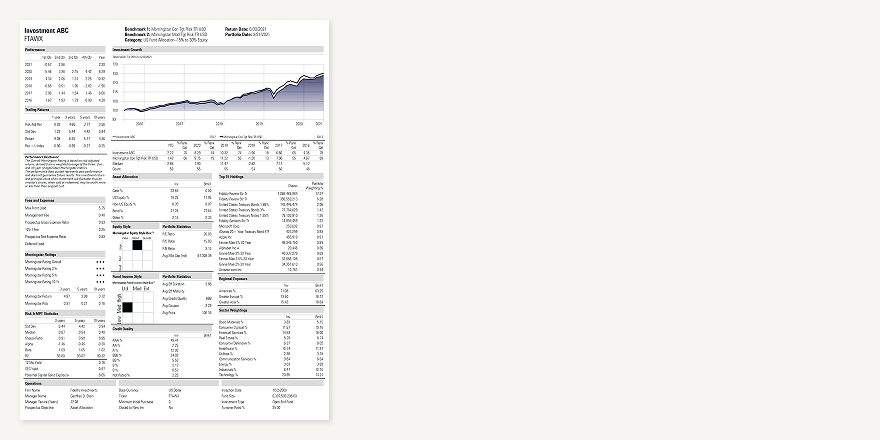
Factsheets provide a concise summary of key information about a fund or investment product. They give potential investors a quick but comprehensive overview of an investment opportunity.
Typical components include:
- Investment objectives and strategy
- Key performance data
- Risk metrics
- Top holdings
- Asset allocation breakdown
- Fund manager information
Factsheets should be visually appealing and easy to read, often fitting on a single page or two.
Internal Investment Reporting and Strategy Analysis
Asset Allocation
Asset allocation reports break down the composition of a portfolio across asset classes. They show how portfolios align with investment strategies and risk tolerance.
These reports include:
- Current asset allocation versus target allocation
- Drift analysis
- Rebalancing recommendations
More sophisticated versions might include risk contribution by asset class and liquidity analysis. Style box analysis and style drift monitoring are often incorporated to maintain consistency with stated investment objectives.
Investment Strategy Reporting
Investment strategy reports provide an in-depth analysis of portfolio performance and risk characteristics. They inform decision-making and refining investment strategies.
Key components often include scenario analysis, Monte Carlo simulations, and efficient frontier analysis. These techniques help managers anticipate potential outcomes, assess long-term risks, and identify optimal asset allocations for given risk levels.
Attribution Analysis
Attribution analysis reports break down portfolio performance to identify the sources of returns. They help managers understand which aspects of their strategy drive performance.
These reports typically separate the effects of asset allocation decisions from security selection. Key components include sector allocation effect, security selection effect, currency effect (for international portfolios), and interaction effect.
Peer Comparison and Competitive Analysis
Peer comparison and competitive analysis reports benchmark a fund or portfolio’s performance against similar offerings in the market. They help managers understand their competitive position and identify areas for improvement.
Typical elements include:
- Performance comparisons across time periods
- Risk-adjusted return metrics
- Fee comparisons
- Style consistency analysis
These reports are crucial for maintaining a competitive edge and can inform product development and marketing strategies.
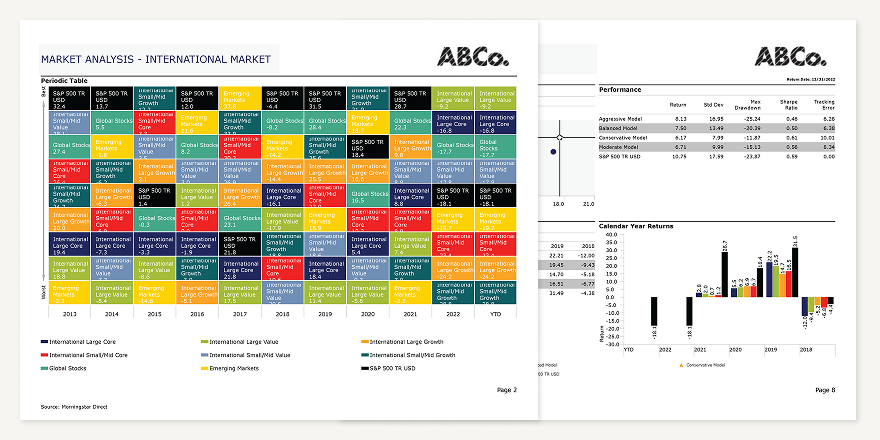
Sample market analysis report.
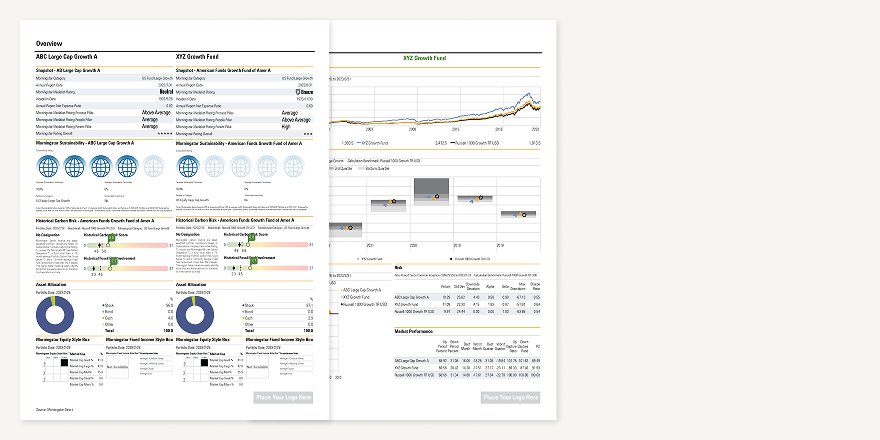
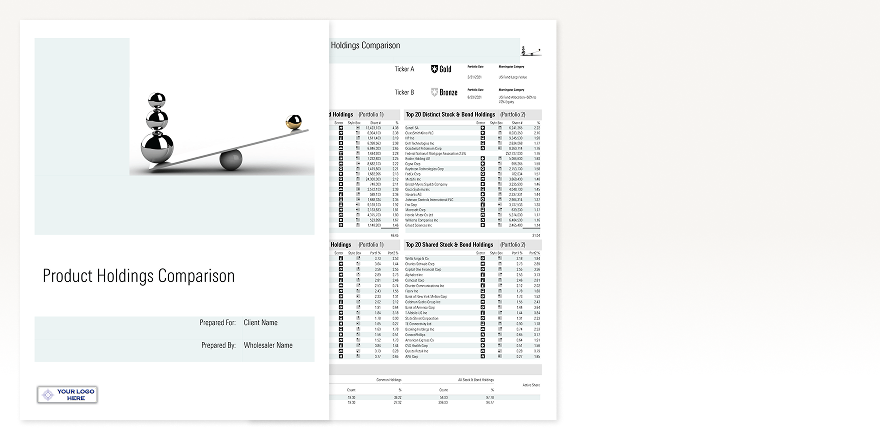
Sample investment comparison report.
The Most Popular Investment Reporting Templates
The reports investment teams use most frequently can provide valuable insights into industry trends and client needs. We analyzed Morningstar data to identify the most popular reporting templates in Presentation Studio.
These are the top report types, their key features, and why they’ve become essential tools in investment reporting.
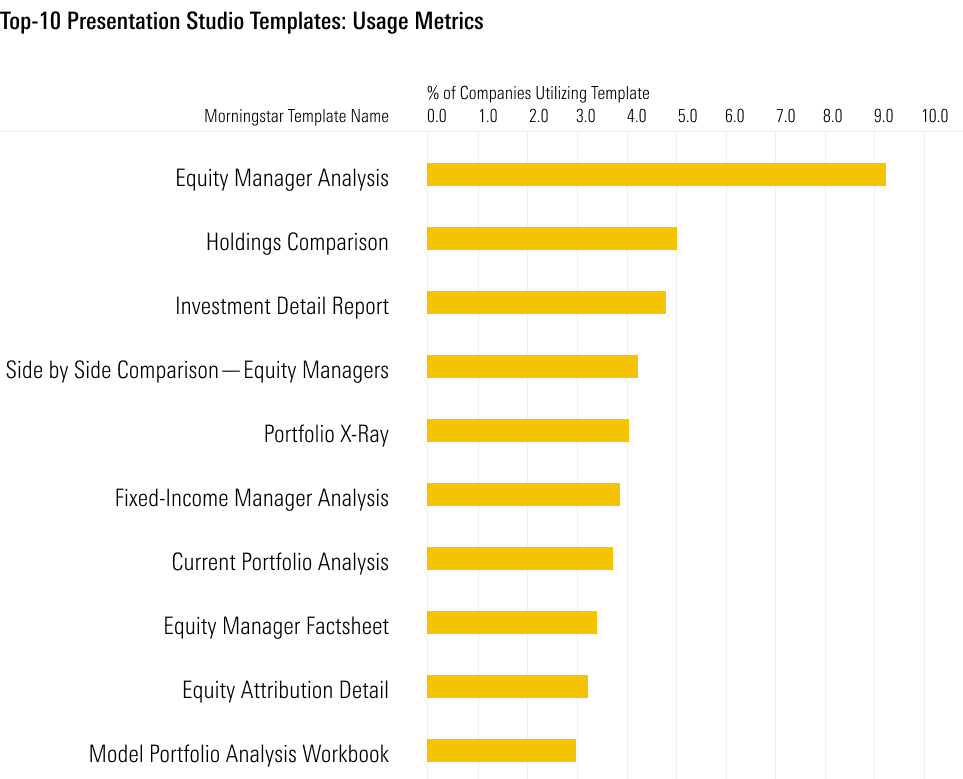
Presentation Studio contains over 70 reporting templates across the use cases and audiences above.
The most popular report templates included:
- Equity Manager Analysis
- Holdings Comparison
- Investment Detail
What does this mean for you?
Reporting templates give asset and wealth managers advantages, including:
- Compliance. Pre-approved templates can help you meet regulatory requirements, industry standards, and client needs.
- Consistency. Batch, automate, and incorporate your own branding to create reports that are on time and on brand.
- Customizability. Start with the foundations, then tailor the reports to your clients’ needs to create a personalized experience that clearly showcases your value.
- Differentiation. Use templates as a foundation, then enhance them with your branding or customize them for your clientele. Include your firm's logo, color scheme, and overall aesthetic.
Investment reporting templates make it easier to communicate complex financial information in a consistent format. This saves time and effort while also building trust with clients.
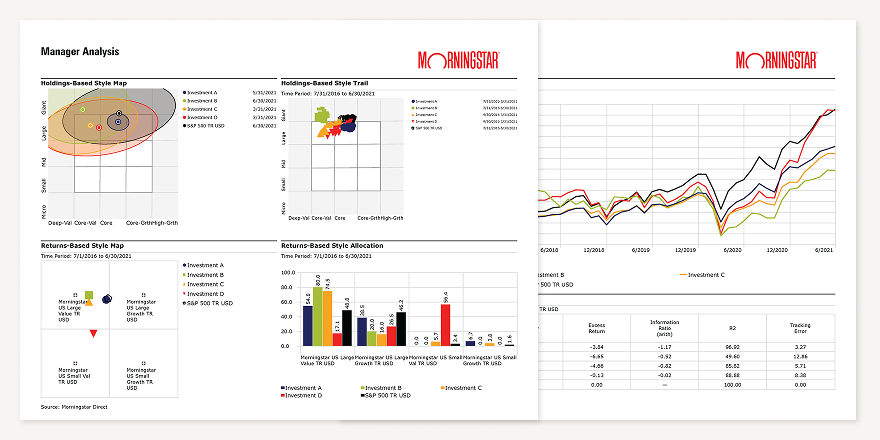
Sample equity manager analysis report.
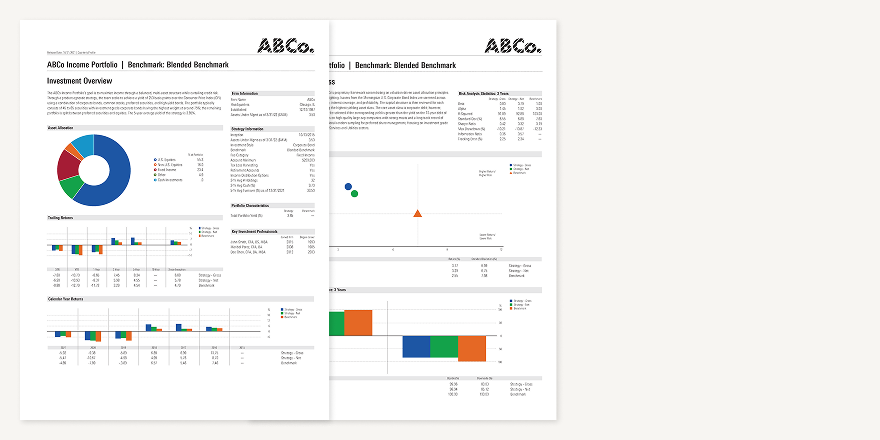
Sample quarterly profile report.
Overcoming Challenges With Investment Reporting Software and Solutions
Investment reporting software is a balancing act between efficiency and customization. On one end, off-the-shelf solutions offer speed and cost-effectiveness but lack tailored reporting options. On the other hand, highly customizable platforms provide flexibility at the cost of higher complexity and longer implementation times. Understanding this spectrum helps firms optimize their reporting processes.
When evaluating investment reporting software, firms should consider their client base, investment strategies, regulatory requirements, integration capabilities, scalability, and total cost of ownership. The right solution will depend on the specific needs and goals of each firm.
High Efficiency, Low Customization Solutions
These solutions emphasize speed and scalability through features like:
- Prebuilt templates
- Automated data processing
- Standardized methodologies
- Quick deployment
Downside: Limited flexibility for individual client needs.
High Customization, Low Efficiency Solutions
These platforms offer extensive customization with:
- Bespoke report design
- Flexible data input and calculations
- Proprietary methodologies
Downside: Higher costs and longer setup times.
Balanced Solutions: Custom Reports at Scale
Modular systems, such as Morningstar’s reporting and distribution solutions, offer a balance with:
- Standard and customizable components
- Flexible data integration
- Customizable and templated reports
Morningstar’s Investment Reporting Solutions
Morningstar’s solutions are built for efficiency, compliance, and customization. Within Morningstar Direct you’ll find:
- Flexible report generation with both prebuilt templates and custom options
- Comprehensive data integration
- Advanced analytics and customization capabilities
- Regulatory compliance features
- Interactive reporting options
With Morningstar Direct’s new browser experience, performance reporting has never been easier or more user-friendly. In the Performance Reporting module, you can access reports built on qualitative and quantitative factors to:
- Assign benchmarks
- Define data
- Performance ranking analysis
Monitor your investments through easy-to-read scorecards that use standardized values and custom grades to showcase top performers across categories and peer groups. The result? Automated due diligence processes that create on-brand, compliant, and actionable reports.
Our solutions are underpinned by Morningstar‘s comprehensive research and data. This means your reports are not only efficient and customizable, but also built on a solid foundation of accurate, in-depth information that spans global markets and asset classes.
With Morningstar‘s investment reporting solutions, asset and wealth management firms can produce high-quality, compliant reports that resonate with their audience. Maximize efficiency in the reporting process, maintain your unique brand identity, and stay ahead of evolving regulatory requirements and market demands.