
5 min read
Data Integration and Strategy Data
Key Takeaways
Strategy data identifies and links together managed investments that employ the same strategy.
Asset managers can use strategy data to search for all investment strategies within a particular category of investment fund or analyze the aggregate performance of a strategy across different vehicles.
Morningstar’s strategy data includes a growing set of derived analytics linking strategy-level and investment-level data.
Imagine you're looking for a Caribbean vacation.
There’s a luxury resort brand you love, and you want to compare availability, prices, and amenities across locations. You could do your research island by island, combing through the options until you find your favorite brand. Or you could go to a travel website, search there for the resort you want across the locations you're considering, and begin comparing resorts instantly.
Many asset managers go about their investment research like our hypothetical vacationer. They start with a fund manager and an investment strategy that they like, then hunt through vehicles and domiciles looking for the right investment.
That wasn’t especially onerous when the choice was between a mutual fund and an ETF. With the rise of alternative investments, a fund manager might choose to execute their strategy through a closed-end fund, an open-end fund, a separately managed account, a unit trust, a collective investment trust, or an uncollateralized debt instrument.
From a data perspective, the way to solve this problem is to abstract the investment strategy from the vehicle. When we do, each becomes discoverable independently. As part of a broader data-management system, tagging a fund with a strategy identifier can improve data integration across an entire portfolio.
What Is Strategy Data?
An investment strategy refers to an investment decision-making process and portfolio construction approach. Morningstar’s strategy data sits above investment-level data, identifying managed investments that use the same strategy.
Those investments may span investment types, regions, markets, and advisor/subadvisor relationships. With strategy data, asset managers can screen, filter, and analyze a strategy, as well as link and view the complete range of investments that use it.
Strategy data can also inherit investment-level data from below, such as categories, fund performance and fees. With this capability, asset managers can search for all strategies in a fund category or analyze aggregate strategy performance across vehicles.
Morningstar strategy data is comprehensive. We track 150,000 separate strategies, covering 98.5% of the Morningstar managed investments universe.
A Worked Example
Take an asset manager who wants to add real estate investments to a model portfolio. A search for managed investment funds in the “Global Real Estate,” “Real Estate” or “Static Real Estate” categories yields 5,981 results. A search for investment strategies in those categories yields 226 strategies across 128 asset management firms.
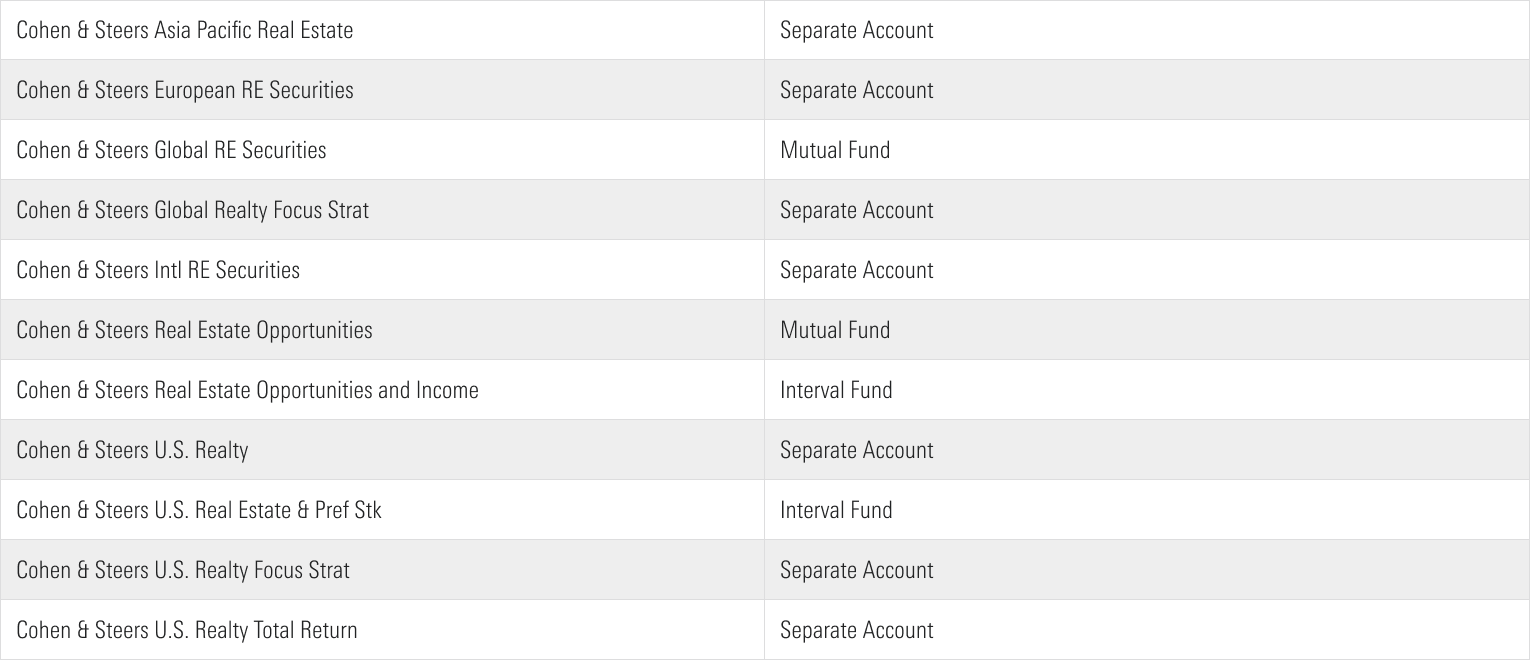
The asset manager decides to narrow their search by focusing on real-estate strategies from Cohen & Steers, an asset manager they follow and admire. They find 11 distinct real estate strategies that cut across mutual funds, SMAs and interval funds. See the example below.
Morningstar’s strategy data includes a growing set of derived analytics linking strategy-level and investment-level data. For instance, in cases where a strategy is shared across multiple vehicles, Strategy Performance Source can identify the vehicle with the longest continuous gross performance stream.
Also, when a fund manager offers a spectrum of solutions for investors, we link this family of strategies using a Strategy Series ID. That can identify strategies that share the same management team, portfolio processes and investment philosophies, but differ by asset allocation, risk targets, and related benchmarks.
How Else Can You Use Strategy Data?
Asset managers can use strategy data to:
- Aggregate, organize, and associate vehicle-level data related to a specific strategy or designated group of strategies.
- Formulate a policy portfolio consisting of an optimal mix of investment strategy sleeves to target for investment.
- Identify strategies that pass search criteria by conducting strategy comparison.
- Analyze a strategy to confirm if the manager’s stated approach has translated to expected performance outcomes.
- See differences between a strategy’s available vehicles to determine which is best for a portfolio.
- Insert a chosen vehicle for each strategy into a custom model and benchmark it against the investment policy.
- Communicate a strategy-oriented story in client materials.
Morningstar categories are assigned to managed investments based on our own best judgment of the fund’s peer group. In contrast, strategy data is designed to reflect the intention of the fund manager. We create the data both qualitatively, by analyzing the fund’s stated objective, and quantitatively, by analyzing the fund’s portfolio holdings and the analytics we derive from them.
Sometimes, our analysis does not align to the fund manager’s stated intention. For example, the fund might declare a US large cap growth strategy, whereas our holdings analysis consistently puts it in a different style box. This can be useful for a manager to understand as they refine their positioning.
Just as a vacation resort which markets itself first as a wellness refuge might be curious to learn that its customers come principally for the bar and buffet.