
8 min read
Sustainable Fund Flows Turn Positive in Q1 2026
After a difficult 2025, global sustainable funds returned to net inflows, driven by renewed demand in Europe.

The global sustainable fund industry started 2026 with a welcome reversal.
After a year marked by persistent outflows and shifting investor sentiment, sustainable open-end funds and ETFs attracted USD 3.5 billion in net inflows during the first quarter. The rebound was driven by Europe, where investors returned to sustainable funds for the first time in nearly two years.
While the return to positive territory is encouraging, the broader backdrop remains challenging. Political opposition to ESG investing, evolving regulation, mixed performance, and heightened geopolitical uncertainty continue to shape investor sentiment globally.
Download the full Q1 2026 Global Sustainable Fund Flows report for detailed regional analysis, asset manager rankings, sustainable fund launch trends, and market commentary from Morningstar Sustainalytics.
Global Sustainable Fund Statistics

Source: Morningstar Direct. Data as of March 2026.
Global Sustainable Fund Flows Return to Positive Territory
Europe accounted for the vast majority of sustainable flows recovery, gathering USD 9.1 billion in net new money, including active strategies gathering USD 90 million and passive over USD 180 million. However, allocation funds experienced net outflows of nearly USD 100 million.
The United States continued to experience outflows, while the rest of the world collectively recorded net redemptions. Canada and Australia/New Zealand were the only regions outside Europe to post positive flows.
The shift comes after a difficult 2025, when global sustainable funds posted their first calendar-year of net outflows since Morningstar began tracking the market in 2018.
Sustainable Fund Assets Fall Amid Market Volatility
Despite improving flows, global sustainable fund assets declined during the quarter.
Assets fell approximately 10% to USD 3.51 trillion at the end of March 2026, down from USD 3.9 trillion at year-end 2025. The decline was driven primarily by market volatility as investors reacted to trade tensions, geopolitical uncertainty, and broader equity market weakness.
Even with the recent pullback, the long-term growth story remains intact. Since the end of 2018, global sustainable fund assets have increased nearly sixfold, growing from roughly USD 600 billion to more than USD 3.5 trillion.
Quarterly Global Sustainable Fund Flows
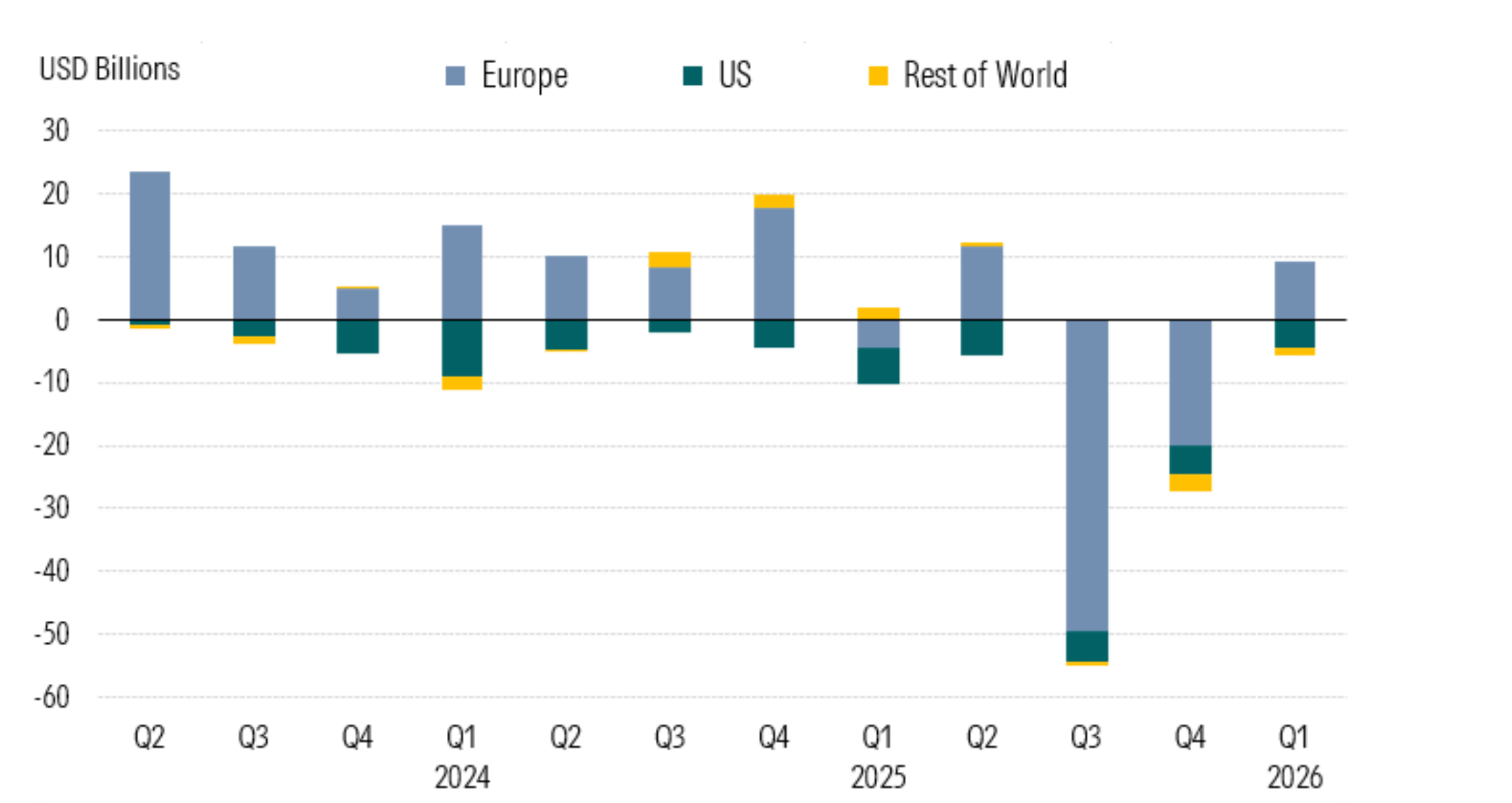
Source: Morningstar Direct. Data as of March 2026.
What's Driving Sustainable Fund Flows in 2026?
Several forces continue to shape global demand for sustainable funds.
Political and regulatory uncertainty
Anti-ESG sentiment remains a significant force in the US market, contributing to continued investor withdrawals and prompting some asset managers to scale back sustainability commitments. European asset managers are also navigating uncertainty as policymakers review key sustainable finance regulations, including SFDR.
Market volatility
The first quarter brought renewed volatility across global markets. Trade policy uncertainty and geopolitical tensions weighed on investor confidence, contributing to declines in sustainable fund assets despite improving flow trends.
A changing product landscape
Asset managers have become increasingly selective about launching new sustainable products. Regulatory scrutiny, greenwashing concerns, and softer investor demand have shifted industry focus toward refining existing offerings rather than expanding product lineups.
Europe Drives the Global Recovery
Europe delivered the strongest signal of recovery in the global sustainable fund market.
European sustainable funds attracted USD 9.1 billion in net inflows during the first quarter, reversing USD 16.6 billion in outflows from the previous quarter and marking the region's first quarter of positive flows since the second quarter of 2024.
Passive strategies powered the rebound, attracting USD 24 billion in net new money. Active sustainable funds continued to experience redemptions, losing USD 14.8 billion during the same period.
Fixed-income strategies led the way, attracting USD 9.5 billion in inflows. Sustainable equity funds also returned to positive territory after significant withdrawals during the second half of 2025.
The improvement follows a challenging year for European sustainable investing. In 2025, the region recorded its first annual outflows since 2018, making the first-quarter rebound an important signal for investors and asset managers alike.
Top 10 European Sustainable Fund Flows in Q1 2026

Source: Morningstar Direct. Data as of March 2026.
US Sustainable Funds Remain Under Pressure
The United States remained the weakest major sustainable investing market.
Investors withdrew USD 4.3 billion from sustainable funds during the first quarter, marking the 14th consecutive quarter of net outflows. During the same period, conventional US funds attracted USD 337 billion.
The divide between active and passive sustainable investing continued to widen. Passive sustainable funds attracted USD 3 billion in inflows, while active funds lost USD 7.3 billion.
Fixed income remained the only asset class to attract net new money. Sustainable equity funds recorded their 14th consecutive quarter of outflows, losing USD 4.6 billion.
Despite the broader weakness, certain sustainability themes continued to resonate with investors. The First Trust Nasdaq Clean Edge Smart Grid Infrastructure Index Fund led all US sustainable funds with USD 2.1 billion in inflows, benefiting from growing investor interest in energy infrastructure and rising electricity demand associated with artificial intelligence.
Top 10 US Sustainable Fund Flows
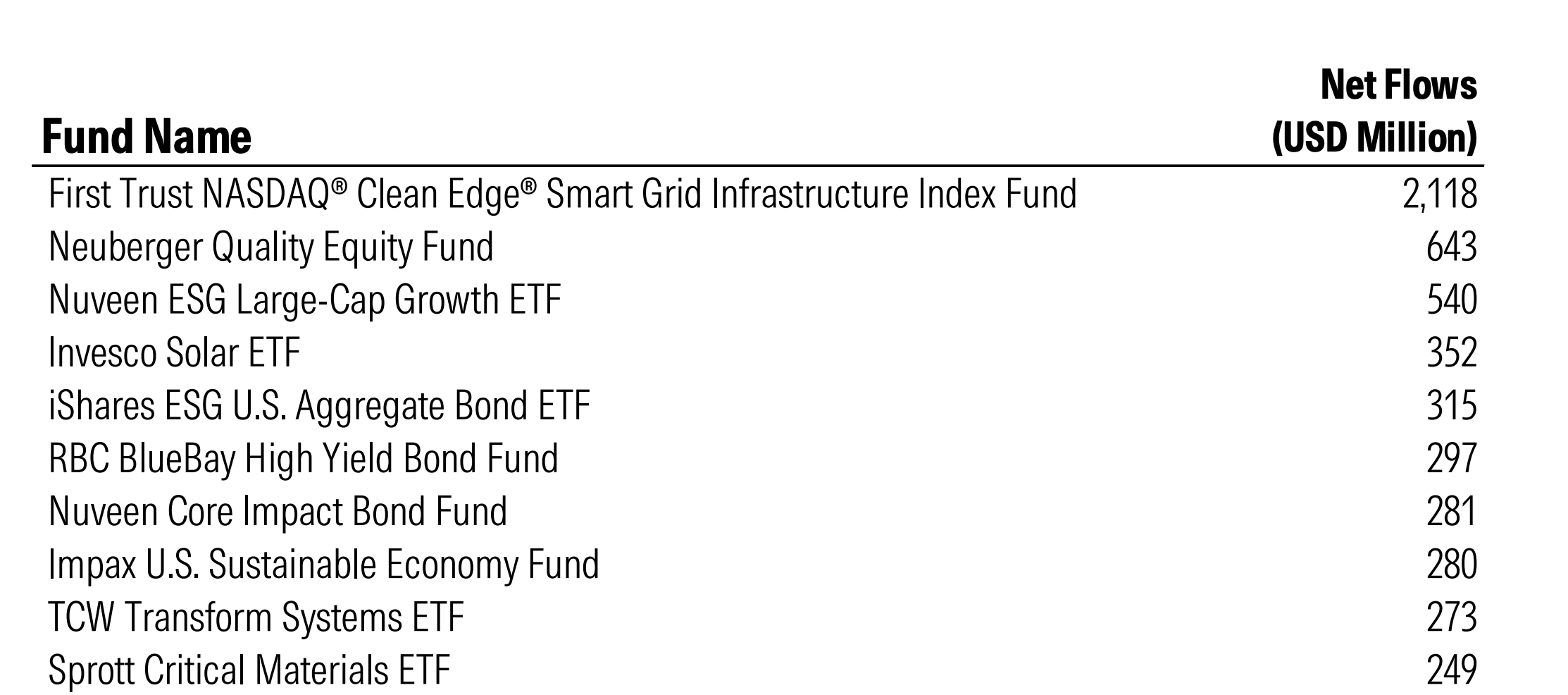
Source: Morningstar Direct. Data as of March 2026.
Outside Europe, Sustainable Fund Flows Remained Mixed.
Canada attracted USD 443 million in net inflows during the first quarter, reversing modest outflows from the previous quarter. Equity funds led the recovery, while passive strategies accounted for roughly two-thirds of total flows.
Australia and New Zealand recorded approximately USD 275 million in net inflows, extending their streak of positive flows to three consecutive quarters. Both equity and fixed-income strategies attracted new money during the period.
Japan continued to experience persistent redemptions, recording its 15th consecutive quarter of outflows, though the pace slowed meaningfully from the previous quarter.
Asia ex-Japan also remained under pressure, with outflows concentrated in South Korea and Taiwan. Thailand was the region's primary bright spot, attracting inflows into sustainable bond strategies.
Sustainable Fund Launches Continue to Slow
Product development activity slowed further during the first quarter.
Only 17 new sustainable funds were launched globally, down from 50 in the previous quarter and the lowest level recorded in Morningstar's global sustainable fund dataset.
Asia ex-Japan accounted for nine launches, while Europe contributed eight. No new sustainable funds were launched in the United States, Canada, Australia/New Zealand, or Japan during the quarter.
Global Sustainable Fund Launches Per Quarter

Source: Morningstar Direct. Data as of March 2026.
Blackrock Continues to Lead Global Sustainable Investing
As of March 2026, BlackRock managed approximately USD 407 billion in European sustainable fund assets, maintaining its position as the region's largest sustainable asset manager. Amundi ranked second with USD 220 billion, followed by UBS with USD 207 billion.
In the United States, BlackRock, Vanguard, and Morgan Stanley remained the three largest sustainable asset managers by assets under management. Their respective assets under management stood at USD 65.4 billion, USD 43.3 billion, and USD 34.7 billion.
What Comes Next for Sustainable Investing?
The first quarter of 2026 suggests the sustainable fund industry may be entering a new phase.
While challenges remain, including political opposition in the US, regulatory uncertainty, and market volatility, Europe's return to positive flows demonstrates that investor demand for sustainable strategies has not disappeared.
The key question for the rest of the year is whether this recovery broadens beyond Europe and translates into sustained global growth. For now, sustainable investing remains a global market worth more than USD 3.5 trillion and one that continues to evolve alongside changing investor priorities, regulations, and market conditions.
This article is adapted from the Q1 2026 Global Sustainable Fund Flows report by Morningstar Sustainalytics, which analyzes fund flows, assets, launches, and market trends across the global sustainable investment landscape.
To explore the data in more detail, download the free Q1 2026 Global Sustainable Fund Flows report from Morningstar Sustainalytics.
The data evaluated in the report was generated in Morningstar Direct, a comprehensive application that helps asset and wealth managers conduct research, analyze investments, and manage portfolios. Start a free trial of Morningstar Direct today.