8 min read
How Vanguard Compares to the Largest 150 US Fund Families
Morningstar ranks the top 150 asset managers on assets, stewardship, and fees, with a walkthrough of Vanguard’s fact sheet.
Vanguard oversees more than USD 11 trillion in US fund assets. Pzena Investment Management, the smallest firm in this year’s report, oversees USD 4.7 billion. Both rank among the 150 largest fund families in the United States.
That gap is the starting point for any fund family comparison, and it’s why investors need to look beyond scale to judge how well a firm manages capital on its clients' behalf.
Morningstar’s Fund Family Digest: US in 2026 includes fact sheets for the 150 largest firms, comparing fund assets under management, fund offerings by asset class and management style, manager tenure, fees, and aggregate Morningstar Medalist Ratings.
How Do You Read a Fund Family Fact Sheet?
Every fund family in the Digest gets a single-page fact sheet. Using Vanguard as an example, this piece walks through a few included data points in detail. To view the full fact sheet, download the report.
What Does Morningstar’s Parent Pillar Rating Assess?
The Parent rating reflects Morningstar analysts’ opinion of how well an asset manager stewards capital in the best interests of its investors. It is one of three pillars underpinning the Morningstar Medalist Rating.
Analysts weigh several factors, including but not limited to:
- Investment culture, including a firm’s ability to attract, develop, and retain investment talent.
- Approach to key-person risk and succession planning.
- Product development and governance, including fund launches and obsoletions, judged over the long-term.
- Fee practices and the philosophies that guide compensation and fees.
- Risk-adjusted performance, measured through Morningstar ratings and success ratios.
The rating also draws on portfolio-manager tenure at the fund, firm and industry level, manager workload, and how much managers invest in the funds they run.
Morningstar’s manager research analysts assign Parent ratings to more than 100 of the 150 largest US firms. Other firms are rated using algorithmic techniques.
Analyzing Vanguard’s Fact Sheet
Here’s how Vanguard compares to the other largest fund families in the United States.
Vanguard’s Parent Rating
Vanguard sits at the top; it holds a High Parent rating, reflecting how well the firm’s culture, resources, and incentives serve fund investors, rather than focusing on the performance of any individual product. Only eleven of the 150 fund families in the Digest earn High ratings. For asset managers, that rating serves as a competitive benchmark.
Fund Assets Under Management
Scale reinforces the picture: Vanguard’s open-end and exchange-traded fund lineup holds $11.0 trillion in U.S. assets and $11.8 trillion globally, ranking No. 1 in both markets. Trailing one-year net flows of $205.1 billion and $289.0 billion for the US and global markets, respectively, rank No. 2 out of 150 peers, only trailing BlackRock/iShares.
Organic growth rates tell a different story, at 1.2% and 1.7%, ranking around the middle of the pack. This data point holds value; it helps to put flows into perspective by comparing them against assets under management at the beginning of a period. Because Vanguard has long maintained considerable size, even massive net flows don’t move the organic growth rate needle too much.
Vanguard’s Fund Lineup
The leftmost panel on a fact sheet breaks down a firm’s lineup in three ways: by asset class, by management style, and by vehicle. Each ring pairs a share of assets under management with a count, so you can see where the money sits and how many products hold it.
Vanguard’s asset class mix is concentrated in equity, at 83% of assets across 107 funds. Fixed income accounts for 16% across 82 funds. Allocation holds 1% across 23 funds (these assets exclude funds of funds, including many allocation funds, to avoid double-counting). Alternatives and other round to 0%, with one fund each.
Open-End and Exchange-Traded Fund Offerings
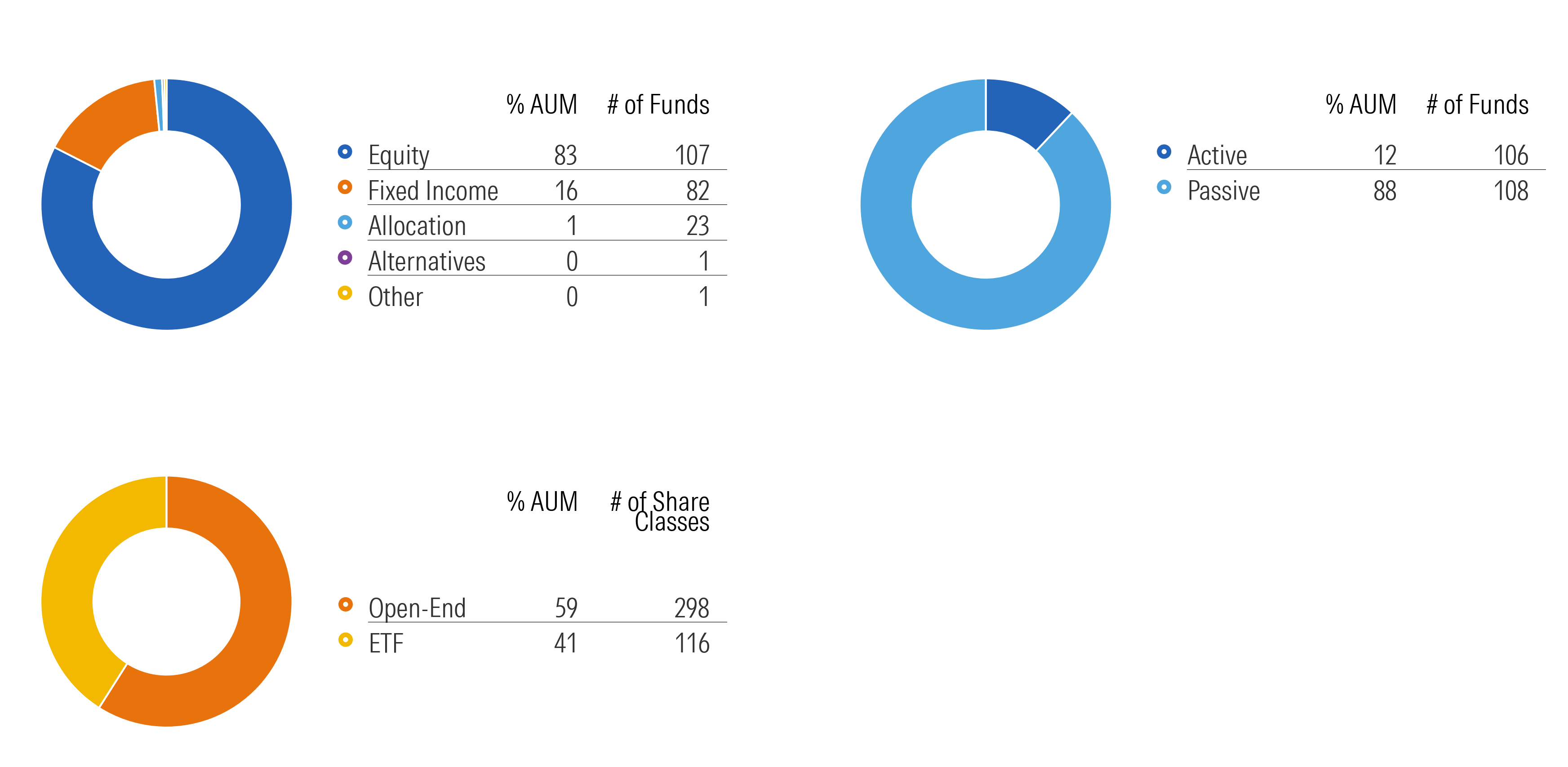
The management style ring shows the split that defines the firm. Vanguard runs 106 active funds and 108 passive funds, a nearly even count. By assets, the split is 12% active and 88% passive.
The third ring reports share classes rather than funds in recognition of the rise in ETF share classes. Open-end share classes hold 59% of assets across 298 share classes. ETF share classes hold 41% across 116.
What Are Vanguard's Largest Funds?
Vanguard holds 45% of its assets in its five largest funds, ranking 121 of 150. The column sorts the most concentrated first, so Vanguard’s assets are spread more evenly across its funds than most firms in the report.
Vanguard Morningstar Medalist Ratings
91% of Vanguard’s AUM sits in Gold-rated funds, with 99% overall in share classes earning higher Medalist ratings (Gold, Silver, or Bronze), ranking 6th out of 150 peers.
That level of concentration in highly rated funds is strong. It also suggests investment appeal is consistent across the platform rather than concentrated in just a few flagship products.
Fee Levels
Vanguard's Average Fee Level in its Peer Group is 16, ranking it 7th out of 150 peers. This reflects a deliberate, long-running strategy. The firm made its largest-ever round of fee cuts in early 2025, an estimated USD 350 million investment in staying cheap even as it manages rapid asset growth.
Low fees are a key reason almost all of Vanguard's share classes earn Gold, Silver, or Bronze Medalist Ratings, since ratings reflect a fund's expected ability to outperform peers after fees. For asset managers, this fee position is a structural advantage that compounds into a harder-to-replicate competitive moat.
How Do the Largest Fund Families Differ in Assets Under Management and Market Share?
The US fund industry remains top-heavy. Vanguard, BlackRock, and Fidelity together manage about 52% of assets among the 150 largest US fund families, up from 50% a year earlier. The 10 largest asset managers command roughly three-fourths of the total. Figures cover US-domiciled open-end funds and ETFs, excluding funds of funds and money market funds.
The 10 largest US fund families by fund assets under management, as of June 2026:
- Vanguard: $11 trillion
- BlackRock: $4.96 trillion
- Fidelity: $4.11 trillion
- Capital Group: $2.99 trillion
- State Street Investment Management: $2.15 trillion
- Invesco: $1.26 trillion
- J.P. Morgan: $871 billion
- Schwab: $871 billion
- T. Rowe Price: $802 billion
- Dimensional: $776 billion
Get the Top Fund Families From Every Region
The Fund Family Digest covers leading asset managers market by market, using the same ratings, fee measures and stewardship data. Compare how the largest firms stack up elsewhere: